

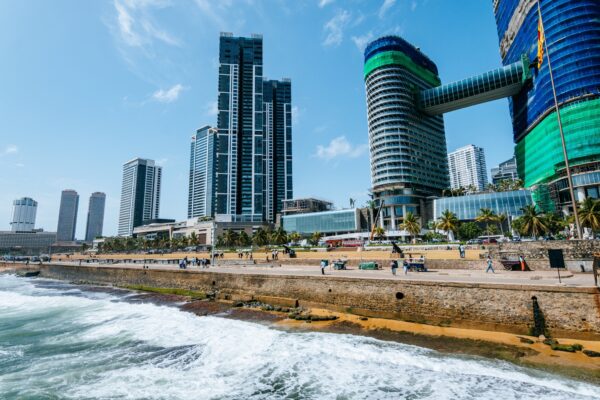
A few months back, two of Sri Lanka’s largest real estate companies launched two apartment projects in Colombo Port City, reclaimed land in Colombo developed by China Harbor Engineering Company (CHEC) as a joint venture with Sri Lankan government. One was a residential development project while the other is a luxury twin residential tower in Central Park district in port city.
The pitch to buyers was simple and very tempting: invest in an apartment and get a higher return. One company advertising slogan promised that if you invest today, you will double your money in four years, “guaranteed.” It is an appealing proposition, promising a very high return, expected to be made through property price speculation.
These are not the only real estate projects in Colombo Port City. Before these two real estate agencies launched their projects, another leading construction company launched another luxury apartment project in Port City. Together, these three real estate projects have estimated value of $650 million.
The investments for all three projects came from local companies. After years of struggle, Colombo Port City is now receiving considerable investments. By April this year, Sri Lanka’s Cabinet of Ministers had approved 77 Businesses of Strategic Importance (BSIs) to operate in Colombo Port City and had attracted investments worth $2.19 billion to date.
Luxury apartments are, however, not just confined to Colombo Port City. They are booming in many areas of Colombo, Sri Lanka’s commercial capital and largest city. Most of these luxury apartment projects are advertised as investment opportunities. The Central Bank’s condominium market survey for the first quarter of 2026 shows that more than 20 percent of condominiums are purchased for investment, and that high-end units account for a growing share of sales. Nearly 52 percent of condominiums sold were valued at more than 50 million rupees ($150,000). Such high-end apartments accounted for only 33 percent of apartment sales a year ago.
An apartment in Colombo Port City costs about $500,000 and up. These prices are expected to increase substantively in coming years, allowing those who purchase apartments to sell at a higher price and make a substantial return. Sri Lanka’s apartment projects have now transformed into a speculative investment dominated by buyers chasing price appreciation rather than genuine housing need. While this is also the case in places like Dubai, Sri Lanka’s regulations on real estate industry or the government institutions are not built for such a speculative driven industry.
When property is treated as an investment, the promised return depends on price appreciation. Rental yields on new luxury apartments have been rising, but they come nowhere near the allure of doubling the underlying asset value. The money, in other words, is made through speculation on asset prices rather than steady rental income. That is normal for real estate everywhere, but a speculation-driven market carries risks that are usually contained through strong oversight, well-designed regulation, and strict enforcement by capable state institutions. Sri Lanka has almost none of these.
In plain terms, Sri Lanka’s luxury real estate industry is expanding far faster than the government’s capacity to regulate or monitor it. That is a serious macroeconomic risk, and financial history shows that an unregulated property boom rarely ends well.
Regulations Built for a Different Era
The body nominally responsible for apartment blocks in Sri Lanka is the Condominium Management Authority (CMA), which oversees the country’s luxury apartments, including those in Port City. But the CMA was never built to regulate speculation-driven investment property, and it does not have the capacity to do so.
The authority began life as the Common Amenities Board, created under a 1973 law to perform the narrow task of looking after the shared parts of apartment buildings, such as lifts, water, drainage, and common areas. A 2003 amendment renamed it and broadened its remit, but its core job remained that of a caretaker for completed buildings. It was never meant to be financial regulator for a fast-moving, pre-sales market worth hundreds of millions of dollars.
As a result, many standard practices that are required to oversee a speculative-based real estate market are not incorporated into Sri Lankan law, and not practiced by the CMA.
One such standard practice in large-scale real estate markets, like in Dubai, is to tie every project to an escrow account under the regulator’s supervision. Dubai’s Law No. 8 of 2007 made such accounts compulsory for any apartment sale. Under this law, buyers’ payments go into a ring-fenced account (referred to as the escrow account), and the Dubai Land Department (DLD) approves releasing the next tranche of money in the escrow account only after it verifies that construction has genuinely progressed. A developer cannot dip into those funds to meet other cash-flow needs. This protects investors and limits the financial risk to the wider economy.
Sri Lankan law requires nothing of the sort. Escrow accounts are left entirely to developers’ discretion. Thus, the money paid by buyers is not guaranteed to be spent on the project or its progress. Most developers, including some of those constructing apartments in Colombo Port City, choose to do projects without escrow accounts. Therefore, when a buyer makes an up-front or monthly payment, that money does not go into a protected account; it flows straight into the developer’s general finances, to be spent as the company sees fit.
For the individual buyer, the danger is obvious: if a project stalls or a developer collapses, the money can simply vanish. For the economy, the picture is worse. Developers are effectively borrowing from ordinary buyers without the scrutiny a bank lending the same sums would face, and the failure of one project could ripple across a developer’s other projects and trigger a domino effect through the industry. This is exactly what happened in China, where developers like Evergrande used home buyers’ money to pay down debts from other projects – leaving buyers stuck with mortgages on forever-unfinished apartments. The resulting crisis dragged down the entire real estate sector, and China’s economy.
Embedding escrow accounts into law is therefore not merely desirable but considered as an essential regulatory practice to ensure the stability of the growing real estate industry, and overall economy. Sri Lanka has not made that regulatory change.
Sales Without Records
India, in contrast, made this regulatory leap in 2016 through the introduction of Real Estate (Regulation and Development) Act, 2016 (RERA), which made escrow accounts compulsory and established property data portals in each state to ensure transparency. Sri Lanka has no legislative requirement that mandates transparency on property sales, progress, or even licensing brokers and advertising.
Lack of transparency had allowed Sri Lanka’s developers to broadcast eye-catching sales figures to stimulate demand and justify price increases while buyers have no means to check those claims. One real estate developer company, for instance, claimed that 50 percent of its Port City twin-tower project had sold ahead of launch. But there is no way to verify this, or any of the claims made by real estate developers, brokers, or sellers. There is no authoritative public record of what is being sold, at what price, or how far each project has been built. There are no regulations mandating developers to disclose the data, or make project progress publicly available.
While luxury real estate industry is expanding fast, Sri Lanka is lagging behind the standard practice of transparency in real estate industry. For example, Dubai has a public register of real estate projects updated daily, through which any buyer can verify a transaction, and check units sold, valuations, and developer details. Sri Lanka policymakers as well as businesses claims that they aims to follow the footsteps of Dubai, and aspire to become a real estate hub in South Asia. However, Sri Lanka has not followed Dubai’s steps in setting up regulations, laws, or government institutions to facilitate a luxury real estate industry.
A Mismatch of Scale
Sri Lanka is, in effect, running a sophisticated, foreign-currency-denominated property market with the only oversight provided by a glorified residents’ association administrator. It simply has no capacity to regulate or oversee the rapidly expanding speculative real estate market in Colombo.
The fixes are not mysterious. Sri Lanka needs a law to regulate the fast-growing luxury real estate industry, and set up institutions with sufficient capacity to implement regulations. India did this ten years ago with the introduction of RERA. Such a law needs to make escrow accounts compulsory for pre-completion sales and to bring advertising under regulatory guidelines. Sri Lanka also need to set up an online register of projects on the Dubai model, so sales, prices, and project status can be independently verified. It must create a new regulator, with the powers, staff, and expertise to license developers, scrutinize their marketing, and monitor their accounts, alongside a mechanism to tax capital gains on apartment price appreciation.
None of this can wait. The promise of “up to 100 percent gain” in four years is a textbook sign of speculation, and speculation can inflate a bubble whose collapse spills into the wider economy. Sri Lanka learned in 2022 how weak institutions and poor governance lead to economic disaster. Its luxury real estate is now expanding faster than the state’s ability to watch it, and the government must act before this boom becomes the next crisis.