

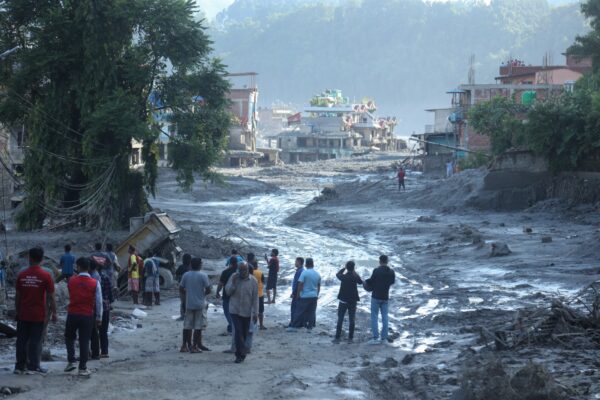
Nepal’s recent floods, which have killed at least 1,280 people while over 5,600 are still missing as of this writing, rank among the country’s worst natural disasters. Preliminary estimates put economic losses at $2.56 billion. But the disaster’s consequences will extend far beyond the immediate human and economic toll.
It has also undermined the efforts of successive post-2015 governments to achieve more geopolitical balance, largely through the development of new transport, trade and transit facilities with China.
As a landlocked country wedged between India and China, Nepal has long sought to preserve its strategic autonomy by balancing the influence of its two neighbors.
For a variety of reasons, India, which surrounds the country on three sides, has blockaded its open border with Nepal three times since 1969 — most recently in 2015. That year, Nepal promulgated a new constitution that had failed to address India’s concerns. At other times, New Delhi has openly meddled in Nepali politics.
To reduce that vulnerability to Indian pressure, Nepali rulers have felt the need to increase engagement with China, the northern neighbor.
After the 2015 blockade, the then-K.P. Sharma Oli government signed a slew of agreements with China to establish new trade and transit links. As part of the process, a significant investment was made to upgrade the Kerung border point (known as Gyirong on the Chinese side) into an all-weather international crossing. Much of China-Nepal trade has gradually shifted to Kerung from Tatopani, the previous main artery of bilateral trade that was badly damaged by the 2015 earthquakes.
Unfortunately, the recent floods literally washed away much of the investment around Kerung. There is not even a trace of the customs buildings and customs yards — on either side of the border.
After the flooding of the Kerung border, China has also shut down Tatopani, citing possible landslides on the Nepali side. (Beijing has also long been wary of the possible use of the Tatopani route by “Free Tibet” activists.) All cross-border traffic has been diverted to Korala, the third international border crossing between Nepal and China. But Korala is not an easy crossing, nor is there much in terms of cross-border trade infrastructure. Besides these three, the three other designated points for Nepal-China trade are minuscule and limited to handling local trade.
In the big picture, Nepal’s trade with China, which was already limited, will be further restricted after the floods.
India is Nepal’s largest trade partner, with China coming in at a distant second. The floods will exacerbate an already troubling imbalance. But Kathmandu’s options are limited. Rebuilding Kerung or upgrading Korala to handle more traffic will require a lot of time and money. Shipping goods from China is an option, but a costly one. The country’s dependence on India will thus further increase. Besides the prospect of some Indian goods replacing Chinese ones in Nepali markets, Nepal will now have to use Indian ports to import even vital supplies from China.
With the floods knocking out around 10 percent of Nepal’s electricity-generation capacity, the energy dependence on India could go up too.
The Rasuwa floods will strengthen the argument that geography leaves Nepal with no realistic substitute for India as its principal commercial and transit partner, with China serving mainly as a supplementary option. And as India’s commercial clout increases in Nepal, so will its strategic sway. Nepal, after all, shares a long, flat open border with India and the two countries are bound together by cultural and family ties.
Nepali Prime Minister Balen Shah had already complicated Nepal’s external relations with his unconventional approach, initially avoiding individual meetings with foreign envoys and senior visiting officials. Beijing, with whom Nepal will now have to work closely to rebuild damaged infrastructure along the border, was particularly displeased at what it saw as the Nepal government’s repeated failures to uphold the “One China” policy.
Yet rebuilding Nepal’s northern connectivity could itself have geopolitical consequences. Kathmandu will need Chinese technical and financial assistance to restore damaged border infrastructure. China will also be averse to involving other countries in reconstruction in the sensitive region. The floods could therefore produce a peculiar form of dual dependence: greater reliance on India for immediate trade and transit, even as Nepal turns to China to rebuild the infrastructure needed to reduce that very reliance.
For the 36-year-old Nepali prime minister, this creates a separate political dilemma. Shah will have to rely more on India for trade and connectivity while also being under pressure to maintain a safe distance from New Delhi — in keeping with the wishes of core nationalist constituencies.
The mountainous trade routes to China have long been vulnerable to landslides and earthquakes, limiting the northern neighbor’s viability as a trade and transit alternative to India. The recent disaster has highlighted this weakness like never before.
The floods will not change Nepal’s need to balance India and China. What they will change is the feasibility of one crucial component of that strategy.