

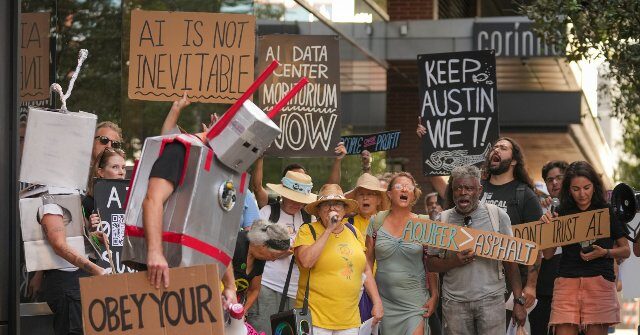
A new poll finds that even as more Americans turn to AI tools in their daily lives, most remain deeply uneasy about where the technology is taking the country. An overwhelming 69 percent of respondents oppose AI data centers being built in their area.
NBC News reports that 70 percent of adults say they’re more worried about AI than excited about it, according to the NBC News Decision Desk survey conducted online among 7,105 adults from August 20 to September 1.
About two-thirds of respondents say AI poses high risks to society, and a similar share oppose building an AI data center in their own community. Eighty-one percent say the government isn’t doing enough to regulate the technology.
None of that has slowed adoption down. 52 percent say they use AI tools very often or sometimes, up six points from a June 2025 survey. The share using AI “very often” has climbed to 23 percent, up from 14 percent a year earlier. Trust hasn’t kept pace: just 18 percent say they can trust AI-generated information most or almost all of the time.
Neither party has won the public over on AI policy. 44 percent trust neither party to handle it, while 20 percent trust Democrats, 16 percent trust Republicans, 15 percent are unsure and five percent trust both equally. Asked who should protect consumers from AI misinformation, 38 percent point to government, 34 percent to the companies building the tools, and 28 percent to individuals themselves.
Majorities think AI will do more harm than good in K-12 education, news and information, elections and democracy, higher education, and national security. Pluralities expect more harm than help in the economy, healthcare, and arts and entertainment.
Misinformation tops the list of worries: nearly three in four Americans cite deepfakes, fraud and misinformation as their biggest concern, and two-thirds worry people are becoming too dependent on AI. One respondent, answering an open-ended question about AI concerns, wrote: “It will become a Frankenstein beyond human control. It will dramatically widen the gap between the haves and the have nots.”
Jobs are another flashpoint. 70 percent say AI is taking away job opportunities, compared with just 7 percent who say it’s adding them; 23 percent see no difference or aren’t sure. Among adults 18 to 29, 73 percent say AI is costing job opportunities. The concern splits along party lines: 78 percent of Democrats and 69 percent of independents worry about fewer job opportunities, compared with 62 percent of Republicans. On the economic question more broadly, one respondent wrote: “If we don’t heavily tax companies that use chatbots (and other AI uses) soon, we will eventually have companies without employees. It simply becomes a cost cutting exercise. That is probably not a good thing.”
Views split by subject and by gender. Fifty-five percent believe AI will do more good than harm in scientific research, versus 26 percent who see more harm than good, while 47 percent expect more good than harm in healthcare against 30 percent who expect more harm. Nearly two-thirds of men expect AI to benefit scientific research, compared with 45 percent of women, and men are twice as likely as women to think AI will help the economy more than hurt it.
Confidence in AI varies sharply by task. Nearly three-quarters feel confident relying on AI-generated recipes or cooking instructions, but only about a third feel that way about AI-provided information on historical events or health conditions and medical treatments. Just 21 percent are comfortable relying on AI-generated content for breaking news or personal financial decisions.
AI data centers and the integration of this technology is changing the political landscape. Breitbart News social media director Wynton Hall has written his instant bestseller Code Red: The Left, the Right, China, and the Race to Control AI to serve as the definitive guide on how the MAGA movement can create positions on AI that benefit humanity without handing control of our nation to the leftists of Silicon Valley or allowing the Chinese to take over the world.
Read more at NBC News here.
Lucas Nolan is a reporter for Breitbart News covering issues of AI, free speech, and online censorship.