

Kazakhstan presently sits in a unique and potentially precarious spot: It’s the only country in the world to have joined both Washington’s Pax Silica and China’s World Artificial Intelligence Cooperation Organization (WAICO), competing AI alliances. With a Reuters report last month suggesting that the U.S. may pressure partners to pick a side, Central Asia’s – and Kazakhstan’s – multivector methods may soon be challenged.
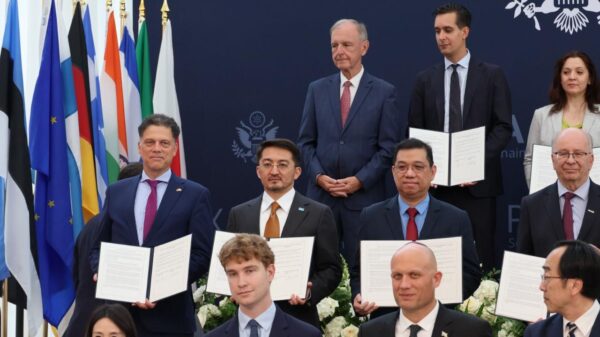
Astana joined Pax Silica officially on June 27, with Deputy Prime Minister and Minister of Artificial Intelligence and Digital Development Zhaslan Madiyev signing the relevant declaration and the joint statement on the AI Opportunity Partnership during the second Pax Silica Summit in Washington, D.C.
Less than three weeks later, Madiyev attended the World Artificial Intelligence Conference 2026, in Shanghai and became a founding member of WAICO alongside 28 other countries.
As it stands now, Washington’s Pax Silica counts 24 countries as signatories, with Taiwan listed as a “non-signatory participant.” Beijing, meanwhile, counts 37 countries as members of WAICO, with Bangladesh taking on an “observer” status.
Pax Silica, launched in December 2025, is branded by the U.S. State Department as its “flagship effort on AI and supply chain security, advancing new economic security consensus among allies and trusted partners.” The declaration highlights supply chain resilience, particularly as it applies to the AI supply chain – everything from energy to critical mineral, manufacturing to technology and infrastructure.
Although China is not directly named, the declaration’s references to “reducing excessive dependencies” and “forging new connections with reliable partners and suppliers committed to fair market practices” are clear dog whistles screaming Beijing.
WAICO, meanwhile, was first proposed by China in July 2025 and came into being in July 2026. It frames itself as an international organization focused on AI governance. Notably United Nations Secretary-General António Guterres attended the signing as a guest, providing at least the impression of U.N. endorsement.
Despite the differences in focus – Pax Silica is crafted around physical concerns, while WAICO homes in on governance and norms – the two blocs are being positioned as the combatants in a new cold war. Whether that analogy works or not comes down to whether countries are effectively forced to pick a side.
And that day may be coming.
In mid-August, Reuters reported on an undated draft letter addressed to the 35 signatories of the AI Opportunity Statement from the State Department. The draft stated: “To be part of everything is to be part of nothing. Signature of the Pax Silica Declaration is not merely a membership subscription, but a commitment.” According to Reuters, the letter urged the countries to “choose deliberately” on AI, and explicitly stated that membership in Pac Silica “cannot be held alongside membership in duplicative initiatives whose expectations conflict with our own.” The letter, apparently, did not directly mention China.
As of writing, it does not appear that the letter has been sent. But the warning stands, and the Central Asian countries might have gotten it first hand. In early August U.S. Assistant Secretary of State for South and Central Asian Affairs Paul Kapur visited several countries, including Kazakhstan and Uzbekistan. In Kazakhstan, among other meetings, he met Madiyev to “discuss digital development.”
One clue as to how the U.S. plans to proceed might be glimpsed in how Uzbekistan progresses in following Kazakhstan into dual membership. Uzbekistan, like Kazakhstan, joined WAICO in July (as did Kyrgyzstan and Tajikistan).
In late August, Uzbekistan’s ambassador to the U.S., Furqat Sidikov, told a group of journalists that Tashkent had requested to join Pax Silica. He said a diplomatic note had been sent to the State Department: “Now, the U.S. should confirm. We are ready to sign.”
Sidikov pushed back on the idea of red lines circumscribing participation in this or that initiative, calling it “counterproductive.” He said countries should have a “chance to be part of any kind of international cooperation.”
That is certainly Central Asia’s perspective. Now, what will Washington do? Some of Pax Silica’s core areas – such as critical mineral dependences – are directly addressed by the budding U.S.-Central Asia partnership. But as Edward Lemon and Bradley Jardine argued earlier this year in The Diplomat, the “United States is losing the race for Central Asia’s critical minerals.” Despite various investment announcements, Russia and China remain dominant in the critical minerals mining sector in the region.
Forcing the region to choose a side may not yield the result Washington wants.