

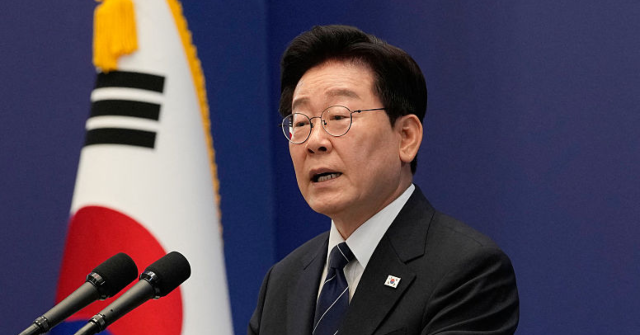
South Korean’s left-wing President Lee Jae-myung told a meeting of his Cabinet on Tuesday that he values his country’s alliance with the United States, but Korea should stop taking a “submissive or subservient attitude toward other countries.”
“Diplomacy should be pursued in a way that always upholds South Korea’s dignity and safeguards its national interests,” he said. “Any submissive or kowtowing stance should be shunned.”
“The guiding principle of South Korea’s diplomacy is pragmatism. The most important thing for South Korea is its national interests,” he said.
“We must always pursue diplomacy that serves Korea alone, allows it to stand tall and protects its national interests,” he said.
Lee stressed that the partnership between Seoul and Washington is “very important” and said differences between the two countries should be “continuously debated, raised, and coordinated,” so their disagreements can be kept to a “manageable level.”
“Relations with other major powers around us remain equally important,” he added.
Lee was speaking in the context of a dispute with the United States that began in March, when South Korean Unification Minister Chung Dong-young disclosed the existence of a North Korean uranium enrichment site during a meeting with Parliament.
The site at Kusong, North Korea, has long been known as a military fabrication facility, with a recent shift in focus to developing drone technology. Chung told Parliament that Kusong has also become North Korea’s third uranium enrichment plant.
This angered the U.S. intelligence community, which said Chung had revealed information that was supposed to be kept secret. Chung was the first South Korean official to make a public reference to possible uranium enrichment at Kusong. The U.S. also found the incident more disturbing because South Korea has been moving to improve its relationship with China, potentially creating intelligence problems.
The U.S. took the incident seriously enough to begin restricting intelligence-sharing with South Korea in April. South Korea also appears to have been excluded from what should have been a trilateral meeting with Japan and the U.S. over North Korean cyber threats in June.
South Korea’s ambassador to the United States, Kang Kyung-wha, acknowledged on Monday there have been “limitations in our communication with the White House” over the past six months.
“There have been various consultations regarding problems in connection with intelligence cooperation, but there have not been any complaints raised against any individual,” she added.
Chung said on Monday that he did not believe his remarks about Kusong were the sole cause of tensions between South Korea and the United States, and he denied that he exposed any secret intelligence.
“The U.S.’s misunderstanding was that intelligence had been shared, passed on to the unification minister and then somehow leaked by the minister. What I want to point out is that I made those remarks in July last year as a lawmaker, not as unification minister,” he told reporters.
“The U.S. may have overlooked that. Had they known, they would not have raised the issue. They saw it as a leak because they thought I was speaking as minister. Even the U.S. can get the facts wrong,” he said.
South Korean government sources told the Yonhap News Agency on Tuesday that Lee’s office has created a “task force” to “prepare for a potential golf outing between President Lee Jae Myung and U.S. President Donald Trump later this year,” during which the two leaders might patch up some of their differences.
“While the golf session has not been confirmed, observers have raised the possibility that it could take place on the sidelines of the Group of 20 summit in Miami in December,” Yonhap reported.
An official with the South Korean presidential office said it would be “not just a casual round” of golf, but “a diplomatic event.”