

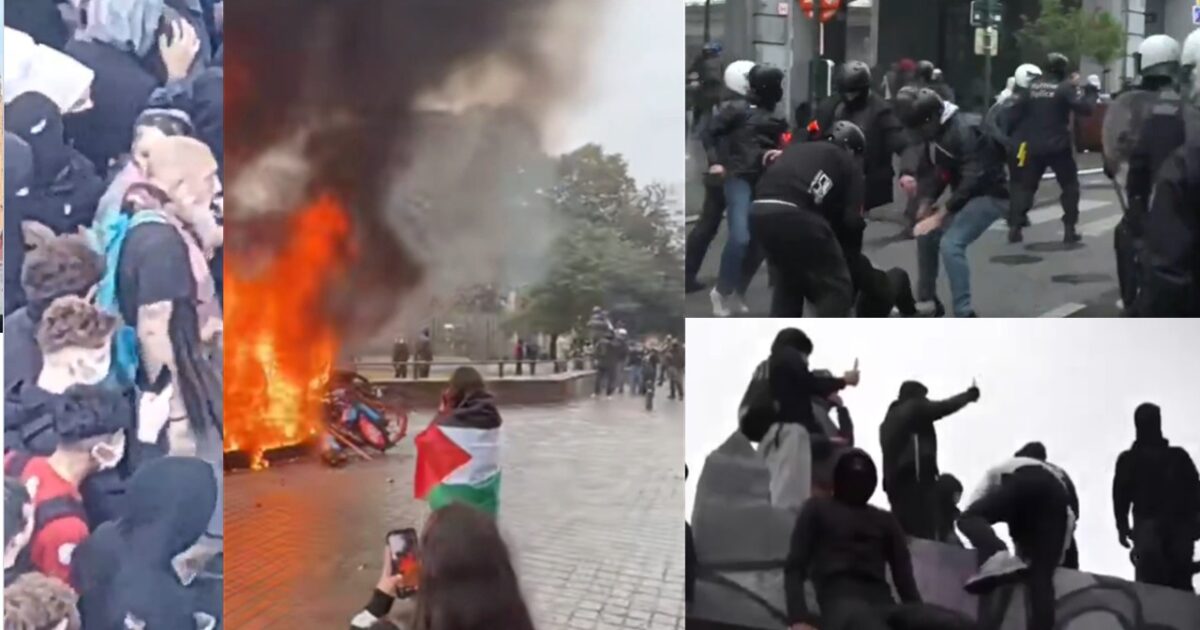
Several left-wing organizations have been linked to Belgium’s protests. RedFox, the secondary-school youth movement of the Workers’ Party of Belgium (PTB), distributed stickers among protesters. Education Minister Valérie Glatigny and MR president Georges-Louis Bouchez accused far-left extremists of manipulating students. RedFox denied responsibility for the violence.
Public buildings vandalized, buses set on fire, police pelted with paving stones and fireworks. Officially, Belgium’s unrest is a protest over education. As in France, education is a pretext.
The movement began on October 1 with school blockades in Liège and spread within days to Mons, Charleroi and Brussels. Students say they oppose overcrowded classrooms and a tuition increase in Belgium’s French-speaking Community. Reuters reported that they were inspired in part by the unrest in neighboring France.
On October 6, Liège police reported 31 administrative arrests, two judicial arrests and several injured officers. That same week, Liège prosecutors detained a 13-year-old who had called on social media for others to bring gasoline cans to burn down a school.
The violence escalated in Brussels on October 9 during a national union strike that drew 30,000 marchers, according to police, and 50,000, according to the FGTB union. The march itself was peaceful, but more than a thousand rioters gathered nearby, some carrying Molotov cocktails, sticks and mortars. Police said the violence had no connection to the union march. A police union representative told VRT the rioters were not youths or students but outright scum.
Brussels transit operator STIB reported four vandalized buses, including one completely destroyed, and three trams with smashed windows. Police confirmed that one bus was set on fire. At Brussels-Midi station, glass along an entire bus platform was smashed. More than 100 people were arrested, roughly 80 administratively and 30 judicially.
The riots continued. On October 13, police made at least ten judicial arrests near Brussels-Midi, nine involving minors, and seized fireworks and bottles of flammable liquid. On October 17, an unauthorized gathering turned into riots. A car was flipped onto its roof, and the Socialist Party headquarters was attacked. Interior Minister Bernard Quintin said the violence was no longer a protest.
After the October 9 riots, the social media account Visegrád 24 stated that second- and third-generation migrants had joined forces with Antifa near Brussels Central Station to clash with riot police. Police, prosecutors and the Interior Ministry have not yet released information on the backgrounds of those arrested that day.
Similar descriptions have emerged after earlier unrest. Following the 2026 New Year’s riots, the mayor’s office, citing police reports, stated that the vast majority of perpetrators were young Belgian nationals with a migrant background.
Vlaams Belang made a similar claim about the June riots at Brussels Central, saying footage showed mainly young people with a migrant background. The party also criticized politicians’ unwillingness to name the problem.
RedFox’s presence was confirmed by a protester who said on camera that the material came from the organization. Its head, Manon Vidal, is a PTB member of the Brussels parliament. Political scientist Pascal Delwit has said RedFox promotes the party’s narrative of class struggle between the dominant and the dominated.
The PTB was founded in 1979 on a Maoist program. In December 1989, its newspaper Solidaire called Romanian dictator Nicolae Ceaușescu “our comrade Ceausescu”. The party also backed North Korea and the Tiananmen Square crackdown. In 1994, party president and founder Ludo Martens published a book defending Stalin. The PTB dropped its references to Stalin and Mao only at its 2008 congress. Belgian media continue to describe it as a Marxist party.
In 2019, a PTB provincial councillor in Namur quit the party, saying elected members had to hand over all their allowances and that members’ social media activity was monitored.
The FGTB, Belgium’s socialist trade union, has also had leaders convicted over earlier strike actions. In 2021, a Liège appeals court convicted 17 FGTB members and leaders, including current president Thierry Bodson, of malicious obstruction of traffic for blocking the E40 highway during a 2015 strike. In 2019, the head of the FGTB in Antwerp was convicted of the same offense over a port blockade.
In France, where the unrest began, La France Insoumise declared its full support for the student movement and said it would march alongside it. On October 17, protesters forced their way into Lille’s town hall.
LFI deputy Raphaël Arnault co-founded the Jeune Garde, an antifascist group the French government dissolved in June 2025. France’s Council of State upheld the dissolution as proportionate to the gravity of its threats to public order.
In February 2026, 23-year-old nationalist activist Quentin Deranque was beaten to death in Lyon on the sidelines of a conference by LFI MEP Rima Hassan. Jeune Garde members were placed under formal investigation for manslaughter, including two former assistants of Arnault.
President Donald Trump designated Antifa a domestic terrorist organization in September 2025. In November 2025, the State Department designated four European groups as Specially Designated Global Terrorists. They included Germany-based Antifa Ost, which the department said attacked people it deemed “fascists” between 2018 and 2023, and Italy’s Informal Anarchist Federation, which has claimed responsibility for bombs and letter bombs against political and economic institutions.
The unrest comes as most French people express dissatisfaction with their government’s immigration policy. A CSA poll in September 2025 found that 79% wanted a tougher policy. An Odoxa poll for Le Figaro in January 2026 found that 70% of French people said there were too many immigrants in France, while 77% held a poor opinion of the government’s immigration policy.
In May, 69% of 18- to 24-year-olds backed a three-year suspension of legal immigration, the highest share of any age group. In June, CSA found that 83% supported sending home foreign criminals, delinquents and the long-term unemployed, including 90% of respondents aged 18 to 24.
The divide between voters and political leaders predates the current unrest. In 2005, 54.68% of French voters rejected the European Constitution in a referendum. In February 2008, Parliament, meeting in Congress, cleared the way for the Treaty of Lisbon, which retained the main elements of the rejected text, without another referendum.
In a 2017 discussion at Harvard, World Economic Forum founder Klaus Schwab said “we penetrate the cabinets” through his Young Global Leaders program. He named France, describing President Emmanuel Macron as one of the program’s participants.
Trending Now
 BREAKING: Massive Explosion at Alberta Military Base Kills and Injures Troops, Hospitals Reportedly Full, ‘Significant Casualties,’ Defense Minister Says ‘Situation Active and Delicate’ (Updated)
 Conservative Commentator Gives Christian Moms a Wake-Up Call About a Troubling Homecoming Dress Trend: ‘It Needed to Be Said’
 Americans LIGHT UP CBS After Noticing the Word the Outlet Uses to Describe the Horrifying Islamo-Marxist Riots in France
 HORRIFYING MOMENT: Military Officer Hospitalized After Horrifying Freefall From Alamodome Rafters During College Football Demonstration —
Ad block users: Some site features may not work correctly while an ad blocker is enabled, because they break scripts and content this website depends on. If you can’t see comments below, for example, please disable your ad blocker.