

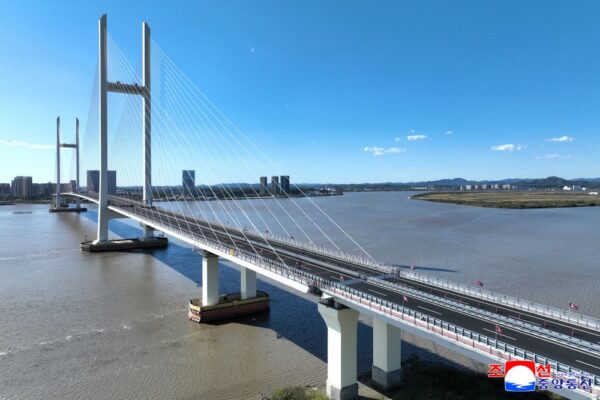
The New Yalu River Bridge, which links Dandong in China’s Liaoning province with Sinuiju in North Pyongan province, has finally opened, a full 12 years after construction finished in 2014. The two countries held an opening ceremony on October 15 and began running cargo trucks across the bridge, which is known as the Amnok River bridge in North Korea.
For years the bridge symbolized China-North Korea economic cooperation and also the practical limits on how far that cooperation could actually go. Now it is finally doing the job it was built for.
The two countries agreed to build the bridge in 2009, and construction began the following year. It was a major project meant to get past the logistical limits of the existing Sino-Korean Friendship Bridge. A four-lane bridge more than 3 kilometers (1.9 miles) long could greatly expand the flow of goods between Dandong and Sinuiju. China was willing to pay for construction to open a new channel for economic cooperation with the North.
Fifteen years ago, I was reporting for Daily NK in China. Back then, Dandong was full of anticipation about the bridge. People everywhere said a new crossing would bring a surge in China-North Korea trade, and that a new economic zone would grow up around Sinuiju and Dandong. Chinese businesspeople expected trade with the North to expand, and property prices near the planned development areas began to climb.
In August 2011, Daily NK reported that work on a pontoon bridge for the construction was 70 percent complete and that nearby real estate prices were rising. Some in Dandong even speculated that the bridge might lead North Korea to open its economy more widely. I still remember that mood clearly from my time on the ground.
Reality fell short of those hopes. The bridge was finished in 2014, but the North Korean side never properly built the connecting roads or customs facilities. Ups and downs in bilateral relations, international sanctions, and the COVID-19 border closure followed, and the bridge stayed shut for years. It was a long wait for the Chinese businesspeople who had hoped for new opportunities, and for everyone who had expected trade with the North to grow.
North Korea’s insularity alone doesn’t explain the delay. The two countries’ economic interests, the political climate, sanctions, and other factors all played a part. What is clear, though, is that North Korean authorities took a long and cautious approach to how much economic contact with the outside world they would allow, and how they would manage it.
In the end, the hard part was not building the bridge. It was getting past the North Korean authorities’ extremely narrow threshold. Pyongyang wanted the economic benefits, but it never let down its guard against the changes outside contact might bring. The 12 years the bridge sat effectively unused lay bare this contradiction at the heart of the North Korean economy.
More Trade Means New Opportunities and New Tests
So now that the bridge is open, will North Korea’s economy change? In the short term, we can expect more trade and more efficient transport between the two countries. Freight that used to pile onto the Sino-Korean Friendship Bridge can now be spread out, and there is finally a route that can reliably carry larger volumes of goods.
Still, it would be a mistake to assume the opening will quickly produce a jump in trade or better lives for ordinary North Koreans. How much actually moves will depend on customs procedures, transport costs, trade permits, and how goods are distributed inside North Korea. A wider bridge does not necessarily mean North Korea’s economy has opened any wider.
The bigger story may be how distribution inside North Korea changes. Markets are still central to how ordinary North Koreans make a living. Lately, however, the authorities have not simply been suppressing the general markets. They have been using state-run stores, state grain shops, and other retail outlets to expand state control over distribution and sales.
Under these conditions, if more imports flow across the bridge, state-approved trading companies and distribution agencies are likely to benefit first. In the past, private merchants brought in imported goods through various channels and supplied them to markets. That model may give way further to one where the state manages the import and allocation of goods, with markets and retail outlets operating beneath it.
Private merchants could still find new openings. More stable logistics and a larger supply of Chinese consumer goods and raw materials could mean more choice for shoppers and steadier prices for some items. If factories and enterprises can source raw materials more easily, production could benefit too.
But if the state tightens its grip on imports and distribution, the gains could concentrate in the agencies that hold trade permits and the power to allocate goods. Private merchants would become more dependent on state-designated distribution channels, and the various costs and informal payments they face could well rise.
How the bridge ties into North Korea’s “20×10” regional development policy is also worth watching. The North is racing to build local industrial factories, but putting up a building is one thing and running a factory is another. What matters is not how many factories have been built. It is how many days a month they actually run, where their raw materials come from, and what prices residents pay for what they produce. Without a steady supply of raw materials, electricity, and production equipment, these factories will struggle to operate.
Here, more Chinese raw materials and supplies could improve operating conditions at some local factories. Yet the more these factories rely on Chinese inputs, the further they drift from the self-reliant local economy the authorities keep promoting.
Development around Sinuiju also deserves attention. According to a recent Daily NK investigation, North Korea has reportedly pitched Chinese businesspeople on a plan to develop the area behind the bridge and some 40 square kilometers (15 square miles) of southern Sinuiju into an economic hub for logistics, processing, trade, and commerce. This suggests Pyongyang wants to use the bridge’s opening to make more economic use of the border region.
We should still separate development plans from actual investment and production. Current United Nations sanctions sharply restrict imports of industrial equipment, exports of North Korean processed goods, and joint ventures. Early on, the benefits will likely be limited to better customs and logistics, with any large-scale industrial cooperation moving slowly.
Above all, North Korea’s economy could become even more dependent on China. Deeper reliance on Chinese raw materials, consumer goods, capital, and logistics networks might give the economy a short-term lift. It could also leave the economy more exposed to shifts in Chinese policy and trade conditions. The gap between the self-reliance the regime preaches and its real dependence on China could grow wider.
Ultimately, the bridge’s opening is both an opportunity and a major test for North Korea’s economy. The question is what the authorities do with the extra goods and economic openings. Will they let ordinary people expand their economic activity, or will the state tighten its hold on profits and distribution channels? The answer looks set to shape the structure of North Korea’s economy in the years ahead.
The Real Measure Is How People Live
The number of trucks crossing the bridge is not the only thing to watch. Actual freight volumes, the goods being traded, customs procedures, and shipping costs all matter. But to really judge how North Korea’s economy is changing, we need to follow where those goods go, who controls the trade, and how it ultimately affects people’s daily lives.
That means tracking specific economic indicators over time. How many trucks cross the bridge each month? How much does the share of Chinese goods in markets change? How are people’s purchases split between state-run outlets and the general markets, and how is that changing?
We also need to look at how many days local factories with more Chinese inputs actually run and how much they produce, and how more imports affect consumer prices and people’s purchasing power.
With these questions in mind, the Daily NK sees a need to keep tracking changes in North Korea’s economic structure and in people’s living conditions. Comparing trends at three months, six months, and one year after the opening should give a clearer picture of how the economy is really changing.
What matters here is the direction of change, not whether a single number rises or falls. If imports go up but purchasing power doesn’t improve, we need to find out why. If state stores see more customers, we need to know whether private market trade is shrinking or whether both are growing. More goods coming in and people finding it easier to buy things are two very different matters.
In particular, comparing economic conditions in major cities such as Sinuiju (North Pyongan province), Pyongsong (South Pyongan province), and Hyesan (Ryanggang province) can show whether more border trade is reaching people inland and in the provinces. Even if imports grow at the border, distribution costs and local supply conditions mean residents in different areas may feel the change very differently.
We also need to see whether development in Sinuiju actually creates jobs and raises incomes. New facilities, roads, and housing are hard to count as a success if residents are hit with demands for money or forced labor mobilizations along the way. Beyond how the development looks, we need to see who bears the costs and who reaps the benefits.
Sanctions enforcement also remains an important issue. Expanded trade in legitimate goods for ordinary people must be clearly distinguished from transfers of sanctioned items. We need to check whether wider economic cooperation becomes a channel for evading sanctions. At the same time, we need to look closely at how much legitimate trade and economic activity, the kind needed to improve people’s lives, is actually happening.
The people I met in Dandong 15 years ago expected North Korea to change once the new bridge was built. Instead, the finished bridge stayed closed for 12 years. Things are clearly different now. North Korea needs more trade and practical economic gains, and China wants to expand its influence through economic cooperation with the North.
Even so, we shouldn’t simply repeat the hopes of that time. Expanded China-North Korea economic ties will not automatically mean freer markets or more freedom for people to make a living. North Korea has a history of chasing economic gains while tightening control over markets and ordinary people’s economic activity.
The New Yalu River Bridge is finally open. But the true test of change in North Korea’s economy won’t be the trucks crossing it. It will be what North Korean society does with the goods they carry.
We now need to look more closely at what is happening on the North Korean side of the bridge: how state control is shifting, how the markets are adapting, and whether people’s lives are getting even a little better. What matters more than the bridge opening is how far the changes it brings actually reach ordinary North Koreans. That is where our view of the New Yalu River Bridge, open after 12 years, should begin.