

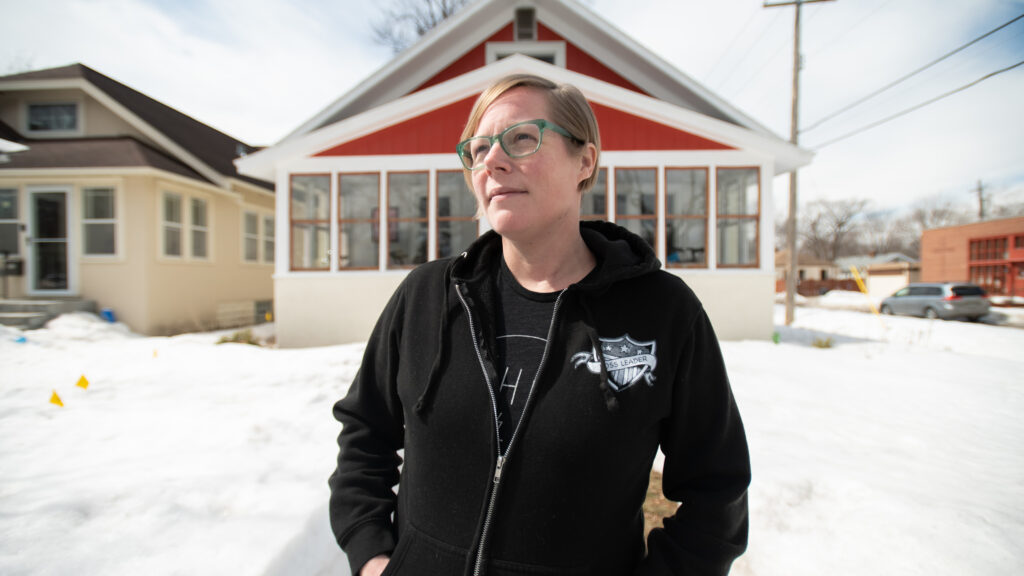
When Jeannette Cleland learned earlier this year that she could get chemotherapy at home, after dropping a particularly toxic medication, it seemed like good news.
But then Cleland, a 44-year-old Minneapolis event planner who has stage 4 pancreatic cancer, did the math. She added up the time involved: waiting for a nurse to arrive to draw her blood; waiting for a courier to pick up her blood; waiting for another courier to drop off the chemotherapy drugs; waiting for a nurse to arrive to connect her to the infusion pump and later for another nurse to return to disconnect her.
The scheduling and waiting for people to show up, Cleland pointed out to her cancer physician, would eat into parts of Mondays, Tuesdays, Wednesdays, and Thursdays.
“And since I do chemo every other week, taking up another good day to just be around my house and waiting for the person to come to draw my labs or drop off stuff at my house just sounded horrible,” Cleland said. Instead, she’s opted to continue going to the clinic at the University of Minnesota, where she spends roughly four hours every other Tuesday getting her chemotherapy before returning home with an infusion pump that a nurse stops by to disconnect on Thursday morning.
Cancer drug studies already collect numerous data points: overall survival, progression-free survival, side effects, and so on. In the last few years, some researchers have proposed a newer data point: time toxicity. Treatment studies, they argue, should calculate how much of a patient’s additional time, in terms of survival, will be spent in related medical care. Providing that information to physicians and patients, they maintain, could better frame difficult conversations about the pros and cons of treatment options, particularly as the end of life nears.
“It certainly is not up to me as the treating physician to tell a patient how they should or should not spend their time,” said Christopher Booth, a Canadian oncologist and professor who practices at Queen’s University in Ontario and is among those who have promoted the concept.
“But as an oncologist, patients rely on us to convey to them the relative risks and benefits of a treatment,” he said. “And I think we should consider time toxicity more explicitly in these conversations.”
Despite ongoing cancer research, the survival benefit of recent drug treatments averages just a handful of months, according to a 2021 analysis of 298 randomized studies. The JAMA Oncology analysis, which looked at phase 3 studies involving drug therapies for breast, colorectal, and lung cancers, found that the median improvement in overall survival was 3.4 months in those studies that found benefit. While some drugs have proven to be home-run treatments, the low median overall survival indicates that there also are many “pretty mediocre drugs,” Booth noted.
Booth and other proponents for assessing time toxicity suggest a simple approach. Any day that a patient interacts with the health system — even if it’s just for an hour or two — should be classified as a health care day.
Any touch point would count: clinic appointments, picking up medication, hours spent in the infusion chair, related emergency room visits, home-based care like physical therapy, time on the phone with the insurance company. That’s because even an appointment that’s described as “just a blood draw” can easily consume several hours with driving to the clinic, parking, waiting on the nurse, and other logistics, said Arjun Gupta, Cleland’s physician, and a gastrointestinal oncologist at the University of Minnesota who also has written about time toxicity.
“Seemingly short appointments turn into full-day affairs for patients and their care partners,” said Gupta, who is conducting interviews with patients, caregivers, and oncology clinicians. “Also, patients told us, ‘We have to take a day off from work and we can’t really plan anything around it. We have to be at the doctor’s at 9 a.m.’”
Booth and Gupta are advocating that many drug treatment studies conducted in the U.S. and Canada, and particularly those involving therapies for advanced cancers, should also measure patients’ time burden, along with survival and other data.
Annette Hay, a hematologist who also is a senior investigator with the Canadian Cancer Trials Group, found the concept intriguing after Booth reached out to her last year.
“It’s definitely worth exploring further,” said Hay, who is interested in testing the time tracking approach on a Canadian study in the near future. “It’s relatively simple to collect, analyze, report, and understand.”
Spokespeople at two U.S.-based trials groups, ECOG-ACRIN Cancer Research Group and SWOG Cancer Research Network, were contacted about the pros and cons of measuring time toxicity in research. Neither provided someone to comment.
Anthony Back, an oncologist at the University of Washington School of Medicine and long-time proponent of improving physician-patient communication, expressed some ambivalence. The terminology follows in the footsteps of phrases like “financial toxicity,” he said, as cancer physicians attempt to reframe various quality-of-life issues as a form of toxicity.
While time in cancer treatment can pose a strain on patients, Back said, what they crave even more is getting enough support, particularly as the end of life nears, he said. For instance: Are their physicians and other clinicians providing the information that they need, listening to their priorities, and communicating with respect?
“Do we need to create jargon like time toxicity,” Back asked, “to realize that patients who have a limited amount of time left need to be enabled to understand and grasp their situation, and then make wise decisions that are really based on what really matters to them?”
Booth and Gupta maintain, though, that some patients would benefit from having a stronger sense of the time involved. For instance, patients involved in clinical trials could fill out a form asking how many days they had spent at least part of their time on a list of treatment-related tasks, Booth said. That approach also would capture those unexpected complications, he said.
“There are these unplanned visits, or the unanticipated visits, where someone gets sick with diarrhea and has to have an extra visit to the cancer center for IV fluids,” he said. “Or someone develops a fever and goes to the emergency room.”
In one recent analysis, Booth and Gupta were among researchers who applied the time-in-health care metric to two already published studies, one involving advanced bile duct cancer and the second for a type of brain cancer called glioblastoma. In both studies, the treatment increased median survival by 27 days.
But that improvement was offset by 28 to 30 days spent interacting with the medical system, according to the findings, published last year in the Journal of Clinical Oncology. “There’s basically a direct tradeoff, whereby every extra day of life may be traded off by one extra day getting a CAT scan, going to the emergency room, coming to the infusion center, or seeing the oncologist,” Booth said. “This is actually a fairly simple thing to measure that has real meaning to patients.”
JJ Singleton, who has been getting infusion treatments for Stage 4 colon cancer since 2016, believes that all patients need a more accurate and upfront appraisal of the time involved.
He warns newly diagnosed patients that they’ll potentially spend a larger chunk of their day getting an infusion than they were initially told. The time estimates, he’s found, are more often based on the best-case scenario and don’t take into account delays in getting blood labs, nurse availability and other time-consuming steps.
“They tell you treatment is going to be four to six hours. But most likely you’re going to be there eight or nine hours if they say six.”
“I wish doctors wouldn’t kind of make it sound easier,” said the 35-year-old, who lives in Canton, N.C. “Because they tell you treatment is going to be four to six hours. But most likely you’re going to be there eight or nine hours if they say six.”
Jeannette Cleland’s decision to keep getting chemotherapy at the hospital illustrates why more research, including interviews with patients, will be required to determine how best to measure time toxicity, said Gupta. He noted that home-based care might present more of a time drain for some patients. “I one hundred percent supported her decision and actually I’m a huge home-infusion advocate.”
As of late March, Cleland had completed 55 chemotherapy sessions at the university clinic. Otherwise, she has plenty to fill her days. Her event planning company was involved with coordinating logistics for Covid-19 testing and vaccination sites in Minnesota. She enjoys checking out restaurants and music shows with her husband, who plays in a local punk rock band. She has adjusted her chemotherapy schedule to travel. Several weeks ago, she and her husband enjoyed a Boston getaway.
Anything’s better, she said, than tying up unnecessary hours with cancer-related tasks. “Just living my life,” Cleland said with a laugh. “Hanging out with friends. Going for walks. Or maybe I do just want to lay on my couch on my own.”