

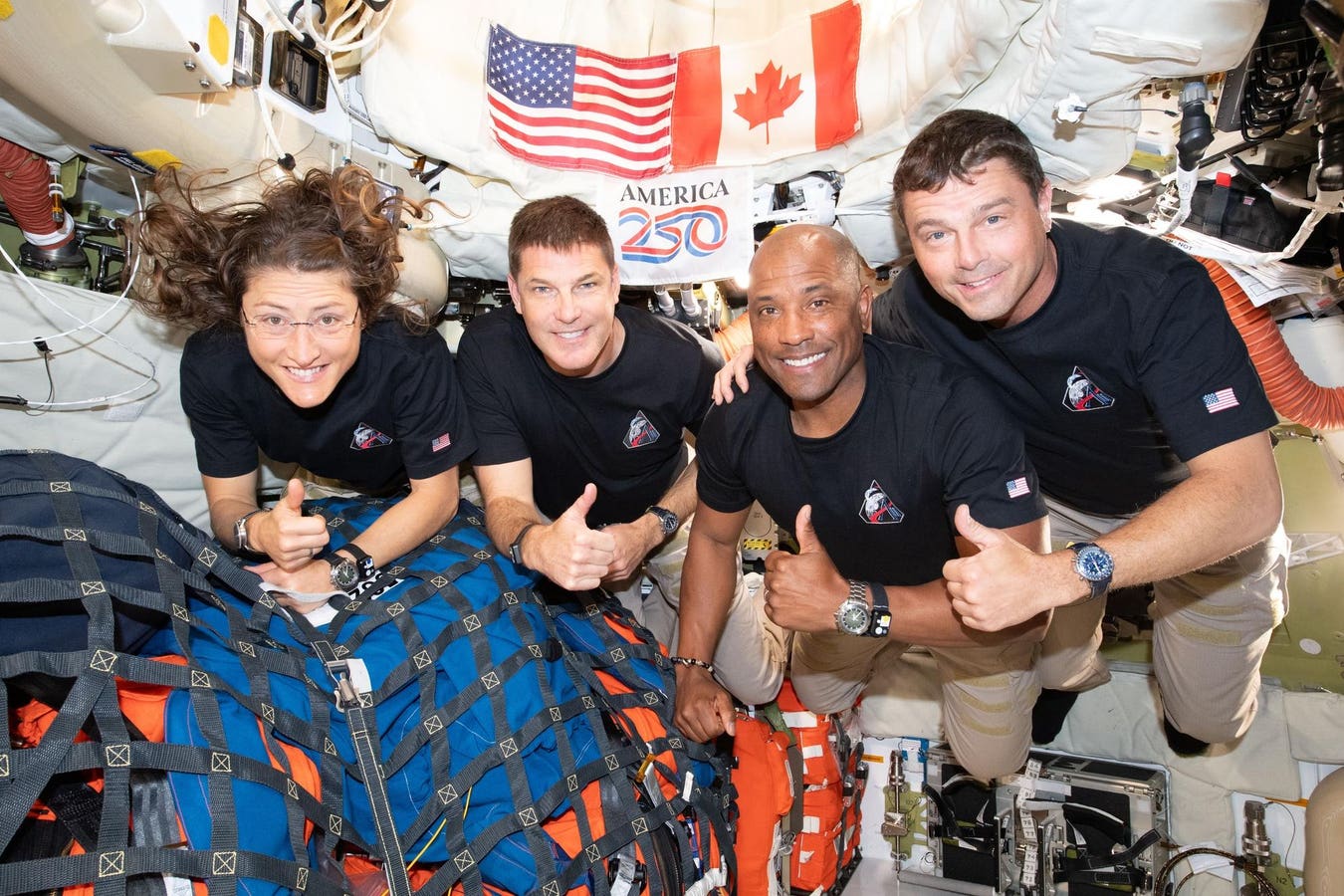
IN SPACE – APRIL 07: (EDITOR’S NOTE: This Handout image was provided by a third-party organization and may not adhere to Getty Images’ editorial policy.) In this handout image provided by NASA, The Artemis II crew – (from left) Mission Specialist Christina Koch, Mission Specialist Jeremy Hansen, Pilot Victor Glover, and Commander Reid Wiseman – pause for a group photo inside the Orion spacecraft on their way home. Following a swing around the far side of the Moon on April 6, 2026, the crew exited the lunar sphere of influence (the point at which the Moon’s gravity has a stronger pull on Orion than the Earth’s) on April 7, and are headed back to Earth for a splashdown in the Pacific Ocean on April 10. (Photo by NASA via Getty Images)
NASA via Getty Images
On April 10, 2026, four astronauts splashed down in the Pacific Ocean after the first crewed trip around the Moon in more than half a century. NASA’s Reid Wiseman, Victor Glover, and Christina Koch, along with Canadian Space Agency astronaut Jeremy Hansen, traveled 252,756 miles from Earth aboard the Artemis II mission, farther than any humans have ever been. The headlines, rightly, celebrated the milestone.
What got less attention was a small experiment tucked in alongside the crew: tiny chips of living bone marrow tissue, grown from each astronaut’s own blood cells, sent into deep space to see what radiation and weightlessness would do to them.
That experiment is called AVATAR, and it is not really about astronauts. It is about the rest of us.
Why Space Is A Better Laboratory Than You would Think
On Earth, gravity flattens cells grown in a petri dish into thin layers that do not behave much like real human tissue. In space, the same cells float and self-assemble into three-dimensional structures that look and act far more like actual organs and tumors. Proteins grown as crystals in space form cleaner, more perfect versions than anything we can make on Earth, which matters enormously when scientists are trying to design drugs that fit those proteins like a key in a lock.
Astronauts themselves go through a kind of fast-forward aging. Their bones lose density at rates that resemble severe osteoporosis. Their muscles waste within weeks. Their hearts remodel themselves, all without the confounding variables of diet, smoking, or sedentary living that muddy aging research on Earth. What happens to a healthy 40-year-old astronaut in six months of weightlessness tells us something about what happens to a bedridden patient after hip surgery, a cancer patient on prolonged treatment, or anyone whose body is aging faster than it should. This is not a loose analogy. These are shared biological pathways, and research on the International Space Station has already driven real-world changes in how we treat bone loss and manage fluid shifts after surgery.
IN SPACE – APRIL 06: (EDITOR’S NOTE: This Handout image was provided by a third-party organization and may not adhere to Getty Images’ editorial policy.) In this handout image provided by NASA, as the Artemis II crew came close to passing behind the Moon and experiencing a planned loss of signal, they captured this image of a crescent Earth setting on the Moon’s limb on April 6, 2026. In this photo, the dark portion of Earth is experiencing nighttime, while Australia and Oceania are in daylight. In the foreground, the Ohm crater is visible, with terraced edges and a flat floor interrupted by central peaks. Peaks such as these form in complex craters when the lunar surface is liquified on impact, and the liquefied surface splashes upward during the crater’s formation. (Photo by NASA via Getty Images)
NASA via Getty Images
What The Artemis II Experiment Actually Did
Researchers at Harvard’s Wyss Institute took blood from each of the four Artemis II astronauts and used it to grow miniature, living copies of their bone marrow, the tissue in your body that makes blood cells and is among the most radiation-sensitive organs you have. One set of these chips flew with the crew around the Moon. An identical set stayed on Earth as a comparison. Now that they are back, scientists will compare the two, cell by cell, to see exactly how deep-space conditions changed the way genes switched on and off inside living human tissue.
The implications for medicine on Earth are immediate. Bone marrow damage is what limits how much chemotherapy a cancer patient can tolerate. It is the concern radiation oncologists weigh most heavily when planning treatment. A validated human-tissue model, grown from a patient’s own cells, stressed under controlled conditions, and read out gene by gene, is the beginning of truly personalized cancer treatment. In this respect, before starting therapy, you would know how your specific bone marrow would respond. That is a different kind of medicine than we practice now, and the data coming back from Artemis II is a real step toward potentially changing out treatment paradigms.
From Orbit To The Hospital
The translation from spaceflight to everyday medicine is already well established. The problems you have to solve to keep a crew alive far from Earth are the same problems you have to solve to deliver care in a rural trauma bay, a refugee camp, or an ICU during a supply chain collapse: minimal equipment, no evacuation, remote decision support, and interventions that have to work in the hands of whoever is actually there.
When NASA astronaut Michael Fincke suffered a transient neurological event aboard the ISS in January 2026, unable to speak for about 20 minutes, the response depended entirely on wearable monitors, remote diagnostics, and protocols designed for a place where no ambulance is coming. The mission was cut short, but the technology performed. The same portable ultrasounds, wearable biosensors, point-of-care blood analyzers, and AI-assisted triage systems developed for spaceflight are now the backbone of emergency medicine in places where the nearest hospital is six hours away. During COVID-19, digital health tools built on exactly this logic absorbed patient volumes that would have otherwise broken health systems across every income level. Space medicine and public health medicine are solving the same engineering problem, and the benefits flow in both directions.
IN SPACE – AUGUST 15: In this handout photo provided by NASA, Astronaut Rick Mastracchio, STS-118 mission specialist, participates in the mission’s third planned session of extravehicular activity (EVA) as construction and maintenance continue on the International Space Station August 15, 2007 in Space. During the 5-hour, 28-minute spacewalk, Mastracchio and astronaut Clay Anderson (out of frame), Expedition 15 flight engineer, relocated the S-Band Antenna Sub-Assembly from Port 6 (P6) to Port 1 (P1) truss, installed a new transponder on P1 and retrieved the P6 transponder. (Photo by NASA via Getty Images)
Getty Images
The Next Orbital Laboratory
The International Space Station (ISS) is scheduled to be retired in the early 2030s, and NASA will not build its replacement. The agency is focused on the next generation of space habitats on the Moon, leaving the orbital laboratory role to commercial operators. Several commercial stations are in development, including Haven from Vast Space; Starlab, a privately owned station being built by a joint venture of Voyager Technologies, Airbus, Mitsubishi, and MDA Space; Orbital Reef, a joint venture between Blue Origin, Sierra Space, and others; and Axiom Station, led by Axiom in partnership with others.
This is a meaningful shift. The ISS was built and operated under international treaties that required open science, shared data, and broad collaboration. A commercial space station has none of those obligations by default, and its business model centers on selling access to the customers who can write the check: pharmaceutical companies, universities, wealthy individuals, large companies, and national space agencies. It will be important to ensure broader accessibility to these environments as the commercial space economy matures and becomes more sustainable.
What the Artemis II crew brought back is more than scientific data. The bone marrow chips carry information we have never had before about how real human tissue behaves in deep space. They are proof that personalized, tissue-level medicine is achievable in conditions far more extreme than any hospital on Earth, and they are the latest example of a pattern that has held for decades: the research that keeps astronauts alive also ends up benefiting the practice of medicine on Earth. Space has always been framed as a frontier for all of humanity.
The challenge now is making sure that the science and new data which emerges from the Artemis mission continues to serve this purpose.
Dr. Shreenik Kundu, Dr. Alaina Rajagopal, and Dr. Owais Durrani contributed to this article.