

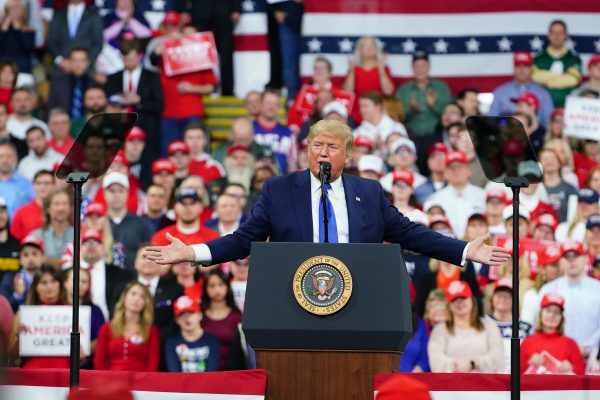
The United States is in the middle of campaign season for an election whose outcome could very well significantly alter Washington’s diplomatic, security, and economic orientation vis-à-vis Asia. The specter of a second presidency for Donald Trump, especially, has U.S. allies and “like-minded” partners in Asia worried. His “America First” approach is well-established, and media reports have warned that a second administration might well be one of “Trump unhinged.”
Ideas and policy proposals circulated by think tanks in the United States that are aligned with Trump and his “Make America Great Again” (MAGA) slogan can give us a preview into a second Trump term. Drawing on such materials, we argue that it is a potential escalation of a trade war with China, rather than military brinkmanship, that will most likely have the biggest impact not only on China-U.S. relations but on the entire region.
Defense and Security
In the field of security and defense, Trump’s potential return to the White House would most certainly pose a challenge for U.S. allies and “like-minded” partners, which in the past have relied on the U.S. for balancing or hedging against a growing Chinese assertiveness in the region.
First, a reinvigoration of Trump’s “America First” doctrine, coupled with a transactional view on alliances and partnerships could prompt at least a gradual scaling back of U.S. military presence in cases where U.S. allies or partners are deemed to “free ride” on U.S. security guarantees. Trump is expected to pressure Japan and South Korea to increase their financial contributions for the stationing of U.S. troops, particularly targeting South Korea, which he has accused of enjoying a “free ride.”
Trump himself, in a recent interview, considered the complete withdrawal of U.S. troops from South Korea. He has said as much and also halted joint military exercises with South Korea in the past. A similar, perhaps more assertive, stance might be adopted again if he returns to power. At least partially in response to this (as well as to a general rise in regional tensions) Tokyo and Seoul have begun to raise their defense spending substantively.
However, all in all NATO allies in Europe, rather than U.S. allies in Asia, will most likely bear the brunt of a Trump 2.0 security and defense policy. Trump believes that European allies in particular have made the U.S. carry most of the costs for Europe’s defense over the past decades.
While Trump has refused to answer whether the United States will come to Taiwan’s aid in case of an invasion launched by Beijing, MAGA-aligned think tank experts propose that Taiwan should continue to receive considerable diplomatic and military support from Washington to deter China. Taiwan will also almost certainly remain a major regional geopolitical flashpoint as well as a bone of contention in China-U.S. relations for years to come. Likewise, Trump’s stance on the South China Sea and commitment to the alliance with the Philippines is expected to remain firm.
The possibility of re-engaging with North Korean leader Kim Jong Un through summits remains uncertain due to the failure of the previous Hanoi summit. Instead, it is suggested that under a second Trump administration, Washington needs to openly challenge the evolving North Korea-Russia-China partnership.
Trump will also very likely maintain the general adversarial stance vis-à-vis China that shaped his first term in office as well as that of the current U.S. administration under Biden. After all, the overall strategic aim of retaining Washington’s pre-eminent position in the region through the pursuit of military primacy has broad bipartisan support in the United States.
With regard to the U.S. Free and Open Indo-Pacific strategy, Trump’s security policies are expected to align closely with Biden’s, particularly regarding support for minilateral initiatives aimed at balancing or deterring China such as AUKUS and the Quad. However, there might be an increase in bilateral or regional military exercises among allies like Japan and Australia, who are wary of Trump’s unpredictable decision-making.
Enhanced security cooperation with India is also likely, given Trump’s rapport with Prime Minister Narendra Modi – who just began his third term in office – and India’s strategic role in countering China. This includes suggestions to waive the Countering America’s Adversaries Through Sanctions Act (CAATSA) sanctions imposed on India over its purchases of Russian arms to allow India greater access to the U.S. defense industry market.
At the same time, however, it is unlikely that a Trump 2.0. administration will be able (and willing) to alter the relative decline in U.S. military power in Asia that the region has witnessed over the last decades. The United States has only gradually increased its military presence in the region since the end of the Cold War.
Trump might increase the number of U.S. missile interceptors and nuclear-capable ballistic missiles deployed in the region to counter the dual threats of Chinese aggression toward Taiwan and North Korea’s nuclear capabilities. Trump might also implement, at least partially, his idea to deploy more U.S. naval ships in the Indo-Pacific to counter China’s growing military presence in the region. None of this, however, will alter the relative decline of U.S. military power. Neither is it likely that Trump would be able or willing to revise the “absolute decline in American resolve.”
Trade
While the changes in U.S. foreign policy put forward by MAGA-aligned think tanks would certainly pose challenges for Asian allies and partners, the ideas floated do not have the potential to significantly alter the structures or practices of security cooperation in Asia. In the field of trade and commerce, however, Trump’s potential return has Asian officials and observers hugely worried.
Almost all Asian states have over the last two decades derived increasing trade and investment from China to the extent that regional supply and value chains have become increasingly China-centric. The ideas floated regarding a 10 percent across-the-board tariff on U.S. imports, with even higher rates on goods from China, have set alarm bells ringing.
While the Biden administration recently imposed a set of new tariffs on Chinese-made electric vehicles and related components, MAGA-aligned think tanks as well as Trump himself have suggested his administration would increase tariffs on China further. They seek to tackle what they perceive as Beijing’s “strategy for global dominance” with even more tariffs, an assertive trade policy, and a further decoupling of American supply chains from China.
Seeing the United States as locked in a zero sum game with China, MAGA think tankers suggest it should be U.S. policy to ultimately harm China’s economy. Rather than managing competition with China, Washington under a new Trump administration should win the competition instead.
As Washington intensifies efforts to reduce its trade with China through hiking tariffs, Chinese exports to, and imports from, the rest of Asia would likely increase as a result. And exports from other Asian states, who often rely on Chinese imports for many of their exports, to the United States will likely increase further. For example, exports to the U.S. from countries like Vietnam or Indonesia have surged as a result of Trump’s first “trade war” with China, leading to growing trade imbalances.
However, reducing trade surpluses with the United States – with China and the EU especially, but also other states – is a designated core interest of Trump. A Trump administration would very likely put Asian countries with trade surpluses like Japan, South Korea, Vietnam, or Indonesia under the spotlight.
MAGA-aligned think tanks have also proposed the introduction of a “U.S. Reciprocal Trade Act.” This would allow a future Trump administration to impose tariffs on countries that refuse to lower theirs. This approach would adversely affect U.S. allies like Japan and South Korea, but also other countries like India would be impacted. Trump has specifically criticized India’s high tariff rates, referring to it as the “tariff king.” It has also been suggested that the U.S. Congress should review China’s permanent normal trade relations (PNTR) status, which gives China preferential trade treatment via, for example, lower tariffs or the absence of import quotas.
The Indo-Pacific Economic Framework (IPEF), launched by the Biden administration, is widely regarded as a positive initiative by the think tank community. However, there are calls for modifying the IPEF to focus more on trade issues and reduce the emphasis on non-trade topics such as climate change. Meanwhile, Trump himself has threatened to withdraw the U.S. from the IPEF, echoing his previous decision to exit the Trans-Pacific Partnership (TPP) during his first term in office.
The IPEF, unveiled in May 2022 by President Joe Biden, has been viewed as the lynchpin of a broadening of stronger economic U.S. engagement in the region, with the intention of providing Asian states with an alternative to China’s growing economic dominance. The proposed collapse of IPEF could have far-reaching consequences for the regional economic order.
Initially launched to enhance economic integration, supply chain resilience, and sustainable development, IPEF is seen as a critical tool for countering China’s growing influence. U.S. partners had high expectations for the framework to deliver tangible benefits, such as robust supply chains, collaborative decarbonization efforts, and fair economic practices. However, the possibility of a U.S. withdrawal raises not only serious questions about American reliability but also increased economic overdependence on China by Asian states – a scenario many Asian policymakers seek to avoid.
MAGA-aligned think tanks also propose further economic decoupling from China as well as increased “friend-shoring” of U.S. trade and investment. This would amount to changes in the regional supply chains as goods would be re-routed to or assembled in other states, which in turn could lead to increased exports from India and Southeast Asia to the United States. Vietnam, with its already significant trade surplus with the U.S., could be heavily affected, particularly in its electronics sector. However, it would very likely also tie those economies more closely to China, because that’s where much of the capital, supply chains, and funding of new infrastructure will come from.
It has also been suggested to use USAID assistance strategically to counter China’s Belt and Road Initiative (BRI), providing aid only to countries loyal to Trump or the U.S. government. This transactional approach to foreign aid could further strain bilateral relationships with developing countries in Asia and undermine the broader U.S. strategic positioning. If Trump pressures Asian countries to economically align with the U.S., their strong economic ties with China might push them closer to Beijing, thereby further bolstering China’s influence.
Conclusion
In conclusion, if the proposed policies and instruments outlined above were to be applied by a Trump 2.0 administration this could significantly alter the strategic landscape in Asia. Close examination of the ideas floated by MAGA-aligned think tanks suggests that changes pertaining to the region’s strategic landscape will be visible in various policy areas with trade and commerce particularly affected. It is in this field where MAGA-aligned think tanks have floated the most drastic proposals.
This is because instead of managing the competition with China, various think tanks suggest that Washington’s general strategy should shift to outright winning the competition. In the process, China’s economy is to be hollowed out through tariffs, decoupling of supply chains, and other measures. The proposal made by Trump himself to withdraw from IPEF and the potential introduction of a U.S. Reciprocal Trade Act could further negatively impact regional supply chains and economic stability.
The obvious limitations of our analysis stem from the unpredictability of Trump’s decision-making style and the potentially diverse, heterogeneous reactions in Asia if the aforementioned policies and instruments were to be applied. Nonetheless, even if some of the proposals outlined above never transition from the “chattering class” into policy, they do contribute to a further shift in the public debate by further normalizing economic nationalism, launching a trade war with China and entrenching zero-sum great power confrontation as the prime strategic frame of reference of U.S. foreign policy.