

When discussing the geopolitics of electric vehicles (EVs), many people immediately think of the tariffs imposed on Chinese EVs and the related issues about overcapacity. But these issues do not encapsulate the whole picture of geopolitics and EVs. To fully grasp the geopolitics of EVs, it is crucial to look beyond market access and delve into the complexities of the supply chain.
The EV supply chain contains three streams: raw materials, intermediate goods, and the final product, the vehicle. While different, each segment is interconnected and offers unique insights into the broader geopolitical dynamics at play. This perspective reveals a much more intricate and nuanced picture, challenging the conventional focus on tariffs and market concerns.
Upstream
The upstream of the EV supply chain encompasses the extraction and processing of critical minerals, such as lithium, cobalt, nickel, and rare earth elements.
Lithium, key for battery production, is largely found in the famous “lithium triangle” countries, Argentina, Chile, and Bolivia, which account for about 75 percent of global reserves. However, lithium reserves do not equal production; Chinese companies currently control nearly half of the world’s lithium production in various ways.
Nickel is mainly used in lithium-ion battery cathodes to increase the battery’s energy density and extend driving range. The growing demand for nickel in EV batteries has intensified competition for nickel resources among different industries. The world’s major nickel producers include Indonesia, Australia, and Brazil.
Cobalt’s thermal stability and high energy density can contribute to the battery’s charge and discharge process. The Democratic Republic of the Congo (DRC) holds over half of the world’s cobalt reserves, and more than 70 percent of production, though the production from Indonesia is also promising. The mining of cobalt in DRC faces legal, human rights, and environmental concerns, triggering the development of alternative technologies.
Rare earth metals are essential in electric motors due to their magnetic properties. China accounts for nearly 70 percent of the world’s production and imposes strict export regulations, which prompted many Western companies to develop rare earth-free motor technology to reduce dependence on Chinese supplies. Meanwhile, countries like the United States are exploiting their own resources to secure supply.
The geopolitical implications of the upstream supply chain are multifaceted. First, the rising debates over “supply chain security” and techno-nationalism have created complex dynamics between suppliers and consumers. Raw material suppliers adopt strategic measures such as nationalization, export regulations, or rejection of foreign acquisitions of mines to tighten their control over the resources. Meanwhile, consuming countries are using both commercial and political means such as free trade agreements (FTA) and administrative acts to ensure or diversify the supply, or to cut Chinese dominance.
Second, environmental concerns on mining not only expose the mining countries to international criticism, but also provide an incentive to improve and collaborate to adhere to environmental, social, and governance standards.
Third, regional powers could leverage abundant resources to secure a better position in the supply chain. Endowed with rich nickel and cobalt reserves, Indonesia has attracted significant investment, and aims to make itself a key player in EV battery production.
Midstream
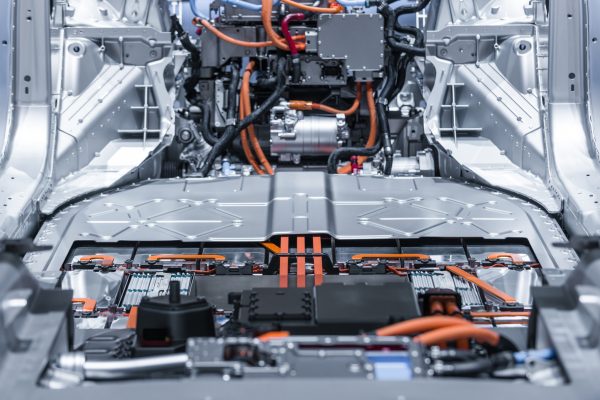
The midstream of the EV supply chain comprises batteries, motors, and electronic control systems. Semiconductors, integrated into every corner of EVs, also play a vital role in the midstream.
Chinese, Japanese, and Korean companies dominate the EV battery sector. China’s CATL and BYD hold significant market shares. Japan and South Korea focus more on export markets, with Korean companies like LG leading in European manufacturing capacity.
Lithium-ion batteries currently hold the largest market share, with ongoing innovations to improve efficiency. Emerging alternatives like sodium-ion batteries and solid-state batteries also represent significant technological competition and indicate a potential change in the current context.
The production of motors and electronic control systems is diverse, with technologies tailored to resource availability and efficiency. U.S. carmakers, for example, initially favored AC induction motors to mitigate rare earth constraints, whereas Japanese manufacturers prefer permanent magnet synchronous motors (PMSMs) due to Japan’s sufficient rare earth supplies. China’s abundant rare earth reserves have made PMSMs the dominant motor technology in Chinese EVs, highlighting the strategic resource advantage.
EVs use more semiconductors than internal combustion engine vehicles. Most automotive semiconductors are mature process chips and less advanced than those used for smartphones, laptops, and AI. However, the demand for high-end and AI-related chips is growing as autonomous driving and infotainment systems are pushing EVs toward greater intelligence.
Technological innovations will largely shape the future competitive landscape of the midstream. Countries with technological and resource advantages will continue to advance even in the next phase of the EV industry. Moreover, the geopolitics of chips might tell a different story in the future, that is, the “second half” of the competition, the development toward Intelligent Connected Vehicles (ICVs).
Should the United States extend high-end chip controls to EVs, Chinese manufacturers, though striving to localize production, might face challenges due to reduced supply in the short term. In the long term, if China cannot independently develop and mass-produce high-end semiconductor chips, the development of its smart car industry will be severely restricted.
Downstream
The downstream of the EV supply chain focuses on market access and Original Equipment Manufacturer (OEM) production. OEMs are responsible for designing, manufacturing, and selling vehicles, including the overall production process, assembly, and brand marketing. Leading EV companies globally follow this model, incorporating parts from various suppliers into their final assembled and branded products. China, the United States, and Europe are key players in the downstream.
Geopolitics affects the downstream EV supply chain through trade policies. The U.S. and EU have imposed varying tariffs on Chinese EVs, driven by different motivations and methods. The Biden administration’s tariffs on Chinese strategic industries, including a 100 percent tariff on EVs, are largely preventive, aiming to localize supply chain production within the United States. This strategy provides the U.S. with time and opportunities to restructure its supply chain and reduce its dependence on Chinese companies.
In contrast, the EU’s anti-dumping measures and temporary tariffs are remedial, as Chinese EVs have already captured a significant share of the European market, with localized supply chains beginning to take shape. In addition, due to the varying interests and considerations among EU member states, the internal decision-making process is cautious and subject to multiple constraints.
The temporary tariff policy targets EVs “driven solely by one or more electric motors,” making the scope and implementation of these trade tools quite limited. The impact of these tariffs on Chinese EV manufacturers remains within an acceptable range, allowing mainstream EV companies to still be profitable or reduce costs through supply chain shifts.
Beyond tariffs directly imposed on EVs, data compliance has become a key part of market access. Countries have implemented various regulations requiring multinational automotive companies to store driving data locally or on authorized servers. These measures are designed to ensure transparency, traceability, and security throughout the data lifecycle.
For example, the EU’s General Data Protection Regulation imposes stringent requirements on companies from non-approved countries handling individual identifiable data, often necessitating partnerships with local entities or the use of public cloud systems to achieve compliance, as seen in BYD China’s cooperation with CARIAD. Similar measures were developed in China, the United States, and other countries, with varied focuses.
Ongoing geopolitical developments in market access issues regarding data compliance and tariffs will shape the future of the downstream EV supply chain. The distinct data regulations have two implications for multinational automotive companies. First, automakers are compelled to adapt their practices to different markets, which might lead to tailor-made functions for vehicles from distinct regions.
Second, the fragmentation of data compliance guidelines may prevent car automakers from efficiently allocating their resources towards the development of self-driving technologies, essential for ICVs.
Similarly, trade policies, particularly in the form of tariffs, will have a profound impact. In the United States, policies to localize supply chains and reduce dependency on Chinese imports could boost domestic industries but risk higher costs and slower green energy progress if mismanaged. In Europe, the balance between protecting local industries and attracting foreign investment will evolve, with the EU’s cautious approach to tariffs and anti-dumping measures likely persisting, thereby influencing market dynamics and competitive strategies among European and Chinese manufacturers.
A supply chain perspective provides a comprehensive and nuanced picture of the geopolitics of EVs. Unfortunately, competition, accusation, and techno-nationalism overshadow the cooperation and the “green” aspect of the industry. The future of the geopolitical landscape – and the global EV industry – remains undecided. In a pessimistic view, current policies could escalate costs and hinder the green transition, while an optimistic prediction would be that the commercialization of alternative technologies will lighten the tensions and bring the “green” element back.