

The Diplomat author Mercy Kuo regularly engages subject-matter experts, policy practitioners, and strategic thinkers across the globe for their diverse insights into U.S. Asia policy. This conversation with Rodney Faraon – partner and chief creative officer at Crumpton Global LLC, a corporate advisory firm in metro Washington, D.C. – is the 452nd in “The Trans-Pacific View Insight Series.”
How should companies navigate the business impact of geopolitical risk amid shifts in U.S. foreign policy?
The companies winning today aren’t just reading the news – they’re preparing for battle. Geopolitical risk is no longer an external disruption; it’s a business fundamental. Sanctions, trade wars, and regulatory shifts can reshape industries overnight. Companies that fail to anticipate these moves risk being left behind.
The smartest firms build internal intelligence capabilities to track policy shifts, assess risk exposure, and identify strategic pivots before they become necessary. A sudden tariff, security crackdown, or export ban can alter market dynamics instantly. Agility is key, but anticipation is better.
Those with heavy exposure to China have already diversified into Vietnam, Mexico, and India, capitalizing on emerging incentives and infrastructure investments. Meanwhile, regulatory measures are increasingly being used as economic tools, favoring firms that can adjust before shifts take effect. In this environment, the most successful companies won’t just react to policy changes – they’ll shape their strategies around them.
How do U.S. tariffs on Canada and Mexico impact the U.S.-Mexico-Canada Agreement (USMCA) and what are the implications for China?
Tariffs have turned global trade into a moving target, forcing businesses to navigate shifting costs, alliances, and supply chains. USMCA was meant to provide stability, but with the U.S. imposing tariffs on Canada and Mexico, its purpose is eroding. Instead of a cohesive trade framework, North America has become a patchwork of shifting rules, forcing companies to reassess long-term strategies.
Tariffs on China have driven supply chains into Mexico, yet new tariffs on Mexico undermine those very gains. An even bigger question looms: if Chinese manufacturers relocate to Mexico, will the U.S. treat them as local enterprises under USMCA, or will they still face heightened scrutiny as if they were operating from the mainland? For companies betting on nearshoring, the answer will determine whether Mexico remains a viable alternative or just another regulatory trap.
Meanwhile, security concerns are compounding economic uncertainty. The U.S. designation of narcotrafficking cartels as terrorist organizations introduces new legal and compliance risks for cross-border operations. If a company unknowingly deals with a cartel front, is ignorance a legal defense against charges of providing material support to terrorists? The answer remains unclear, creating a chilling effect on investment and trade.
At this point, USMCA is more illusion than reality. The framework that was supposed to anchor North American trade is being replaced by political and economic friction. Companies must now manage not just supply chains, but also an unpredictable mix of trade policy, regulatory uncertainty, and national security imperatives.
What are the risks to global supply chains given the increasingly transactional nature of U.S. trade policy?
Just-in-time is dead – just-in-case is the new reality. Supply chains optimized for efficiency are now being restructured for resilience, driven not just by market forces but by tariffs, sanctions, and shifting political priorities. Companies that previously relied on streamlined, single-source suppliers are now diversifying, but this comes at a cost: fragmentation, price volatility, and increased regulatory exposure.
U.S. trade policy has transformed from a stable framework into a bargaining tool. Tariffs, export controls, and industrial policies are now wielded for short-term leverage rather than long-term economic planning. This shift has turned trade into a geopolitical battlefield, where supply chains for semiconductors, rare earth minerals, and advanced technologies serve as instruments of power.
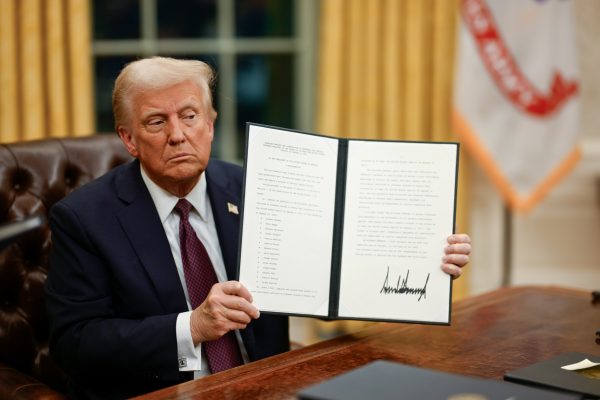
The most unpredictable factor remains the White House itself. A firm aligned with U.S. priorities today may find itself a target tomorrow – not only under a new administration but even within the same one if political winds shift and economic statecraft becomes the change agent. President Trump’s intuitive, transactional approach to decision-making has often led policy agencies to react rather than guide, creating a volatile policy environment. A shift in foreign policy, public sentiment, or even presidential instinct can redefine trade relationships overnight. In this climate, flexibility and foresight are as critical as efficiency and scale – because in an era of transactional trade, certainty is no longer part of the deal.
What trends should companies monitor in the evolving China-U.S. decoupling and offshoring/nearshoring landscape?
Decoupling isn’t a strategy – it’s a vibe, followed by a series of ad hoc measures reshaping trade and investment with no clear endgame. It is as much about political mood and momentum as it is about policy. The U.S.-China trade relationship is being actively recalibrated, often in response to political pressures rather than a coherent long-term strategy. Export controls, investment restrictions, and reshoring incentives are accelerating a push toward economic self-reliance on both sides. While companies aren’t fully exiting China, they are diversifying – expanding into Vietnam, India, and Mexico while maintaining a foothold in the Chinese market.
China, in turn, is doubling down on domestic innovation, particularly in semiconductors and AI. U.S. technology firms face tightening restrictions on both exports and investments, limiting their market access and creating long-term challenges for global competition. At the same time, Washington is escalating scrutiny over U.S. investments in China, particularly in strategic sectors. President Trump’s latest directive calls for expanded reviews on outbound capital flows, targeting private equity, venture capital, and – potentially – publicly traded securities. For the first time, pension funds and university endowments are under the microscope, raising the stakes for institutions that previously assumed they were beyond regulatory reach.
If these restrictions advance, U.S. capital will face increasing pressure to divest from China, reshaping global financial flows. Investors are already reassessing their exposure, and hedge funds and private equity firms are bracing for a more cautious fundraising environment. Meanwhile, the administration has also instructed CFIUS to tighten inbound investment reviews, signaling a broader effort to limit Chinese access to critical U.S. industries, from biotechnology to raw materials.
For businesses, the message is clear: decoupling is no longer just about supply chains – it’s about capital, investment, and financial entanglement. The companies that recognize this and adjust accordingly will be best positioned to navigate the uncertainty.
How should companies manage geopolitical risk under shifting U.S. leadership, particularly in the Asia-Pacific region?
In geopolitics, waiting for clarity is the fastest way to get left behind. The past decade has shown that global markets can be reshaped overnight by executive orders, new tariffs, or shifting alliances. Companies that waited for stability found themselves reacting rather than leading.
Nowhere is this more evident than in the Asia-Pacific, where U.S. policy remains fluid, but regional trade frameworks like RCEP [Regional Comprehensive Economic Partnership] and CPTPP [Comprehensive and Progressive Agreement for Trans-Pacific Partnership] are setting new rules of engagement. While Washington debates its economic posture in the region, these agreements are reshaping trade flows and regulatory standards, creating both risks and opportunities. Companies that understand and align with these frameworks – rather than waiting for a definitive U.S. strategy – will be best positioned to secure market access and supply chain stability.
Beyond trade, companies must anticipate how political risk intersects with consumer sentiment and regulatory enforcement. In key Asian markets, a misstep – whether in corporate messaging or supply chain decisions – can trigger swift regulatory or reputational consequences. U.S. firms navigating this landscape must recognize that alliances, compliance expectations, and market dynamics are increasingly set by regional actors, not Washington.
The firms that succeed will be those that remain agile, monitor policy shifts, and develop strategies that are not dependent on U.S. trade leadership. The future of commerce in the Asia-Pacific is being written with or without Washington’s direct involvement. The companies that recognize this and adapt accordingly will not just survive but gain a competitive edge.