

On April 2, U.S. President Donald Trump rolled out a bold new tariff package aimed at jumpstarting U.S. manufacturing. It sparked headlines across the world, but two challenges remain unresolved: a severe skilled manufacturing labor shortage and a fragile, incomplete supply chain.
The United States does not lack jobs; it lacks stable and accessible quality employment. A 2024 report from the U.S. Chamber of Commerce noted that Wisconsin had only 54 available workers for every 100 job openings, with Pennsylvania and other Midwestern states facing similar shortages.
According to the U.S. Bureau of Labor Statistics, as of January 2025, there were approximately 513,000 unfilled positions in the manufacturing sector – further highlighting the ongoing labor shortage and making it difficult for companies to sustain large-scale production in the United States.
Companies in the U.S. also struggle to live up to their labor promises. Foxconn’s failed pledge to create 13,000 jobs in Wisconsin – ending with fewer than 1,000 by 2023 – stands as a cautionary tale of what happens when policy fails to align with labor and supply realities. Similarly, after struggling to staff its Nevada Gigafactory, Tesla shifted focus to Shanghai – where its facility now produces over half of the company’s global deliveries. In 2024 alone, the Shanghai plant delivered 916,660 vehicles, as reported by Bloomberg.
Consider Foxconn’s iPhone plant in China. Even after extensive use of robotics, it still employs up to 200,000 workers at $2.50 an hour, working long shifts in dormitory-style housing. This model may work in places like Vietnam or Bangladesh, but in the U.S., such conditions are unacceptable to American workers. And that’s just one facility – Apple’s entire supply chain requires more than 1 million such production workers. Can these labor requirements be fulfilled in the United States? Apple’s CEO Tim Cook does not think so.
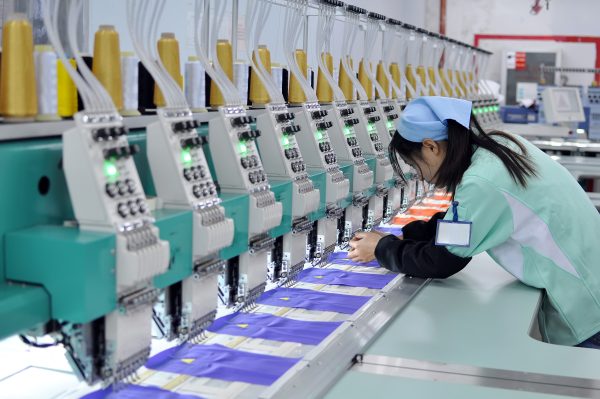
Since 2000, the U.S. has lost 4.4 million manufacturing jobs – a 25.8 percent decline. Of the remaining 12.76 million manufacturing workers today, 3.2 million are foreign-born, underscoring the industry’s long-standing reliance on immigrant labor. The deindustrialization of the United States over recent decades lies at the heart of its labor conundrum, which has led to the loss of manufacturing supply chains and a labor market lacking experienced manufacturing workers. Meanwhile, in Shenzhen, an entire laptop can be assembled, tested, and packaged in a single day – thanks to dense industrial clusters, coordinated logistics, and decades of supply chain integration. This level of efficiency is virtually impossible without a fully localized and responsive supplier network, alongside a dynamic and robust labor force.
These examples show that tariffs alone cannot bring manufacturing back to the U.S. Without addressing structural manufacturing labor shortages and rebuilding foundational supply chain capabilities, even the most ambitious investment plans will struggle to revive the country’s manufacturing sector.
If the U.S. is serious about rebuilding domestic manufacturing, it must restore each link of the supply chain and ensure its labor market can fulfill its manufacturing needs. Washington needs a practical strategy – one grounded in the labor realities the country faces. Taiwan and Malaysia use millions of non-resident workers to power $432 billion in combined exports, without demonstrably negatively affecting local job markets.
The U.S. must fix its labor crutch if it wants to revive manufacturing. It could consider piloting industrial zones – either in manufacturing-heavy states or near the southern border – managed jointly by federal or state governments and industry partners. These zones would integrate multiple segments of the supply chain within strategically designed areas. The president could also introduce a Special Industry Visa Pilot Program to allow temporary non-resident workers to fill designated roles within approved zones. These visas would be time-bound and tied to specific employers and projects, with oversight to ensure labor compliance and transparency. Upon completion of their contracts, workers would return to their countries of origin.
If the idea of establishing domestic industrial zones proves politically contentious, the United States could instead revisit the maquiladora concept – setting up American-administered industrial zones in Mexico, complemented with duty-free reimportation and enforceable labor standards. These zones would offer American workers more employment choices and allow them to focus on higher-value roles such as supervision, quality control, and training. More importantly, they could offer structured and lawful employment alternatives – transforming today’s labor challenges into long-term economic growth, as demonstrated by successful models in other countries.
To ensure workers’ rights are protected, labor standards in these zones should be developed and monitored by a coalition of employers, labor groups, and civil society organizations. Many products Americans use daily are still made under conditions unacceptable at home – yet overseas factories often keep these problems invisible. While many multinational companies have codes of conduct for their suppliers, an overall lack of enforcement remains a serious problem. Bringing some of this production back under a transparent, U.S.-based system – even with its own challenges – would offer greater visibility, accountability, and protection for workers. It would also mark a meaningful step toward restoring Washington’s ability to lead by example in setting global labor standards. In addition, placing more of U.S. supply chains on U.S. soil would not only help revive local economies, but also strengthen national resilience in an increasingly uncertain world.
As the trade war escalates and global markets plunging – with tariffs on China increasing to 145 percent, China’s introduction of retaliatory 125 percent tariffs, and the EU adopting tariffs on $23.2 billion of U.S. goods – a reindustrialization strategy is no longer optional but essential. It would help restore domestic supply chains, strengthen labor protections, and give the U.S. a structural edge in the manufacturing race against China. Tariffs alone cannot undo decades of offshoring. Without a complementary labor strategy and industrial policy, the goals of “America First” will remain out of reach. Tariffs may create pressure on companies, but they cannot rebuild a weakened manufacturing base on their own.
While the idea of establishing industrial zones may generate political debate, it represents a more practical and achievable path – especially when compared to some of the more confrontational policies Trump has already pursued in areas such as trade, foreign aid, and immigration. If successful, it would address the twin challenges of industrial revitalization and equitable employment and may achieve the administration’s aim of bringing manufacturing back to the U.S.
For the American working class, bringing back factory jobs requires more than tariffs – it requires a system that works for both employers and workers.