

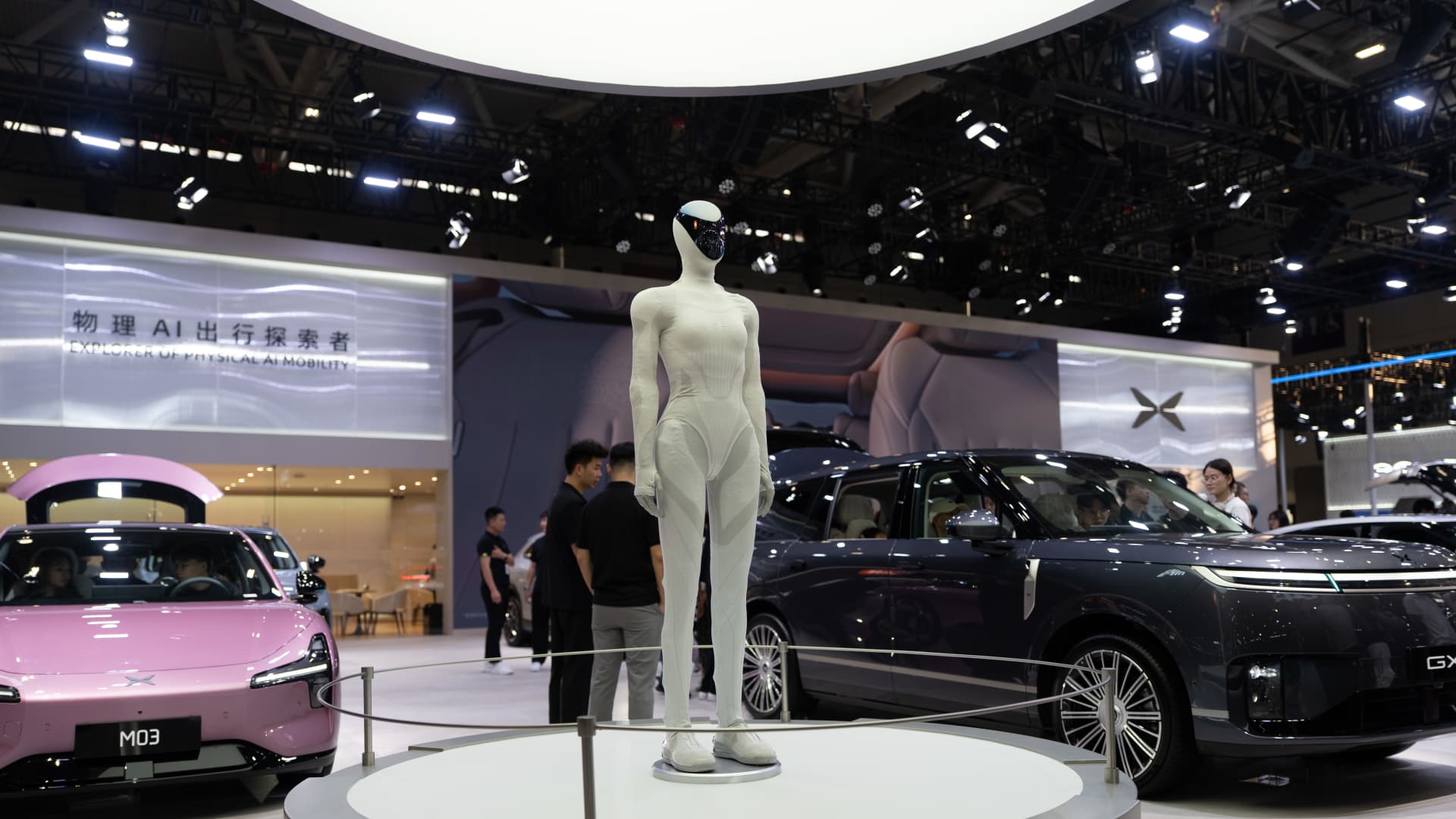
XPeng’s humanoid robot IRON is on display during the 2026 Guangdong-Hong Kong-Macao Greater Bay Area International Auto Show on May 31, 2026 in Shenzhen, Guangdong province of China.
Vcg | Visual China Group | Getty Images
Chinese companies rushed into electric cars a decade ago, and now they are expanding into humanoid robots as the EV market sees a slowdown amid intense competition.
While the commercial viability of humanoids has come under scrutiny, it hasn’t dissuaded companies such as Xpeng from announcing robot production plans, at a time when China’s EV sales are headed for their worst year since 2021.
It’s part of a bid to reshape “capital valuation narratives,” said Kevin Li, associate director at Counterpoint Research. He added that the automakers are also looking to boost the perception that they are tech companies, and establish a second growth curve.
Xpeng shares have tumbled more than 45% this year, making them the worst performer among major EV players. Shares of EV giant BYD are down more than 13% as sales have slumped.
Chinese automakers accounted for more than half of the nearly 20 car companies globally that have entered the humanoid robotics sector through in-house development, investment or incubation as of August, according to Counterpoint.

The venture arm of EV company Nio has also invested in several humanoid robotics startups such as LimX Dynamics and Acorn Robot, according to PitchBook data.
The business diversification comes as slowing growth and weakening profitability put pressure on China’s EV makers. The average profit margin in China’s vehicle manufacturing sector stood at 1.5% in the first half of 2026, according to China Association of Automobile Manufacturers data cited by Counterpoint.
Xiaomi, Li Auto and Geely are also among EV makers making moves into the robotics sector, although their strategies differ.
“Given the slowing growth and weakening profitability in the EV market—particularly domestically—it is a natural strategic move for EV companies to diversify into new applications such as robotics,” said Jing Yang, director of Asia-Pacific corporate ratings at Fitch Ratings.
“This allows them to pursue alternative growth drivers, achieve economies of scale for shared advanced technologies, and potentially improve profitability over the medium term,” she said.
Investors aren’t buying the story yet.
Xpeng shares fell after it raised $900 million for its robotics business last month, the largest single round in China’s “embodied” AI industry, according to the company. Embodied AI refers to hardware-connected artificial intelligence.
The raise valued the car company’s robotics unit at more than $6.3 billion — on par with the $6.5 billion estimated value for Xpeng’s EV business, according to Citi.
Advantages over Tesla?
While there are similarities to how electric-car maker Tesla is developing its Optimus humanoid in the U.S., Elon Musk’s company, the Chinese automakers’ push into robotics have their own advantages, said Xiaoyi Lei, senior research analyst at Jefferies Hong Kong.
She pointed out that Chinese automakers can reuse a significant portion of their supply chain — Xpeng, for example, can use 85% of its motors, chips and smart driving software for humanoids. The robots can then be immediately deployed in the automakers’ stores and factories, rather than having to wait for consumers to buy them, she added.
Xpeng said Tuesday it plans to begin mass production of its robots by the end of this year, starting in its own stores and business venues. Next year, the company plans to launch the robots to the broader market in China and overseas.
Automakers also know how to build things at scale, Lei said. Producing thousands of robots that are reliable and serviceable is what Chinese automakers already do every day, she added.
“Chinese players are the ones actually pushing it into daily use,” Lei said, noting that in-house deployment makes it easier and cheaper for the automakers to collect data — which is critical for humanoid commercialization.
Xiaomi, a consumer electronics company that only launched its first electric car in 2024, started testing humanoid robots at its factory this year.
BYD can also deploy robots in its factories, Counterpoint’s Li pointed out. But he said over the medium-to-long term, Geely and Xpeng could better capture the benefits of diversifying beyond cars, pointing to Xpeng’s greater emphasis on its physical AI strategy.
Humanoid questions
Whether humanoid robots can generate demand beyond automakers’ own operations remains an open-ended question. Lei said Jefferies has yet to see firm external orders from the automakers it covers or clear guidance on external customers and robotics revenue for next year.
Leading humanoid company Unitree saw its shares skyrocket as they debuted in Shanghai last month, but the stock declined for 12 of the 16 sessions since its listing. Founder Wang Xingxing has cautioned that commercialization could still take years, with the humanoid sector’s ‘ChatGPT’ moment likely a decade away.
Reusing car technology for robots may not always be as straightforward as it sounds.
“I would say the real challenge is how they are going to make the algorithm and software stack that is used to be applied to the smart driving system also viable to the humanoid scenario, which is more difficult and more challenging,” Lei said.