

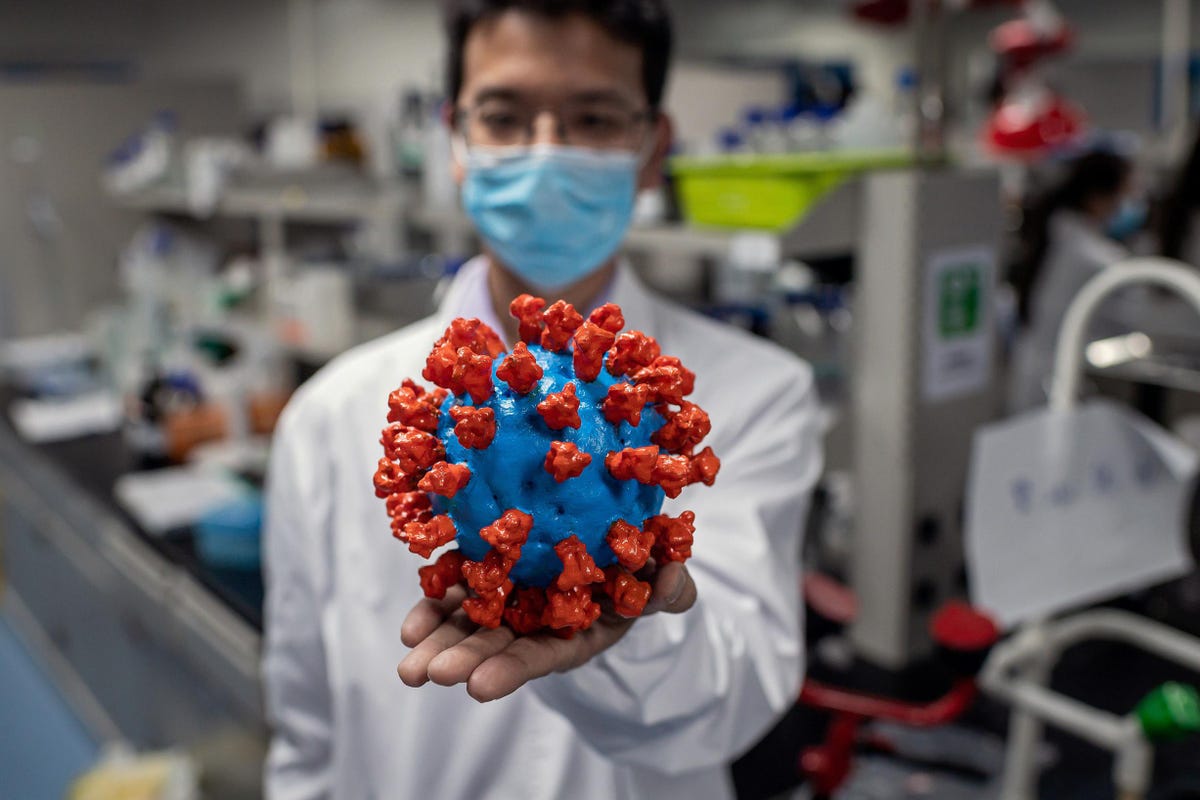
A plastic model of the SARS-CoV-2 virus.
Infectious disease expert and biology professor Dave Wessner explores the scientific merit versus potential danger of experiments that change the genetic makeup of viruses and give them new abilities to better understand how they infect others and causes disease.
When researchers at Boston University reported that they created a new version of SARS-CoV-2, the virus that causes Covid-19, media sources reported the story in varied ways. The paper, which has not been peer-reviewed, described the creation of a new, hybrid virus in a lab setting. This hybrid contained the spike protein gene of the Omicron variant inserted into the genome of the original Wuhan strain of the virus. Some people asserted that the research was “irresponsible” and that a “Frankenstein” virus had been created. Other reporters offered a more nuanced view of the work.
At the heart of the matter is the scientific merit and potential danger of what are called “gain-of-function” experiments. Common in virology, these experiments involve scientists changing the genetic makeup of potential pathogens, like SARS-CoV-2, giving them new abilities so that the researchers can better under how the pathogen infects and causes disease in host organisms. Ultimately, these experiments can help inform the development of vaccines or antivirals. It’s an issue the federal government has been grappling with for more than a decade.
Certainly, the intentional creation of a deadly human pathogen should be monitored. In a recent commentary, however, over 150 virologists argue that regulations must not, “overly restrict the ability of scientists to generate the knowledge needed to protect ourselves from these pathogens.”
The most recent discussion about gain-of-function experiments began when Boston University researchers, led by Dr. Mohan Saeed, explored the basic biology of the Omicron variant of SARS-CoV-2, the variant that has been dominant in the world since the end of 2021. Data show that this variant is much more transmissible than previous variants. However, it also appears to be less lethal than previous strains. Because of these past observations, Dr. Saeed and colleagues asked a fairly basic question: can we elucidate which mutations in Omicron contribute to each of these properties?
To address this question, they created what’s called a “chimeric” virus that contained the Omicron spike protein within the backbone of the ancestral Covid-19 virus. (The name comes from Greek mythological creature “Chimera” which had the head of a lion, body of a goat and tail of a snake.) The thought was that mutations within the Omicron spike protein almost certainly cause the body to recognize the virus less well, thus allowing it to evade the immune system, leading to what virologists call, “immune escape.” This immune escape helps make the virus more transmissible. By creating the hybrid virus, the researchers sought to determine if these spike mutations also determined the decreased lethality of this variant.
As expected, Saeed and colleagues found that the chimeric virus exhibited immune escape, much like Omicron. Additionally, they observed that the chimeric virus was more lethal than Omicron when administered to mice. Indeed, 80% of mice inoculated with the chimeric virus died. But that’s compared to 100% of mice who died from the original strain. From these results, the investigators concluded that mutations other than those in the Omicron spike gene must determine this variant’s decreased lethality.
A bronze chimera sculpture, with the head of a lion, body of a goat and tail of a snake.
The broader debate over gain-of-function experiments certainly did not begin with Covid-19. The current discourse largely can be traced back to 2011. In that year, virologists at the University of Wisconsin-Madison and Erasmus Medical Center independently reported that they had genetically modified the avian influenza virus A/H5N1 to make it transmissible among ferrets. Why is this noteworthy? The A/H5N1 virus has a high mortality rate in humans. However, human-to-human transmission is limited. As a result, a large-scale outbreak of this virus among humans has not occurred. But, if the virus were to evolve to become more transmissible, then we could be faced with a potentially catastrophic situation – a highly lethal virus that easily spreads.
To investigate the likelihood of this event occurring, the researchers at both institutions isolated variants of A/H5N1 that could be transmitted among ferrets, a commonly used animal model of aerosol transmission among humans. For obvious reasons, the implications of these experiments raised concerns within the scientific community and among politicians.
In response to these experiments, President Obama enacted a temporary federal ban on funding gain-of-function research involving several potentially dangerous pathogens in 2014. Three years later, the Department of Health and Human Services released new guidelines related to funding for enhanced potential pandemic pathogens.
The Boston University paper raised questions about whether the experiments should have been allowed under the federal framework, thus illustrating the ambiguities of the process. In a statement released by Boston University, the researchers said they “did not have an obligation to disclose this research” to the federal government for two reasons. First, they used internal funding sources and not federal funding. Second, they argued the research did not involve a gain-of-function. Actually, the federal guidelines do not specifically refer to gain-of-function experiments. Rather, these guidelines refer to research, “that involves, or is reasonably anticipated to involve, creation, transfer, or use of enhanced PPPs [potential pandemic pathogens].”
Does SARS-CoV-2 qualify as a potential pandemic pathogen? Of course. Did the researchers reasonably anticipate that their research would create an enhanced potential pandemic pathogen? Not necessarily.
This debate prompted working groups of the National Science Advisory Board for Biosecurity (NSABB) to develop new recommendations. A draft of these recommendations was published earlier this year. On January 27, 2023, the NSABB, a federal advisory group within the Department of Health and Human Services met to discuss the new proposal. Following a period of public comments and internal discussions, the board voted unanimously to approve the draft, with minor modifications. However, Board members also acknowledged that the guidelines were not perfect and this important conversation must continue.
Some of the new recommendations seem quite reasonable. For example, committee members agreed that the guidelines should apply to all research conducted within the United States, whether or not it involved federal funding. Similarly, the guidelines should apply to research conducted outside of the United States if that research used federal money. However, other changes seem more problematic. For instance, the new proposal recommends that the guidelines apply to a broader group of pathogens, not just potential pandemic pathogens. This increased oversight could slow scientific research and certainly creates some ambiguity.
Bottom line: The regulation of scientific research is difficult. Gain-of-function experiments can provide great insight into the basic biology of microbes and potentially help us design much-needed therapeutics. But these experiments come with a risk and must be done carefully and thoughtfully. Members of the NSABB continue to try and thread that needle.
Full coverage and live updates on the Coronavirus