

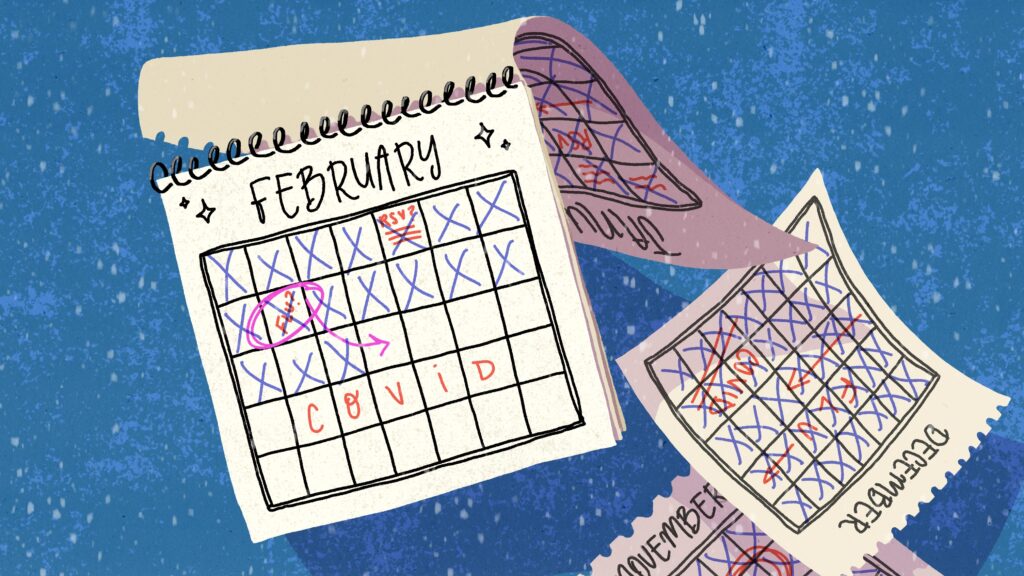
To most people on the planet, the Covid-19 pandemic is over. But for many scientists who have been tracking the largest global infectious disease event in the era of molecular biology, there is still a step that the virus that caused it, SARS-CoV-2, hasn’t yet taken. It has not fallen into a predictable seasonal pattern of the type most respiratory pathogens follow.
Influenza strikes — at least in temperate climates — in the winter months, with activity often peaking in January or February. In the pre-Covid times, that was also true for RSV — respiratory syncytial virus — and a number of other bugs that inflict cold- and flu-like illnesses. Some respiratory pathogens seem to prefer fall or spring. Even measles, when that disease circulated widely, had a seasonality in our part of the world, typically striking in late winter or early spring.
To be sure, you can contract these viruses at any time of the year. But transmission takes off during a particular pathogen’s season. (The Covid pandemic knocked a number of these bugs out of their regular orbits, though they may be heading back to more normal transmission patterns. The next few months should be telling.)
It’s been widely expected that SARS-2 will ease into that type of a transmission pattern, once human immune systems and the virus reach a sort of detente. But most experts STAT spoke to about this question said that, so far, the virus has not obliged. Their views differ on the margins. Some expect seasonality to set in soon while others don’t venture to guess when the virus will settle into a seasonal pattern.
“I don’t see clear seasonality for SARS-CoV-2 yet,” Kanta Subbarao, director of the World Health Organization’s Collaborating Centre for Reference and Research on Influenza at the Peter Doherty Institute for Infection and Immunity in Melbourne, Australia, said via email. Subbarao is also chair of the WHO’s technical advisory group on Covid-19 vaccine composition, an independent panel that recommends which version or versions of SARS-2 should be included in updated Covid vaccines.
Michael Osterholm, director of the University of Minnesota’s Center for Infectious Disease Research and Policy, agreed. “There just isn’t a definable pattern yet that would call this a seasonal virus. That’s not to suggest it might not be some day.”
Maria Van Kerkhove, the WHO’s technical lead for Covid, told STAT in a recent interview that the lack of seasonality is clear. “We expect there to be some seasonality in the coming years. Just based on people’s behavior, perhaps, just because it’s respiratory,” she said. Van Kerkhove does, though, think there are hints of a transmission pattern that is coming into view, something she and others refer to as “periodicity.”
“If you kind of squint, you could see a little, you know, in different places,” Van Kerkhove said. “I think you can see sort of waves of infection every five, six months or so depending on the population. But that isn’t at a national level. … And it’s not hemispheric.”
Questions posed over SARS-2’s lack of seasonality aren’t purely academic. Knowing when to expect a disease is critical for health care labor force planning. The tsunami of RSV-infected babies struggling to breathe in the late summer and early fall of 2022 was made worse by the fact that hospitals weren’t as prepared as they could have been; they normally see RSV peaks in the winter months. Likewise, knowing when to expect SARS-2 surges helps the Food and Drug Administration and the Centers for Disease Control and Prevention time the rollout of Covid booster shots. The protection against infection generated by the vaccines wanes quickly, so giving them too soon or too late would undermine the efficacy of this countermeasure.
Van Kerkhove thinks waning immunity in the population is the reason for the periodic swells of transmission. Protection against severe disease — whether induced by infection, vaccination, or the two combined — appears to hold up reasonably well. But when it comes to SARS-2, protection against basic infection is short-lived. That’s not a surprise given what’s known about the four human coronaviruses that predate the arrival of SARS-2. A study in the Netherlands that followed healthy volunteers for more than 35 years found that people can be reinfected with human coronaviruses within about a year after infection, and sometimes after a mere six months. With SARS-2, there are reports of intervals that are shorter still.
Michael Mina, an infectious diseases epidemiologist who previously taught at the Harvard School of Public Health, is a bit of an outlier in this conversation. He believes SARS-2 has been displaying seasonal behavior for a while, though what he describes sounds like the periodicity that Van Kerkhove and some other experts speak of.
Mina thinks of seasonality in terms of predictability, “that certain periods of time are going to see increases and decreases, but not necessarily that it has to just be winter or summer.”
“I don’t think I use the word wrong but I don’t think it’s well defined one way or the other,” he noted.
Ben Cowling, an infectious diseases epidemiologist at the University of Hong Kong, also thinks seasonality and predictability are intertwined. He doesn’t think SARS-2 is there yet — but believes it’s on its way.
“At the moment I don’t think Covid is predictable but it is showing all the signs of becoming the fifth ‘human coronavirus’ along with OC43, NL63, 229E and HKU1,” he said in an email, ticking off the names of the four human coronaviruses that predated SARS-2.
Osterholm doesn’t agree, arguing that even if they follow a pattern, swells of Covid cases at different points in a year doesn’t equate to seasonality. Furthermore, he noted that the patterns we’ve seen to date have been largely tied to the emergence of new variants, like Beta, Delta, and Omicron, with large surges of infections when those versions of SARS-2 arrived in the spring, summer, and late autumn of 2021 respectively.
“It wasn’t tied to some kind of environmental conditions. And that’s what you often think of with seasonality,” Osterholm said.
It’s thought that with new viruses, the vast number of susceptible people allows a virus to override conditions that would constrain more established pathogens — kids being out of school, unfavorable atmospheric conditions — and transmit at a time when it normally should not be able to. Epidemiologists refer to this override capacity as the “force of infection.”
That, in turn, can impact the ability of other pathogens to transmit during their accustomed times, as was the case with Covid’s disruption of flu and RSV. “When a virus is in a pandemic mode, there are forces occurring that we just don’t understand,” Osterholm said.
There are a number of theories about why some viruses hew to a seasonal pattern. It’s thought an interplay of factors is at work. Some have been mapped out, others remain in the realm of the unexplained.
Some relate to human activities, like school, that bring together lots of children, who are expert at amplifying respiratory pathogens. Or holiday travel, potentially. Marion Koopmans, head of virology at Erasmus Medical Center in Rotterdam, the Netherlands, noted that a study published in Nature suggested that a surge in Covid cases in the summer of 2020 in Europe was likely due to people vacationing. “Without detailed analysis, I do not think we can rule out that what we see is ‘holiday traffic,’” Koopmans said, referring to the upticks of cases that have been reported every Northern Hemisphere summer since 2020.
Environmental factors are also thought to be at play. The lack of humidity in the air in cold winters affects the integrity of mucus membranes, and it allows viruses to survive better outside a human host. People in temperate climates crowd together indoors during the winter, often in settings where air quality is suboptimal. Interestingly, the defined flu seasons that the Northern and Southern Hemispheres experience are not observed in tropical climates, where transmission occurs on a more year-round basis, without the sharp peaks seen in temperate zones.
“There is now a much stronger evidence base on the impact of climate variables (esp. temperature, humidity) on pathogen survival and how this translates to an impact on transmission in the population,” Nick Grassly, an infectious diseases modeler at the school of public health at Imperial College London, said in an email. “The focus has been much more on environmental drivers (particularly humidity, temperature, rainfall, etc.) than human behavior.”
Grassly is one of the people who thinks SARS-2 seasonality is falling into place, noting that the Joint Committee on Vaccination and Immunisation — Britain’s equivalent of the Advisory Committee on Immunization Practices, an expert committee that helps the CDC craft vaccination use guidelines — is now recommending a targeted autumn Covid vaccination campaign for high-risk individuals, in anticipation of a surge of Covid activity this winter. A similar, though more broadly aimed campaign is planned for the United States.
“It remains possible that a new variant showing substantial immune escape could spread rapidly, even in summer, and so disrupt seasonal patterns and planning,” Grassly noted. “I think it is hard to estimate the probability that this happens, but it would deviate from the recent pattern of successive Omicron variants which have emerged without large increases in overall incidence.”
Stanley Perlman, a coronavirus expert whose bona fides in the field stretch back to the pre-SARS-1 days, agrees with Grassly.
“I think for all these viruses” — human coronaviruses — “they probably circulate all year round. But you get large numbers of infections in the late fall, winter, when people are inside, and they spread. That’s what this virus seems to be doing,” said Perlman, a professor of microbiology and immunology at the University of Iowa. “As opposed to last summer, the number of cases is way down this summer. And the prediction is they will increase in the late fall, winter again.”
A break from seasonal transmission of respiratory pathogens can be a sign something is amiss, with off-season spread having been observed during flu pandemics going back to the Spanish flu pandemic of 1918. The first observed cases in that pandemic occurred in the spring, at a time when flu season would normally have concluded. The 1957 pandemic began in Asia in February of that year, but the virus arrived in, and started spreading through, the United States, during the summer. The 1968 pandemic began in July. The 2009 H1N1 pandemic was first detected in April and the pandemic’s major wave ran through the summer, peaked in September and trailed off in October.
“Pandemic influenza doesn’t follow a seasonal pattern in any way, shape or form,” said Osterholm.
It remains to be seen when it will be apparent that SARS-2 has lost its override capabilities, when we’ll feel confident that we know when to expect — plus or minus a month or two — Covid’s annual onslaught.
“I think that — at this stage — all we can say is that we can assume that there are some seasonal effects (since we know seasonality does have an effect on other respiratory infections, both by effects on virus stability and on the host) but that we really cannot say the circulation of these viruses is predictable yet, at least not like we have come to know for flu,” Koopmans wrote.