

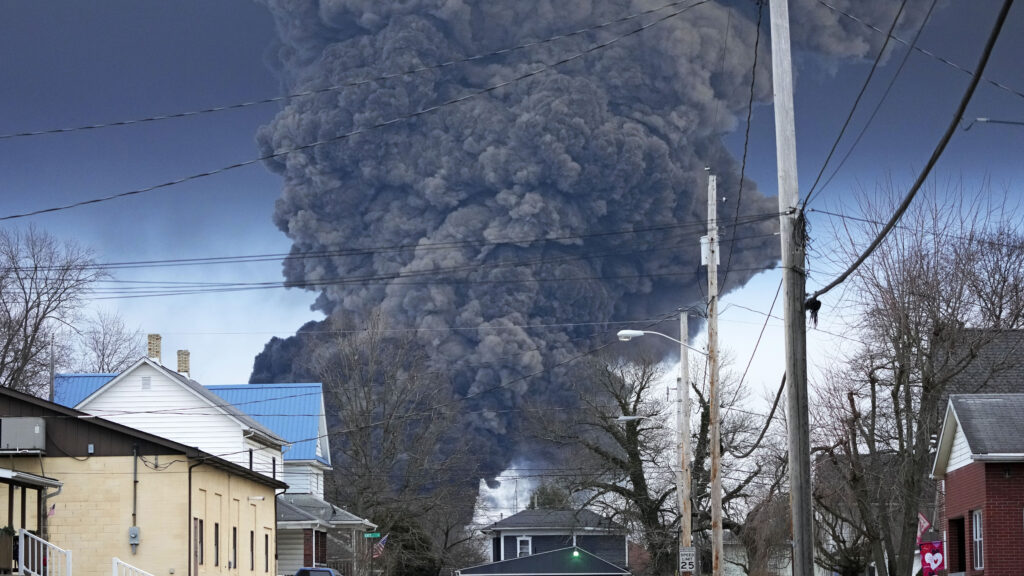
It’s been more than two weeks since a Norfolk Southern train derailed in East Palestine, Ohio, spilling chemicals onto the ground and into waterways, and releasing them into the air as damaged cars burst into flames. A few days later, on February 6, officials intentionally released vinyl chloride gas from five train cars and burned it in order to avoid an explosion.
Many questions have since been raised about toxic exposures sustained by humans and wildlife — not just in East Palestine, with its 4,700 residents, but along the Ohio River and farther north. The New Republic reported that residents endured burning and itchy eyes, sore throat, rash, and migraines in the aftermath of the train derailment. Around 3,500 fish have reportedly died in local waterways, and West Virginia Governor Jim Justice announced that chemicals had been found in the Ohio River in the northern panhandle of the state.
Here’s a look at what we know so far about the potential hazards of air, soil, and water contamination stemming from the train derailment, and what experts say about the chemicals’ possible long term-risks to health.
advertisement
Are the air and water in East Palestine, Ohio, actually safe now?
On February 16, Environmental Protection Agency Administrator Michael Regan met with residents and reassured them that robust air quality testing and 24/7 monitoring found the air and water quality to be safe. “We are testing for all volatile organic chemicals,” Regan announced. “We’re testing for everything that was on that train.” That said, state officials have advised residents with private wells to keep drinking bottled water until those wells can be tested.
Testing for volatile organic chemicals (VOCs) in air and water should cover potential hazards, said Ted Schettler, science director at the environmental nonprofit Science and Environmental Health Network.
advertisement
“They should be testing for individual compounds, and if they are testing for total VOCs as a screen, they need to have very sensitive instruments because some VOCs are much more toxic than others,” he said. Schettler is concerned about news reports that people are smelling chemicals in their homes and being told that their air testing shows no elevated levels. That suggests that the EPA may not be using sufficiently sensitive instruments, he said.
Some experts are raising additional concerns about that EPA statement. First of all, air monitoring of vinyl chloride may not be useful by now. “Vinyl chloride has a short half-life,” said chemist Matt Hartings of American University in Washington, DC. “After a day and a half, it’s likely gone from the air anyway. I’m not surprised they’re not finding it now.”
Air monitoring right now doesn’t answer questions about acute exposure that first night after the train derailment and the following day, Hartings said. On the first night, temperatures in the teens and very light winds would have kept airborne contaminants close to the ground over the town.
Moreover, several experts commented that they were uncertain what equipment the EPA was using for testing, and what exactly they were testing for. “I am still unclear on the timeline of what was released when,” said Hartings. “A lot of people are. I think it’s really important to pin them down on what measurements they are actually making.”
Chemist Nicole Karn of Ohio State University also said on Twitter that the EPA did not correctly preserve five of its six water samples before testing, adding: “These data cannot be trusted.” In the wake of these and other concerns, the New York Times reports that some locals are planning to pay for independent testing for chemicals.
“Removal of impacted materials, including soils, continues to be the top priority, in order to limit the spread of contaminants,” an Ohio EPA spokesperson said in a statement. “A full delineation of impacts to soil and ground water will be required, but has not yet been completed.”
What were the five chemicals the EPA found at the site?
On February 10, the EPA sent a letter to Norfolk Southern Railway Company reporting five toxic chemicals found in air, soil or water surrounding the crash site. They are: vinyl chloride, butyl acrylate, ethylene glycol, isobutylene, and ethylhexyl acrylate. Here’s a quick rundown of each chemical’s toxicity — and their byproducts when burned, which can also be toxic.
Vinyl chloride has gotten the most attention so far. It’s a colorless, flammable gas and known carcinogen.
Most studies on vinyl chloride are related to occupational exposure or to residents who live near factories that produce it. Those longer-term, chronic exposures have been linked to certain liver, brain and lung cancers, lymphoma and leukemia.
Short-term exposures, like those in East Palestine, can lead to irritation in eyes, nose, throat, and lungs. People can also suffer from headaches, dizziness, drowsiness, nausea, or tingling in the arms and legs.
As vinyl chloride burns, the gas can form byproducts including hydrogen chloride, carbon monoxide, carbon dioxide, and traces of phosgene. The EPA tested at least 480 homes around East Palestine and did not detect vinyl chloride or hydrogen chloride in any of them.
The EPA has not indicated whether it tested for phosgene, and has not yet returned STAT’s request for comment on the matter. Phosgene is hazardous at very low levels, notes Schettler, and has been used as a chemical weapon in war. “It’s highly corrosive to the lungs at really low levels, at fractions of a part per million.”
Since vinyl chloride in the air breaks down and dissipates in a day or two, it would not be found in air now. However, it may persist in soil and water, according to soil and crop scientist Murray McBride of Cornell University, who advises farmers and residents near the derailment site to test their soil and water. “Vinyl chloride is highly mobile in soils and water and can persist for years in groundwater,” writes McBride.
Butyl acrylate was released in large amounts when a car full of the chemical derailed. It’s a colorless liquid used to manufacture paints, solvents and sealants. Exposure can cause irritation to the nose and eyes, nausea, and vomiting, as well as allergic skin reactions, said Schettler.
State EPA officials have found butyl acrylate at multiple sampling sites along the Ohio River, though they say the concentrations are low and the river large enough that it poses no risk — it has been found at levels below 3 parts per billion, while the CDC considers levels above 560 parts per billion hazardous.
The Department of Environmental Protection tested groundwater near the derailment site and concluded that wells in town would be safe.
As for contamination of the Ohio River, cities and towns on the river have been monitoring closely. Greater Cincinnati Water Works planned to shut off access to the water reserve once butyl acrylate reached the city, letting it pass through and using reserve water. Other cities also shut down their water plants while the plume of butyl acetate went by.
Ethylene glycol is a solvent used in paints, inks and cleaning products. It’s highly flammable and acutely toxic. “It irritates the skin and eyes, causing sore throat, coughing and skin rashes,” said Schettler.
Isobutylene is a gas used as an antioxidant in packaging and plastics. “At moderate concentrations it can cause dizziness and drowsiness,” said Schettler, but the train’s cargo manifest, which has been widely shared, did not show this chemical leaking. “If that’s true,” said Schettler, “there are no exposures.”
Ethylhexyl acrylate is a colorless liquid used to make paints and plastics that can cause skin and respiratory irritation, sore throat, nausea, vomiting and diarrhea at levels starting at 5 ppm in air.
Benzene, petroleum lubricating oil and other substances likely burned as well.
What other toxic chemicals were created or used in the fires?
Dioxin. One big concern is the possibility of contamination by dioxin, a highly toxic, carcinogenic and persistent compound released when polyvinyl chloride burns. Polyvinyl chloride, or PVC, was present in four of the cars originally on fire. PVC is widely used in plumbing and pipes, flooring, and health care settings.
“Dioxins are persistent pollutants, highly toxic, and on the international dirty dozen list,” said environmental sociologist Rebecca Altman, author of the forthcoming The Song of Styrene: An Intimate History of Plastics.
The EPA has not yet tested for dioxin contamination, but a similar train derailment in Germany in 2000 found high levels of dioxin in the area where fires had burned polyvinyl chloride.
Elevated levels of dioxins have been found in other industrial accidents involving chlorinated chemicals, as well. “The EPA should be testing for dioxins in water and soil,” said Mike Schade, an environmental activist with Toxic Free Future.
Cornell’s McBride concurs, as does Schettler, who said: “We know when polyvinyl chloride burns it creates dioxins. I’m certain from the view of that black smoke plume that it was a witch’s brew of chemicals on fire, and I’m quite certain dioxins would be among them.”
PFAS (perfluoroalkyl substances), which are typically found in firefighting foams, may also have been released. The US government has said that high levels of exposure to these chemicals, called ‘forever’ toxins because they don’t break down naturally, may be linked to a number of health conditions including increased risk of kidney and testicular cancer, changes in liver enzymes, and increased cholesterol levels.
EPA officials have not yet tested the water for PFAS, but have promised to start.
As for other novel compounds released as a result of the derailment, we may never know their full extent. “Studies of wildfire smoke in California find that new and dangerous compounds form when fires burn into communities,” said Schettler. “The chemicals, plastics and paints in homes are much like the materials that were on this train.”
Hartings agrees. “The EPA’s testing is not necessarily monitoring novel toxins and compounds.”
Schettler said the EPA needs to continue to test soil and water away from the actual site. “They are carrying out extensive cleanup in the immediate area, but they need to continue monitoring further away. There is a lot of contaminated soil that could be a continued reservoir for hazardous chemicals that get into homes and food.”
Experts highlight need for tighter regulations on trains carrying hazardous materials
Because the Norfolk-Southern train had some cars containing semolina wheat and vegetables as well as about 20 cars carrying hazardous chemicals, the entire train was not labeled hazardous, and officials were not notified the train would be passing through the state. Ohio Governor Mike DeWine called for this to change at a press conference last week: “We should know when we have trains carrying hazardous materials through Ohio,” he said.
The train derailment has also reignited a conversation about trains’ braking systems. A 2014 Obama-era regulation required high-hazard freight trains to be equipped with electronically controlled pneumatic brakes by 2023. This allows the trains to brake faster. But in 2017, the Trump administration repealed this regulation. Thus far, transportation secretary Pete Buttigieg has not moved to reinstate the rule. The current, age-old technology of hydraulic brakes meant that in the Norfolk-Southern train’s case, when one car derailed, the entire train contracted and expanded like an accordion, sending many more cars off the rails.
Just as significant a problem is the way trains are scheduled, said Anne Junod, senior research associate at the Urban Institute. “Precision Scheduled Railroading (PSR) is likely a key contributor,” she explains. “It’s an industry model that is meant to increase efficiency and on-time deliveries while reducing costs.”
PSR encourages companies to expand the length of trains, because adding more cars means fewer train trips. But more cars can also increase the risk of a derailment. At the same time, she said, there has been a decline in staffing. “We used to see two engineers per train. Now we see increasing industry pressure for one engineer, for these long trains carrying incredibly hazardous materials.”
The number of train inspectors has also been reduced, so that the regions they are responsible for are bigger. “The responsibility for the inspectors is so immense,” Junod said, “that it’s literally impossible for them to do their jobs well.”
Junod points out that the U.S. has had dozens of derailments in the last twenty years, and that most of them are in small towns, simply because much of the 140,000 miles of train tracks in America traverse rural areas. “This is a real industry failure to self-regulate,” she said, “but then communities like East Palestine are left holding the bag.”
Get your daily dose of health and medicine every weekday with STAT’s free newsletter Morning Rounds. Sign up here.