

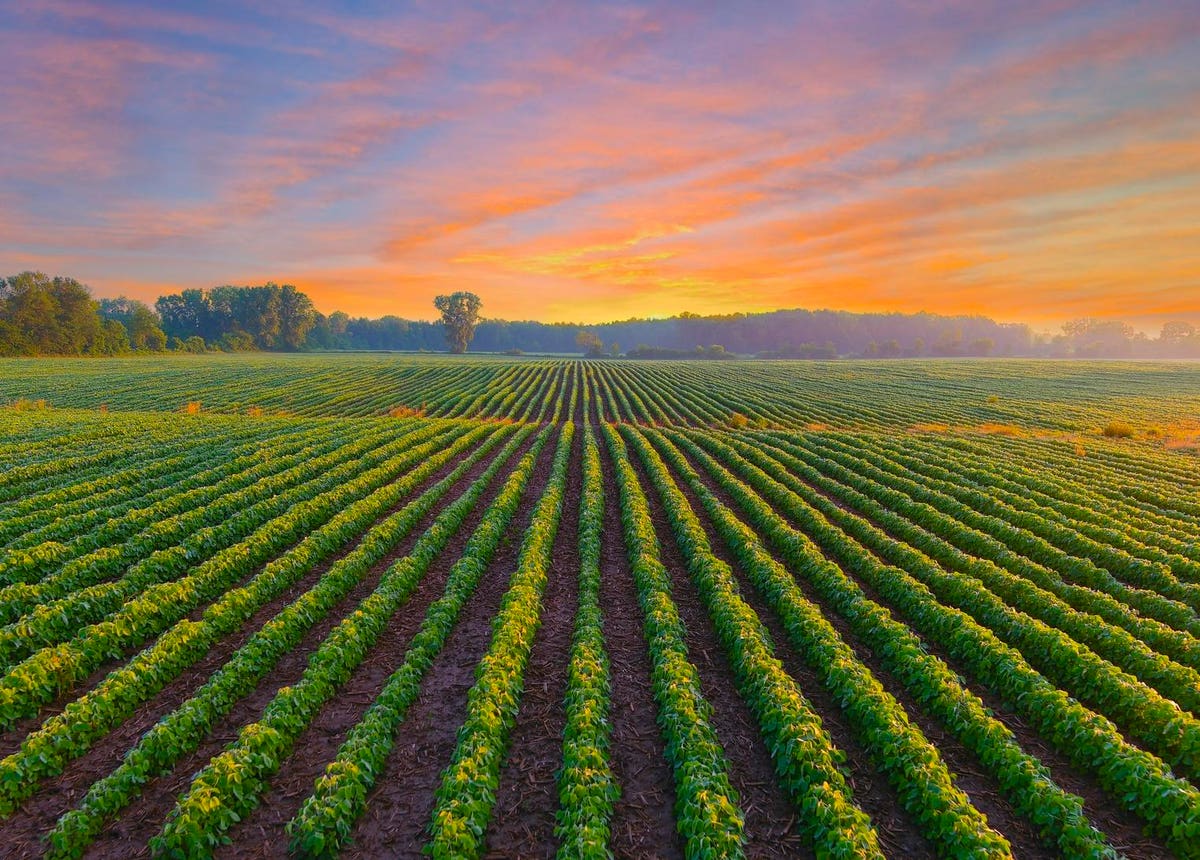
Healthy young soybean crop in field at dawn, with stunning sky.
3.5 billion people. That’s how many of us are alive today thanks to an innovation many people have probably never heard of: the Haber-Bosch process.
Invented back in the early twentieth century, the chemists Fritz Haber and Carl Bosch figured out how to cheaply turn atmospheric nitrogen into ammonia, a nitrogen-rich compound that plants can use to grow, unlocking a powerful new way to help crops reach their maximum potential yield.
The profound impact of this single technology cannot be overstated. Farms in the year 1900 required nearly four times as much land as in the year 2000 to grow the same average crop yield. This dramatic gain in efficiency over the last decades, as illustrated below, rank as one of the greatest breakthrough stories of the modern era.
A graph showing the astonishing decrease in land required to grow the same corn yield from 1940 to … [+]
But there’s a catch.
The Haber-Bosch process requires major amounts of energy and its output, synthetic nitrogen fertilizer, is notorious for its pollutant effect on waterways and its greenhouse gas emissions. By some estimates, agriculture accounts for 25 percent of the world’s greenhouse gases, and Haber Bosch alone accounts for 3 percent.
It’s clearly time to do better, again. If the 20th century was a major innovation success story, the 21st century must top it. Because the challenges we face today are just as steep.
Our changing climate is constricting arable land and threatening the livelihood of many farmers already, while our growing population is set to hit 10 billion by 2050. Put it all together and it seems like an impossible task: How will farmers be able to grow more food, with less land, decreasing their reliance on the status quo, while facing more droughts, heat waves, and floods?
The good news is that with the latest technological tools at our disposal, another transformation in agriculture is quietly beginning. Here are three ways I predict farming will change over the next few decades.
New and Improved Crops
The use of gene editing in agriculture will become increasingly prevalent because of its speed and specificity in developing desirable crop traits.
Rather than using a gene from a different species – like that of a bacterium put into corn to protect it from a common pest — biologists can now engineer changes directly in the crop’s own DNA, silencing or tweaking certain of its own genes to make versions of the crop that are more heat resistant, pest resistant, better tasting, or drought tolerant, for example.
Traditional crop breeding takes upwards of a decade, but with our new biotech tools, enhanced by our rapidly evolving digital ones like artificial intelligence, the development timeframe can shorten to mere months.
“CRISPR-Cas 9 is something that’s really changed that way plant biologists have been able to approach engineering crops because now you can do things that were essentially impossible previously or very difficult,” says Robert Jinkerson, an assistant professor in the Department of Botany and Plant Sciences at the University of California, Riverside. “So the timelines to create new traits or new varieties is rapidly decreasing and this allows us to imagine new traits and also to stack new traits that are known from other varieties into more commercially relevant varieties.”
The U.S. and Brazil have a relatively favorable regulatory atmosphere for encouraging this kind of innovation, and the E.U., in a welcome reversal, has just announced that it will relax its strict rules on gene-edited crops, in recognition of the fact that such direct tweaks to the plant genome could have occurred via conventional crop breeding.
While many plant biologists are experimenting with ways to improve crops through gene editing, Jinkerson is working on a particularly futuristic project: to decouple plant growth and food production from photosynthesis itself. Why? Because, Jinkerson explains, plants are very inefficient at converting sunlight into plant biomass: in other words, to grow. A crop like rice can only take 1% of its solar energy and convert it into biomass. Maize or sugarcane take about 1.5%. By contrast, a solar panel is 22% efficient. But that only makes electricity, which we can’t eat.
Jinkerson’s lab, which is funded by NASA, is developing a new approach using artificial photosynthesis to make food. A solar panel captures sunlight and converts it into electricity for use in a process called CO2 electrolysis. This process takes the CO2 and makes it into compounds like acetate, which the scientists then feed to food-producing organisms in the dark. They have already demonstrated that the approach works to grow yeast, algae, and mushrooms, and now they are working on plants. But plants haven’t evolved to grow without light, so his lab is using genome engineering to try to get them to grow more efficiently in the dark.
Aside from the immediate applications to space travel, their approach would allow the growth of more food with a smaller land footprint on Earth.
“It would be essentially the next version of vertical farming,” he says, explaining that you could in theory produce more food with artificial photosynthesis indoors than you could by relying on plants’ own inefficient processes to grow outside in the sun. “We did the calculation for some land in Illinois. If you had an acre of land, you could either grow corn there or put solar panels there and grow four times as much food.”
He continues, “Ideally, with our approach, we could turn agricultural land back to natural lands by increasing this efficiency. So we could take a quarter of what land is being used now and put solar panels on there and produce food, and take the other ¾ land and turn it back to forests or prairies again.”
Farming Will Help, Not Harm, the Environment
Joanne Chory is another influential plant scientist working on innovative crop development. As director of the Plant Molecular and Cellular Biology Laboratory at the Salk Institute for Biological Sciences, she is focused on engineering plants to be more resilient to the kind of environmental shocks that she expects will be more prevalent in the future, like rain, floods, and fires.
The context for her work is that in the Northern Hemisphere, most of the crops we grow die at the end of the season, and “all the work they did to fix CO2 into biosynthetic mass is gone, because it all gets rereleased into atmosphere.”
Sequestering carbon in the soil, however, is important to reducing climate instability.
Instead of letting nature take its course, Chory sees an opportunity to use gene editing to get plants to overexpress suberin in their roots, which is a naturally occurring polymer that acts as a sealant. “If you make more suberin,” she explains, “you have more recalcitrant carbon that can’t be broken down by microbes.” Thus, more of the plant’s carbon has the potential to end up in the root biomass or in the soil at the end of the season, and may stay sequestered there for multiple years if the farmer is practicing no-till.
Chory also postulates that the over-expression of suberin would have a positive effect on plants, allowing them to better withstand flooding and droughts.
Her lab is working on engineering the major staple crops like corn, wheat, and rice to have this trait. She estimates that half of the world’s arable land – between 500 and 800 million hectares — would need to be replanted with this kind of crop to sequester enough carbon to reach net zero.
“Agriculture is contributing to the problem of greenhouse gas emissions,” she says, “but agriculture can also contribute to drawing down the carbon that’s up in the atmosphere already…because plants are really good at sucking down CO2. We don’t need to do direct CO2 capture in the plant biologist world because we think plants do it better anyway, and cheaper, and can take advantage of the scalability of agriculture.”
Until carbon-sequestering crops are widespread, we already have the means today to tap into agriculture’s scalability to reduce carbon. One way is to apply microbes to the soil during the normal course of planting crops that turn carbon dioxide into permanent minerals.
Moving toward the use of more biological, instead of chemical, products and processes is the way of the future. Nitrogen fixation is another such holy grail. Certain crops, like legumes, evolved a symbiotic relationship with certain microbes that live in nodules in their roots. These microbes evolved the ability to take nitrogen from the atmosphere (which makes up 78 percent of our air) and deliver it to plants to grow, like an all-natural fertilizer. Some of our most important staple crops, however, did not evolve with this special microbe interaction. Therefore, they rely greatly on synthetic nitrogen fertilizer to yield enough.
But what if we could discover the chemical instruction packet in the legumes’ microbes that allows the latter to fix nitrogen from the air, and put those instructions into microbes that already live on corn, rice, or wheat? Theoretically, we would then be able to deploy organisms to do the job we need, rather than greenhouse-gas emitting chemicals.
So far, the initial results of such field trials have been disappointing, but the road to a new paradigm is rarely linear. I am confident we will make the breakthroughs necessary to realize this vision.
Farms Will Yield Both Food and Data
Closer to the present day, the adaptation of digital technologies to aid farming is already well underway. Rather than spraying an entire field with pesticides, for example, farmers are starting to rely on drones, sensors, and lab data to inform them about applying crop protection products. This will allow them to be more judicious with their practices, as well as limit the environmental effects of spraying.
Understanding soil health is another area that is being transformed by technology. The only accurate way to get a sense of the nutrients in the soil right now is to take a sample, send it to a lab, and wait for their report – a process that can take anywhere from several days to several months. It is also not cost effective to do very often on a large field. These issues are barriers to precise decision-making about when and where to use fertilizer. Some parts of a field may require more nitrogen, for example, while other parts need more phosphorous – and the only way to know that is to take multiple soil samples over time.
ChrysaLabs, a Montreal-based startup, has developed a “lab-on-a-stick” to generate real-time soil data including nutrient and carbon insights, more cheaply per acre than traditional soil sampling. It’s already being used on two million acres in the U.S. and Canada. (Leaps has invested in ChrysaLabs.)
Carbon credits are another way that farmers will increasingly monetize their land, by adopting practices or products that sequester carbon, and selling those credits to organizations that want to offset their carbon use. But the carbon credits market has been plagued by problems, including accusations of fraud. An accurate way to scientifically measure carbon is much needed.
Guillaume Breton-Menard, COO of ChrysaLabs, notes that some landowners have waited 1.5 years to get their carbon levels analyzed by a lab. Their soil probe, he says, does it in 20 seconds.
“If there is an NGO or someone in future who will want to analyze your calculations, you might be at risk of realizing that your quantification wasn’t strong enough,” he says. “So we want to bring to the market a stronger methodology that reduces reputational risk.”
From more resilient crops and better data to more advantageous practices, I predict that the farm of the future will be an efficient, integrated system that benefits growers, consumers, and the planet alike.
Now that will be a breakthrough to beat.
Thank you to Kira Peikoff for additional research and reporting on this article. I’m the head of Leaps by Bayer, the impact investment arm of Bayer AG. We invest in potentially breakthrough technologies to overcome ten of humanity’s greatest challenges, which we call “Leaps,” including to provide next-generation healthy crops and to reduce the environmental impact of agriculture.