

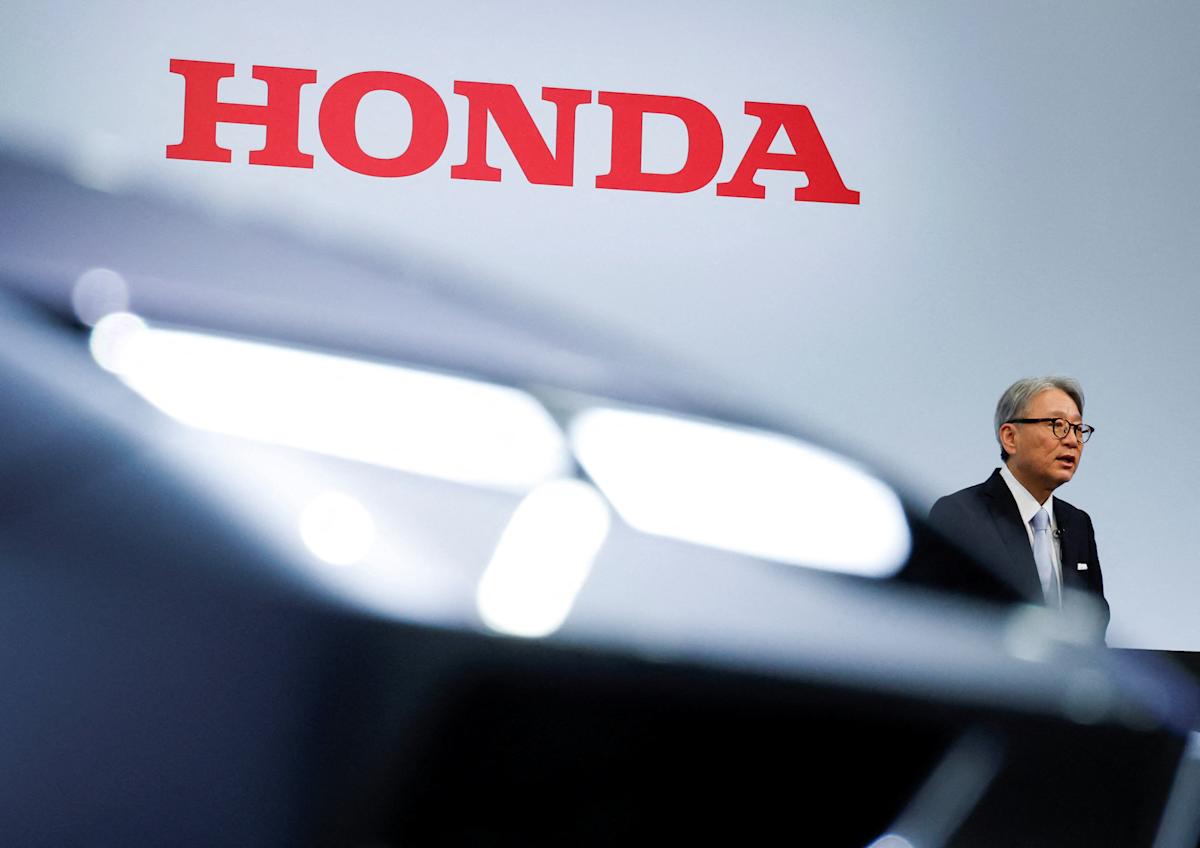
Japan’s Honda (HMC) posted its first-ever loss in its nearly 80-year history, following a strategy shift from EVs, which cost it dearly. But a refocused plan to lean into hybrids and upbeat guidance for the year ahead have investors bullish.
Honda said total EV-related losses for the fiscal year ended March 2026 came in 1.579 trillion yen ($10 billion), leading to an operating profit loss of 414.3 billion yen ($2.625 billion).
“Although the automobile business faced a harsh business environment – including higher tariff burdens and lower unit sales due to factors such as semiconductor supply shortages — we implemented company-wide cost reductions as one team, and excluding EV-related losses, we were profitable,” the company said in its presentation.
Good news came with Honda’s guidance, however. Though EV-related losses in upcoming March 2027 FY will be 500 billion yen ($3.168 billion), the company still sees operating profit at 500 billion yen. This topped Bloomberg consensus estimates of 212.4 billion yen ($1.35 billion), sending Honda’s ADR shares listed in New York up over 2%.
In order to better serve North America and its top market the US, Honda said it plans to roll out 15 new hybrid models by March 2030, primarily in North America, dropping planned EVs and toward mixed powertrain vehicles. Honda said by 2029 it would launch “large size hybrid models,” in the D-segment, meaning full-size sedans, wagons and SUVs.

Honda also said on Thursday that it would drop plans to build out an EV battery supply chain in Canada.
Currently Honda has 5 vehicles in its US lineup that offer hybrid powertrains, however these are of the mild hybrid variety, not plug-ins, which offer more range and efficiency. Honda’s lone EV is the Prologue, which is essentially a re-badged Chevrolet Blazer EV, which has sold at deep discounts at dealerships and will end production in December of this year.

Not surprisingly, Honda is scrapping its goal of being combustion free by 2040, with a new long-term goal of “carbon neutrality” by 2050, which will include a mix of EVs, hybrids, and carbon offsets. This means the company will still invest in next-gen EV hardware and platforms for the future, but the cmopany did not reveal these exact outlays.
Tariff impacts are still a headwind, with Honda manufacturing in regions like Canada, Mexico, and Japan as well as its main plant in Marysville, OH. Honda said tariff expenses for the last fiscal year came in at 346.9 billion yen ($2.2 billion).
Pras Subramanian is Lead Auto Reporter for Yahoo Finance. You can follow him on X and on Instagram.