

A dystopia of job loss and surveillance or a utopia of transformation and progress: This conundrum sums up the intense debate around automation and its impact on the future of work. Optimistic narratives about progress from the Fourth Industrial Revolution or a Second Machine Age are juxtaposed by predictions of a bleak future, where robots and automated processes lead to mass casualization, surveillance, and control.
The reality is not so simple.
Automation involves a new relationship between workers and technology, new “spatial fixes,” whether in global production networks or remote working, as well as enabling new types of employment relations.
It is important to place global narratives on the future of work in labor-abundant economies such as India, where the effects of automation could pose a challenge for development.
India has long struggled with structural inequalities, poverty, a predominance of informal work and self-employment, and rising unemployment. It also has niche expertise in information technology.
Young graduates and mid-level professionals appear likely to benefit from the AI revolution. Tensions over inequality – aggravated by fears that technological innovations will undermine job opportunities and security – dominate.
An assessment of how automation is impacting work in India does not support a dramatic shift from existing employment practices or major changes. Rather, the adoption of emerging technologies is uneven and patchy. It may improve employment conditions for some workers but is not likely to benefit the majority without redistribution of income and wealth.
Manufacturing: Automation With ‘Contractualization’ and Self-employment
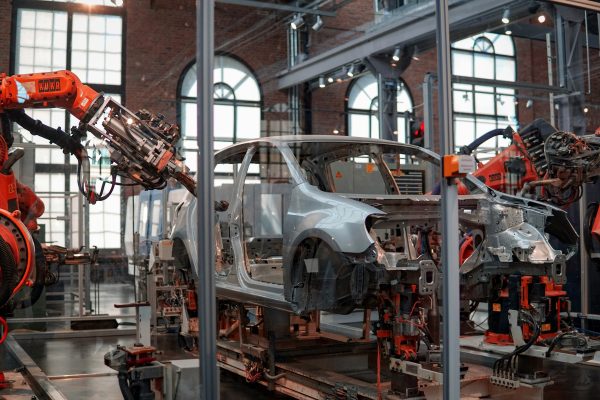
Manufacturing could be heavily impacted by automation, but its adoption needs to be balanced by the cost of upgrades and the cost of labor where labor is plentiful.
High-technology export-oriented automobile and telecommunication production are more likely to adopt advanced automation, partly because of the high number of routine tasks.
Labor-intensive industries such as textile, apparel, leather and footwear are less likely to adopt high technologies because of the need for high capital investments in what are predominantly small-scale firms in the informal sector, with easily available low-cost labor.
Automation in the manufacturing sector is driven by “contractualization” – where contract workers are hired in place of direct hire employees to weaken the bargaining power of regular (full time), unionized workers and keep wage demands in check – and labor replacement by firms. The share of contract workers in total employment has risen while that of directly employed workers fell.
It is also common for apprentices and contract workers to work alongside full-time workers to do the same job on the same shop floor, and for supply chains to source extensively from the informal economy.
While new jobs may be created, increased “contractualization” is leading to worsening employment conditions. Contract workers can be easily dismissed, receive a much lower wage than permanent workers and have no access to social protection mechanisms.
The other employment trend likely to intensify is a shift from wage employment to self-employment. While new opportunities for entrepreneurship may be created, evidence shows that for most, self-employment is not a choice but a necessity.
Over 80 percent of the workforce in the informal sector is classified as self-employed but operates at subsistence level with little access to capital or social security. Countering the myth that this shift to self-employment represents “entrepreneurialism,” the reality is of the “hidden dependency” of self-employment, and its gendered and caste- and community-based basis.
Workers are dependent on large firms or merchants, which leads to work intensification and a reliance on unpaid family labor. These self-employed are largely precarious, informal workers prone to exploitation.
A shift to “contractualization” and self-employment with increased automation may signify increasing informality and precarity, and worse employment conditions for many.
Services: Automation With Self-employment
The impact of emerging technologies is most visible in the Business process outsourcing (BPO) and IT industries, the financial sector and in customer services.
Back-end tasks are increasingly automated. However, this shift is unlikely to create widespread employment opportunities, as suggested by a significant slowdown in hiring and an increase in redundancies in the IT sector since 2016–2017.
One report indicates that 640,000 low-skilled service jobs in the IT sector are at risk to automation, while only 160,000 mid- to high-skilled positions will be created in the IT and BPO service sectors.
IT sector workers will need to rapidly upskill, but fewer jobs will be created in the medium-long run. Informalization and “contractualization” through outsourcing and subcontracting are increasing, at the cost of formal employment relationships in the IT sector.
The platform economy promises new economic opportunities for service workers, especially women and migrant workers, by enabling new forms of micro entrepreneurship and freelance work.
It can improve employment conditions in terms of higher income, better working conditions, flexible work hours or access to banking. Platforms also promise a sense of community that can be mobilized for collective bargaining.
However, leveraging these opportunities requires workers to have technical skills, when a majority have limited opportunity to upskill. This also highlights the disconnect between current education programmes and the skills employers need.
Often, surveillance and control belie the rhetoric of freedom, flexibility and autonomy. Labour share platforms are unregulated, profit-seeking, data-generating infrastructures that rely on opaque labor supply chains and the use of AI to control workers by directing, recommending and evaluating them and recording, rating and disciplining them through reward and replacement.
Like manufacturing, participation in gig-work is driven by the unavailability of alternative secure employment. Most people work multiple jobs for multiple employers on a piece-rate basis and lack access to formal social protection.
Automation appears to be creating a flexible and controlled “digital labor” base, reproducing informality and precarious working conditions rather than positively transforming work.
Agriculture: Limited Automation and Persistent Poverty
Agriculture remains the largest source of employment in India with a high automation potential. Most agricultural tasks can be classified as manual, such as planting crops, applying pesticides and fertilizers, and harvesting. AI technology and data analytics have the potential to improve farm productivity, highlighted by the many agri-tech start-ups in India.
However, the underlying dynamics of agriculture and their pervasive and persistent role in perpetuating informal employment pose a challenge.
Agriculture has structural inequalities, widespread poverty, subsistence farming, low-skill levels and low productivity.
Land ownership is concentrated amongst a few, with limited capital investment, while 75 percent of rural workers work in the informal sector, and 85 percent have no employment contract, health and social security, some being subject to “neo-bondage.”
This extreme inequality combined with the decreasing size of landholdings, low growth and low capital investment means any widespread adoption of advanced farm automation and digital technologies appear unrealistic. More likely is the adoption of micro technologies and incremental mechanization.
Growing labor surplus in agriculture continues to fuel the informal economy, where workers cannot break the vicious cycle of low wages and low skills. The absence of employment creation and increasing informalization of formal manufacturing and service-sector jobs (in the platform economy and gig-work) are likely to aggravate these challenges.
Automation and Inequality
Automation is likely to bypass those sectors which employ most low-skilled workers. The societal implications of this are far-reaching.
The low cost of labor in the informal economy reduces the likelihood of technological adoption. High poverty levels combined with low levels of education among semi-urban and rural men and women and marginalized social groups will limit their access to any gains from technological development. This will restrict economic opportunities.
Women and marginalized groups are less likely to have the digital skills and are more likely to occupy the jobs most vulnerable to the effects of automation. Self-employment is likely to increase, but not necessarily accompanied by an improvement in employment conditions. New technologies could further reinforce the vast urban–rural divide.
Automation could reproduce informal and precarious work rather than transform existing trends.
A fair and equal future of work is possible through the adoption of new technologies – from the growth of the platform economy to remote learning opportunities.
Their effectiveness will depend on how well they are integrated with broader policy interventions which address the deep-rooted inequalities and enduring employment and skilling challenges in India’s world of work.
For example, skills have been identified as key in the national strategy of automation. Yet, India does not have a history of success in up/skilling with low investment in training structures and firms’ reluctance to invest in training and reliance on informal skilling. There is a significant digital gender divide that adversely impacts skilling initiatives.
Policies that facilitate the capacity of women as well as other socially disadvantaged groups to leverage new technologies will help towards an equitable future of work.
Originally published under Creative Commons by 360info™.