

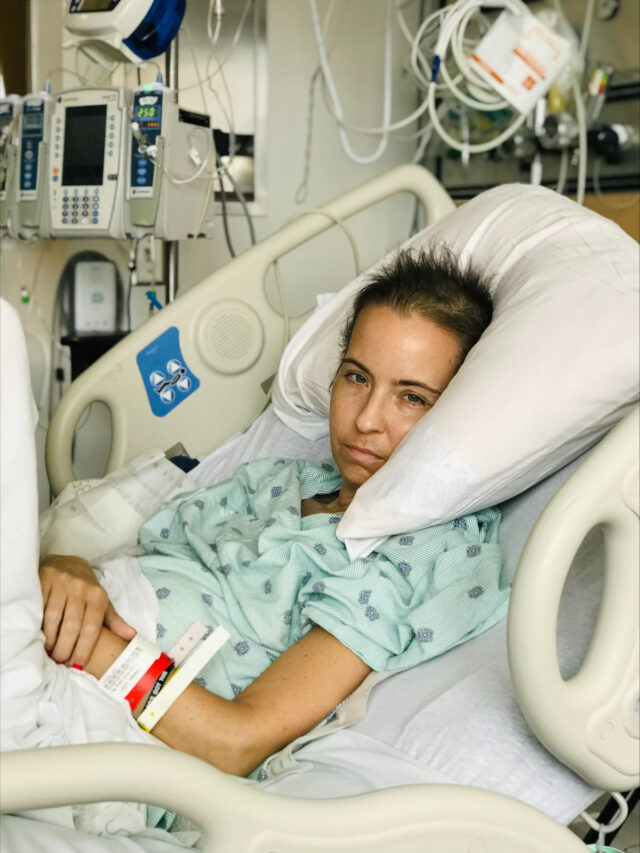
SAN FRANCISCO — It was during some of the darkest days of the pandemic — November 2020 — when Melissa Lawson, 36, was helicoptered from an emergency room in Santa Rosa, Calif., to a hospital here, her blood so thick with white blood cells doctors thought she might not survive the night.
She did, after undergoing a procedure to clear her blood. Diagnosed with acute myeloid leukemia, she got chemo, and less than a month later was in remission. But then her kidneys suddenly stopped working — she’s still not sure why — her lungs filled with fluid, and she was rushed to the ICU, where she coded twice. Her parents were called in (despite strict Covid protocols) to say their last goodbyes.
Lawson survived again, but was in the ICU for 51 days, alone. She battled infections. Her appendix was removed, her bowel resected. Worst of all, she told STAT, was the dialysis she needed three times a week for her acute kidney injury. The sessions left her freezing, nauseous and vomiting, with pounding headaches — and feeling anxious and depressed.
“It’s sad going into a big room where it feels like everyone’s dying. People are moaning and screaming,” said Lawson, a children’s hairdresser who goes by the nickname Liddy. She’d pull her eye mask down and face mask up, wrap herself in a blanket, and try to disappear.
She was told her kidneys would heal. But they didn’t; dialysis became a regular routine. She moved to UCSF Medical Center seeking better care and a place that would allow her parents to visit. There, she met Chi-yuan Hsu, UCSF’s chief of nephrology, who was looking to study patients who might be successfully weaned from dialysis. He believed many patients with acute kidney injury like Lawson stayed on dialysis for longer than they needed.
The results of a new study by Hsu, published Thursday in the Journal of the American Society of Nephrology, validate his suspicions. The study of nearly 8,000 patients, nearly 2,000 with acute kidney injury, found 40% of patients with acute kidney injury recovered their kidney function. But of these patients, just 18% were weaned from dialysis through having fewer sessions, and 9% by having shorter sessions.
More than 70% of these patients ended up eventually stopping dialysis without any weaning — “cold turkey” as Hsu puts it — suggesting they could have been having fewer, or shorter treatments earlier. This is important, he said, because dialysis not only impacts quality of life, as it did for Lawson, it can also lead to infection and heart damage, and possibly — this is still under debate — to additional kidney injury that could inhibit recovery and lead to a need for permanent dialysis.
The study confirms, Hsu and his co-authors said, that patients with acute kidney injury who may be able to stop dialysis (and who make up between 15-20% of new dialysis patients nationally) may be losing the option of timely withdrawal from dialysis because they are treated largely the same as those with end-stage kidney disease who have no hope of stopping dialysis unless they receive a kidney transplant.
It’s not a surprise that the dialysis industry caters to those with end-stage disease; until 2018, patients with acute kidney injury weren’t even categorized separately (or eligible for reimbursement from Medicare). Historically, most either recovered quickly after brief dialysis treatment or, until recent medical advances, died from whatever caused their kidney injuries.
“When the system was designed, these patients were not considered. Then the patients started surviving,” said Hsu. Despite that, he said, dialysis “units are staffed, designed, and structured for end-stage kidney disease.”
Patients with acute kidney injury don’t always get the more frequent lab tests and assessments needed to reveal kidney recovery. The study found only one quarter of such patients received timed urine collections to test their kidney function during their first month of dialysis, something the authors said should be done far more often.
When Lawson learned of Hsu’s interest in weaning patients off dialysis, she eagerly signed on. She went six days, safely, without treatment. For the first time, Lawson said, she felt relatively healthy, and had hope for her future.
Hsu was inspired to start his research on dialysis weaning by one of his previous patients, Marla Levy, who’d been on dialysis after three open-heart surgeries. Hsu examined her and thought her kidneys were healthy enough to work on their own and that she could stop dialysis.
“It was like being told I had won a hundred million dollars in the lottery. It was the best news of my life,” Levy said. The day she had her dialysis catheter taken out, she said in a writeup for UCSF, “is up there with getting married and giving birth to my children.”
Hsu thought Lawson, with her youth, her eagerness to heal, and extremely supportive family was an ideal candidate for weaning. “I think there are people we could take off if we invested the time,” said Hsu. “For these people, it’s an enormous improvement in life.”
But after being transferred from UCSF to a rehab hospital, she was put back on dialysis three times a week because she couldn’t be monitored as closely. It was a huge blow.
Lawson dreaded the side effects and the six hours it took to have and travel to each procedure. She’d return to her room at 10 p.m. to a cold meal on her dinner tray. It didn’t matter, she said, she was too nauseous to eat.
“It could have been a hot 5-star meal and I wouldn’t have been able to stomach it because of dialysis,” she said. She dropped to 87 pounds.
She eventually left the rehab hospital for home after five and half months of hospitalization, with a feeding tube in place and a schedule for dialysis three times a week near her home.
Lawson started making friends with other dialysis regulars. She baked cookies for them and went out for long breakfasts to discuss their interests: the Raiders, the 49ers, trains. “It was my crew,” she said, though they were decades older and mostly suffering from chronic conditions such as diabetes and hypertension. Lawson couldn’t have been a squarer peg.
Still in touch with Hsu, Lawson entered another trial in May of 2022 where her dialysis treatments dropped to two days a week. But she still felt terrible most days, threw up constantly, and felt sad and anxious with no energy for most activities. “I started to feel how am I going to do this forever?” she said, “How will I work and have a family?”
After an unsuccessful attempt at home dialysis last fall, doctors urged her to get a fistula — a kind of “supervein” that makes it easier for patients on long-term dialysis to endure the treatment. She dragged her feet. She didn’t want the fistula surgery, which can be disfiguring, and still thought, despite what the doctors said, that maybe she didn’t need dialysis at all.
At her pre-surgical consult for the fistula this past March, her surgeons were shocked. “Both doctors when they came in did a double take and said, ‘You need a fistula?’” she said. She looked far too young. “They thought I was the patient,” said Lawson’s mother, Debbie, who has attended most appointments and keeps careful track of her daughter’s medical journey neatly written in a 100-page red Oxford composition book. But a round of lab tests shortly before the surgery revealed a turnaround.
Against all expectations, Lawson had been steadily recovering. A few days later, just days after her birthday, Hsu called and told her to cancel the fistula surgery and stop dialysis.
Six months later, she hasn’t had a dialysis treatment. There’s no more nausea and no more depression. She feels strongly that her faith in God played a role in her survival. She is not out of the woods (a phrase she’s come to hate because doctors use it so much) — a bout of pneumonia, for instance, could knock her back into dialysis. But, for now, she’s off the machines and hasn’t felt so good, or so free, for years.
Ian McCoy, an assistant professor of nephrology at UCSF and the study’s lead author, emphasizes that patients should not go off dialysis without their doctor’s OK. It could be a death sentence. “You can fill up with fluid in your lungs. If your potassium and electrolytes are off, it can affect heart rhythms.” On the other hand, he said, staying on dialysis poses its own risks. Just how much? Doctors don’t know.
Acute kidney injury patients have been difficult to study in clinical trials. “These patients tend to be extraordinarily sick,” said Paul Palevsky, a professor of medicine at the University of Pittsburgh School of Medicine and immediate past president of the National Kidney Foundation who has helped conduct such trials.
Palevsky told STAT he has no doubt that some acute kidney patients are on dialysis longer than needed and could be better managed. Perhaps they should have less frequent or shorter dialysis or just stop altogether if their kidneys show signs of recovery. The problem is, he said, no data exists to show what’s best. “There is no right answer,” he said.
Acute kidney patients also differ widely in the pace of their recovery and need for dialysis, he said, adding, “Since there’s no uniform approach, what it requires is careful attention to the patient.”
That’s readily done by nephrologists like Hsu and McCoy, academics who work in a hospital where lab results can be obtained in a matter of hours. It’s much harder, they said, for nephrologists in private practice, who may be monitoring 100 or more patients at a time and not getting timely results.
Palevsky advises patients to be proactive like Lawson was. “Keep asking how your kidneys are doing and if there is evidence of recovery. If urine output is picking up, point that out,” he said.
Hsu and McCoy believe structural issues — from how dialysis is reimbursed to how chairs in dialysis centers are allocated — may be keeping patients in dialysis too long.
The for-profit dialysis industry has come under scrutiny over concerns that a focus on cost-cutting has affected quality of care. A study last year found that home dialysis is used much less frequently in the U.S. than in other countries, and questioned whether financial incentives played a role.
While the current paper did not analyze economics or suggest that financial motives keep patients on dialysis schedules heavier than they need, McCoy said it’s likely money plays some role. “Units are set up on a three-day-a-week schedule. You have [dialysis] one day a week, a chair is empty. Who’s going to take that?” he asked.
Nephrologists are paid less to see patients who are not on dialysis, despite the complexity of their cases, he noted. And more frequent lab tests can raise costs. Fistulas are promoted because dialysis centers can get penalized if too many of their patients have catheters, due to the risk of infection.
But providers may also want to keep patients on dialysis for the support they receive from social workers and nutritionists while in treatment. There may also be a comfort level for physicians dealing with patients who are very ill. “If someone’s on dialysis, you know they’re pretty safe,” said Hsu.
Hsu isn’t calling for a radical revision of dialysis care. But he does want to get word out that his fellow nephrologists should be on the lookout for patients like Lawson. That’s the message he’ll give at a talk at the annual American Society of Nephrology meeting in November. “My message is don’t do anything different right now, just be more vigilant,” he said.
Hsu and McCoy agree more research is needed. Studies like the one released Thursday — looking closely at the records of dialysis patients — have been difficult because the large for-profit dialysis centers have not generally shared such data. This study was possible, they said, because of the cooperation and financial support of Satellite, a mid-sized nonprofit dialysis provider with 70 clinics based in San Jose, Calif.
Wael Hussein, a nephrologist and chief medical officer for research and development at Satellite and a co-author, said the study highlights a “gap between the expected level of care and what is being delivered” and “should be a stimulant for more research to develop solutions to improve care.”
He said part of the problem was dialysis centers not receiving timely information from hospitals about patients so they can better tailor treatment. “A lot of information you need to manage patients, you just don’t get,” he said. The Centers for Medicare and Medicaid Services should also allocate more funding for the care of acute kidney patients on dialysis, he said, since they require more resources, such as more frequent testing.
Lawson still has serious kidney disease and she’ll always be under surveillance for a return of her cancer. But she couldn’t be happier. Her bone marrow biopsies have been clear for three years, her feeding tube is out, her weight has climbed back over 100 pounds, and she’s back to playing with her dog Tucker. She recently went on a month-long road trip across the U.S. with her family and is training for a walking marathon.
She’s happy to share the details of her case in hopes it will help others, she said during an hours-long interview within sight of the 11th floor of the UCSF Medical Center where she spent so much time. She said providers need to work as hard as possible to take people off dialysis who no longer need it — and give them their lives back.
“They don’t realize how difficult it is,” she said as she rubbed the small raised reddish welt near her shoulder where her dialysis catheter used to be.