

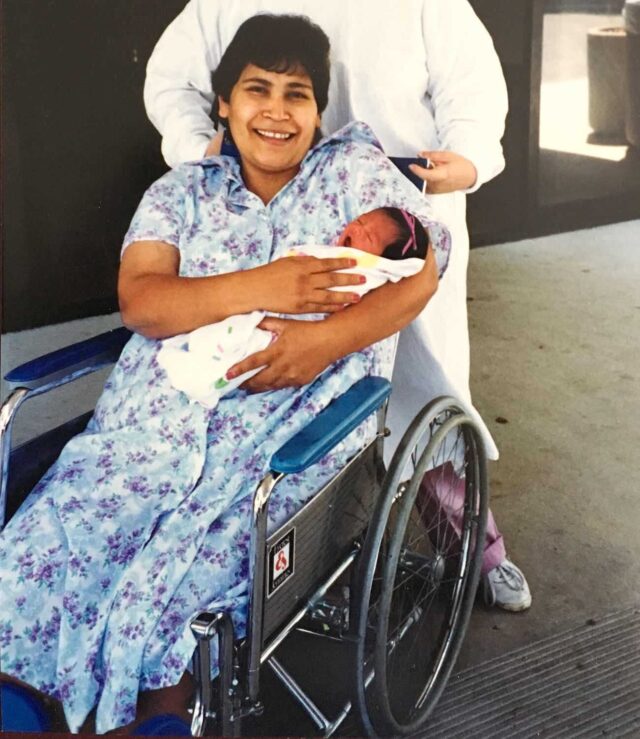
The research question that pursued Jessica Valdez, an OB-GYN resident physician at the University of California, San Francisco, stemmed from her mother’s womb: How important is it to a birthing woman’s experience to be seen by health care providers who share her primary language?
Valdez’s mother was 17 when she immigrated to California from Mexico in the 1970s. She didn’t speak English “and had no idea what normal labor and delivery is supposed to look like because she was practically alone here,” Valdez explained.
The details of her mother’s labor with her firstborn son are fuzzy, but one fact was clear: Her mother was unable to fully dilate to 10 centimeters. Her clinicians likely recommended and administered a C-section. Throughout her hospital stay, her mother never encountered staff who spoke Spanish with her. That meant post-operation, no clinician prepared her to take care of herself after a major abdominal surgery, or when to return to the hospital for any warning signs of an infection, Valdez said.
“So my mom ended up getting a pretty bad surgical site infection, and she didn’t know,” Valdez said. She didn’t seek medical attention until one of the women whose houses she cleaned took one look at Valdez’s mother and said she had to get to a hospital.
There, clinicians administered antibiotics. Had she waited any longer, the doctors told her, the infection would have spread to her whole body and she would have gone into septic shock.
“That story makes me very angry,” said Valdez. “And it motivated me. It’s one of the reasons why I decided to go into obstetrics and gynecology, because I just wish I could have been there for my mom as an OB-GYN Latina Spanish-speaking doctor … from the beginning.”
It’s also one of the reasons she and colleagues published a study in late March that found that being a primarily Spanish-speaking woman makes you much more likely to experience discrimination during labor — but much less likely to feel pressured to get certain medical interventions.
The researchers looked at 1,202 women who self-identified as Latina in the 2016 Listening to Mothers in California survey, a statewide representative sample of women who gave birth in hospitals. Adjusting for other demographic, maternal, and neonatal factors, they analyzed the association between primary language and perceived discrimination due to language differences, perceived pressure for medical interventions, and perceived mistreatment during labor. They found that, compared to monolingual English speakers, Spanish-only speakers were significantly more likely to report language-based discrimination. Bilingual Spanish-English speakers reported experiencing some language-based discrimination, though less compared to monolingual Spanish-speakers.
But primary Spanish speakers were much less likely to perceive clinicians pushing them to induce labor or get a cesarean section, and there was no significant link to verbal or physical mistreatment during labor — findings the researchers weren’t expecting. The medical literature suggested otherwise.
The study, published in BioMed Central Pregnancy and Childbirth, is only the second to look at language or limited English proficiency status and the quality of intrapartum care, and the first to do so among primarily Spanish-speaking Latinas based on their reported experiences.
“This surprises me, that they didn’t find a correlation between language and feeling like people were pushed into certain interventions,” said Stephanie Turcios, a third-year medical resident of obstetrics, gynecology, and reproductive sciences at UCSF, who was not involved in the study. “Because specifically in my family, I’ve experienced it where, not speaking the same language, family members have decided to pursue a certain treatment without really understanding the risks, the benefits, or alternatives.”
Results from the study are not necessarily generalizable to Latinas outside California or to other nationalities and cultural contexts — as the authors note, Latinas are not a monolith. Yet similar experiences abounded among the intrapartum care experts STAT spoke with and the diverse Spanish-speaking populations they’ve worked with over the years.
Being bilingual
Turcios, the daughter of Honduran immigrants, belonged to a family that was uninsured and with adults who only spoke Spanish. So she became the family interpreter. Later, striving to be part of the change in her field, Turcios noticed obstetricians and gynecologists treating primarily Spanish-speaking women differently — taking on “a more paternalistic approach … being more short when it comes to discussing all the options and presenting what they think is best for the patient, and not thoroughly consenting patients.”
When she became a birth assistant at age 17, then a nurse-midwife and women’s health nurse practitioner in 2018, Kateryn Nuñez noticed the same issue with women regardless of their primary language; they didn’t understand what ailments they had, what procedures were being done to them, or what medications they were on.
“It’s not new, and it’s not just my experience that providers don’t have the time nor the training in how to educate their patients properly,” said Nuñez, a Dominican woman from the Bronx. “And that’s in their own native English language, let alone when it comes to people who speak a different language.”
When it comes to Spanish, Nuñez points to inadequate interpretation as just one way health care providers fail to provide proper care for women. While she’s a native Spanish speaker, Nuñez never received medical Spanish-language training. She developed that skill over time. But she recalls being asked to interpret for patients while working in hospitals and clinics despite her lack of medical Spanish vocabulary.
Often, the task of interpretation falls to English-speaking children.
“And that’s not just a ‘me’ thing,” she said. “That is all the experience of any person who has a Spanish-speaking parent, that they are the translators. And despite the fact that getting a Spanish-language translator on the phone is the quickest, fastest language you’re going to get a translator to be able to speak — [for clinicians] that’s time-consuming.”
Annette Perel, a birth and postpartum doula who practices in New York City, has seen poor care impact her clients of Latin American descent, including those who are bilingual. For instance, one of Perel’s clients, a Brazilian woman who spoke English fluently, complained about the way clinicians acted as though she didn’t understand what they were saying, like when she declined to take tests they usually run. They set up the appointments for sonograms anyway. She didn’t show up for them, and after the doctors delivered her baby, they called child services on her, Perel said.
“When we’re talking about patient experience, a lot of that is dependent on how the health care system perceives you,” said Diana Robles, a maternal-fetal medicine specialist at UCSF who was not involved in the study. “So if you are someone who’s fluent — say your health care team sees you with your family or with your partner, and you’re primarily speaking Spanish to each other, the team in that moment perceives you as a non-English speaker and they don’t necessarily recognize your bilingual skills.”
Why Spanish-speaking mothers might feel less pressure
The study authors have a few theories to explain why women who primarily speak Spanish seemed to perceive less pressure for interventions during labor. One is that if providers are unable to communicate with the patient, then it’s nearly impossible for them to place pressure on the patient, or at least for the patient to perceive that pressure.
A second theory is the Latina birth paradox, which shows that foreign-born women of Latin American descent tend to have better health and birth outcomes, such as a lower incidence of low birth weight, than subsequent generations. If primarily speaking Spanish is a proxy for being foreign-born — though not 100% the case, as the authors note — then the Latina birth paradox would mean that clinicians have less of a need to place pressure on these women with better birth outcomes because they’re less likely to need an induction or C-section, the authors explain.
Yet a third theory about the significantly lower reported rates of perceived pressure among Spanish-only speakers taps into a cultural phenomenon known as marianismo. This belief that Latinas, particularly those of Mexican descent, tend to uphold gender norms like submissiveness and passivity could lead to such Latina patients failing to feel pressure they would otherwise perceive.
“The idea is that if a provider were to be giving a recommendation for a certain intervention that, because of the culture, they’re like, ‘Oh, this is what my doctor is recommending. Then I’m gonna do it,’” Valdez said, noting that this might be true only for one particular subset of Spanish-speaking Latinas.
Race as a factor in Latina birth trauma
The study, while well-designed, uses data that don’t fully reflect the diversity of Latinas, including racial differences among Spanish speakers, according to Robles. For instance, Afro-Latinas’ experiences across language and racial barriers in the U.S. aren’t like those of white Latinas.
Perel, the doula, who is Afro-Latina and Panamanian, recalls two distinct realities around childbirth: the joyful event her aunt and grandmother would get excited over abroad, and the birth trauma her mother experienced with Perel’s birth in New York.
While Perel wasn’t her mother’s first or largest baby, surgeons gave her an episiotomy, cutting the opening of her vagina during labor to aid a supposedly arduous delivery that Perel suspects wasn’t so difficult. They didn’t ask for consent. Around the time of her birth, “that’s what happened to every woman. They got episiotomies, whether they needed them or not, because doctors needed to practice,” Perel explained, referring to the late 1970s and 1980s, when the procedure was performed in about 63% of deliveries in the U.S.
“Here in the U.S., it’s like we have to talk about birth in a way that’s so traumatic,” Perel said. “I didn’t grow up with my birth being a good birth experience.”
The distinct lens with which Latina and Black women, in particular, see birth in the U.S. versus abroad are starkest when race compounds ethnicity, language, and gender in expecting women. The business of birthing in hospitals is to blame, according to Perel — as long as the U.S. health care system incentivizes OB-GYNs to administer C-sections, as long as dollars go to surgeons for tasks that midwives traditionally did and are sometimes better equipped to do, and as long as doctors don’t look and speak like the marginalized women they treat, there won’t be real change, she said.
“It’s like systemic racism — it’s so interwoven into the fabric of what the medical industrial complex is, and they’ve tricked the people into believing that they don’t have the power when they do,” Perel said. She pointed to research that shows that the mere presence of a doula in a hospital room with low-risk women in labor significantly cuts the odds of these women getting a C-section.
It was the death of yet another Black woman — Sha-asia Washington — during childbirth that “struck a chord” in New York City-based Eugenia Martinez. “I just was so confused,” she said. “How do you go somewhere, and you think it’s gonna be the happiest day of your life, and you die?”
She quit her corporate job in operations the next day.
Empowering other birthing women
The news put Martinez on a path to becoming a doula in July 2020. Now, the founder of the organization Mujer Fuerte Doula leverages her social media accounts often to raise awareness about health care for women of color. Like so many others whose mothers were Spanish monolingual speakers in the U.S. health system, Martinez’s mother had a traumatic birth story. She had two C-sections at an older age, including at age 41, when she gave birth to Martinez.
“It was completely fear-based, every decision that she made,” Martinez said. “In order for you to give informed consent, you have to be operating from a state of, ‘OK, I know all of my options. All of the information is being presented to me in a way that I understand.’ … With my mom, … if she actually had all of the options presented to her, maybe things would have been different.”
It’s a lot more empowering when women giving birth can make their decisions from the vast information available, “not [by] being coerced or lied to, or manipulated by, the medical system, which sometimes happens, especially with women and people that do not speak English as a first language,” she said. Martinez, like Perel, translates her educational materials, and refers clients who primarily speak a language other than English and Spanish to a doula who does speak their dominant language. Doulas, after all, can help women advocate for themselves through prepartum, intrapartum, and postpartum care.
“You just had your baby, whether you had a traumatic experience or not. The last thing you’re doing is writing a letter to the hospital, [which] is exhausting,” Perel said. “You’re dealing with raising your child, healing. … We’re asking people to be advocates, and during a time of their life when they should be enjoying being pregnant, excited to meet their new baby … That’s not fair.”
When her study was published, Valdez presented the research over a Zoom call where she showed the class a picture of her mother holding her in her arms as a newborn. Later, Valdez and her mother had a crying session when she shared the news with her in Spanish.
“She always tells me, ‘M’ija,’ everything that she does is for her kids,” Valdez said. “She never expected to have such a tremendous impact through her kids, and she just is baffled that other people are benefiting or potentially getting her little nuggets of wisdom … in ways that she never imagined. And I think that that’s really beautiful.”
Correction: An earlier version of this story incorrectly stated that Martinez was born in the Dominican Republic.