

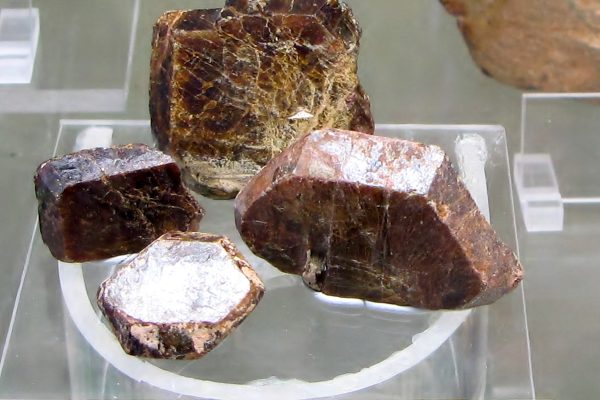
Rare earths are not rare; they’re also not earths. A geology joke for you should you need one over the holiday season. Yet within that misnomer is also what all too many get wrong about the industry. Yes, it’s true that rare earths are essential to many things, including this brave new world of renewable energy systems. We would find it very difficult – not impossible, just difficult – to make electric vehicles and wind turbines without using the “magnet metals.” It would be impossible to make an MRI machine without lutetium; camera lenses would be worse without lanthanum. I could continue across the varied uses of the 17 rare earths – the 15 lanthanides plus scandium and yttrium.
My particular favorite is scandium, for which I handled, for about a decade, 50 percent of the world’s usage – all couple of tonnes a year of it back then. Having me in that role might have been a mistake; I once told Elon Musk of Tesla and SpaceX fame that he didn’t need to bother using scandium in his rockets (which is true, but not a business-enhancing thing to say).
But it is the lanthanides that really concern us politically and economically these days. The crucial thing to understand about them is that, along with not being rare (or earths), finding them really is not a problem in the slightest. It is processing them that is difficult.
The industry as a whole is perhaps 200,000 tonnes a year globally, worth well under $10 billion. For a group that is approaching 20 percent of all the natural elements we know about, that is pretty small. In part, that’s because the material applications of the rare earths are relatively new (unlike metals like copper and iron, which we’ve been playing with for millennia). Serious research into the rare earths as individual elements didn’t really start until the 1940s, and entirely new applications are still being found.
That the industry is small and newish also explains why China has such an important hold on it. China accounts for 80 percent or so of current production, and it was 95 percent only 15 years back. There’s little about the geology of that country that explains this concentration; it’s much more a matter of simply being willing to work at it, and to provide all the world wished to consume at a price it was willing to pay.
This got a little tested back in 2010 when China decided to limit exports – allegedly for environmental reasons, more likely for trade manipulation. The global reaction was simply to fire up production outside China, and prices fell back below their starting point within a handful of years. It’s not possible, obviously enough, to exert trade pressure on metals that anyone can gain a supply of simply by being willing to go digging.
But that doesn’t mean China lacks all leverage. As with lithium, China’s dominance of the rare earths industry is more problematic in the processing department. China has a supply chain that the rest of the world doesn’t, some decades of learning by doing, and so on. It’s entirely possible to catch up, but it will take effort. However, to do so it’s necessary to grasp where the difficulty is.
A supply of minerals containing rare earths is easy enough to find – there are byproducts from a number of other industrial processes (phosphogypsum from fertilizer production, industrial sands for titanium and zirconia) that contain them. True, often along with a bit of radioactivity, but this can be dealt with, environmentalist hysteria aside. Alternatively, there are more difficult but still feasible ways to find ores without that specific problem. So what’s the problem?
We tend not to use rare earths for their chemistry but for their physical attributes – refraction of light, magnetism, and so on. But we use chemistry to separate elements – which is difficult as chemistry depends upon the number of electrons in the outer shell of the atom. Rare earths have that same number there – it’s the inner shells where they differ. That might sound a little in the weeds for a diplomatic magazine, but it gives us our essential problem. Rare earths aren’t rare – but they’re a right damnation to separate one from each other.
Every mine product is a mixture of all 15 of those lanthanides. To gain the characteristics we want – that magnetic effect for example – we have to separate them.
I – or even someone competent – could get you hundreds of tonnes of rare-earths-containing minerals for near nothing. Even a proper concentrate might be dollars per kilogram. But the separation cost is $15 to $20 per kg material, in a plant that usually costs around $1 billion to build.
This is where we get to our economic problem: If the global market is under $10 billion a year, then how many billion-dollar plants will the global market support? Not many, is the answer.
The Western world largely stopped bothering about rare earths given China’s ready supply. Now with China increasingly viewed as a political rival – and thus an unreliable economic partner – we’re all a bit more interested. This has meant a lot of exploration into different mineral sources. We’ve found out, for example, that “ionic clays” (which give us goodly supplies of the two rarest of the magnet metals, dysprosium and terbium) are not unique to south China but exist in many granites weathered in subtropical climes. I’ve noted a dozen companies claiming such deposits on the Australian stock exchange this year alone and know of others on other markets too.
In other words, now that we’ve needed to – or desired to – go looking for alternative sources, we’ve found lots. There is no public, political, response required here.
However, that separation problem, that could do with being solved. There are a number of ways this could be conceptually be done. They’re all variations of physics, not chemistry, which is why the mining industry isn’t good at them used as it is to using chemical methods of extraction and separation. They’re all, also, in the realms of desk and lab research, not industrial rollout – and that sort of pure research is exactly the kind of public good that we institute government and taxation to gain.
There are subsidies going into rare earths, vast sums in fact. Both to open mines, something that simply isn’t needed, and to build separation plants using the current technology – something that might not be needed. Hundreds of millions of public money is being thrown about, in fact. Yet a government that spent – just to invent a number – $20 million in no-strings $500,000 research grants to investigate different separation technologies would probably do more good. Finding a new method would solve the basic rare earths problem, the cost of separating them. Finding out that there is no new method would also be useful even if not quite so much.
The free market, laissez-faire, argument about government subsidies can be a moral one, but it can also be pragmatic. When other peoples’ money does start to be thrown around, then not enough thinking goes into who gets it and why. The rare earths problem is in those separation plants, in the base technology that is used. Therefore any subsidy should be channeled into how we might do that differently – which, sadly, isn’t happening which rather proves that laissez-faire case.
If we’re to spend public money to diversify rare earth supply chains, then it should actually solve the problem. The rare earths problem is the basic technology of separation plants; that’s where the public money should go.