

The cold calls and text messages started arriving on Jan Van Winckel’s phone a couple of months ago, and they have not stopped. They come at a rate of about 10 a day, he said, a steady stream of hope-you’re-wells and long-time-no-speaks from old acquaintances, archived contacts, friends of friends of friends.
The bromides change but the brass tacks are the same. Van Winckel, 49, now works in the United Arab Emirates, but he has spent a good portion of his career in soccer in Saudi Arabia, serving as both a coach and the technical director of the country’s national teams.
That is what makes him valuable to agents, brokers and executives pinging his phone, over and over, all asking for the same thing: an introduction to a Saudi club president, a connection to an official at the Saudi Pro League, the phone number of someone, anyone, who might be able to help them stake their claim in soccer’s new gold rush.
In the first week of June, Saudi Arabia’s soccer authorities and its sovereign wealth fund announced an audacious plan to transform the game in the kingdom: The Public Investment Fund, they announced, would take control of four of Saudi Arabia’s most prominent teams, and hundreds of millions of dollars would be made available to buy some of the game’s biggest stars. And in that moment, even before the first checks were cut, the Pro League became one of the most appealing destinations in the world.
Just as with its interventions in golf, boxing and a host of other sports, the rationale offered by the Saudi authorities focused on public health benefits, the need to diversify the country’s economy, a desire to help wean it from a reliance on oil. Outside, a more cynical explanation took hold: This was just another attempt by the country’s autocratic leaders to hide its abysmal human rights record behind sport’s gilded drapes.
Soccer, though, did not waste time wondering about the whys and wherefores. Instead, the sport — or rather, the web of agents and intermediaries, fixers and middlemen who operate in the game’s opaque player trading industry — did what it always does when there are deals to be done and money to be made. It got to work.
Maelstrom
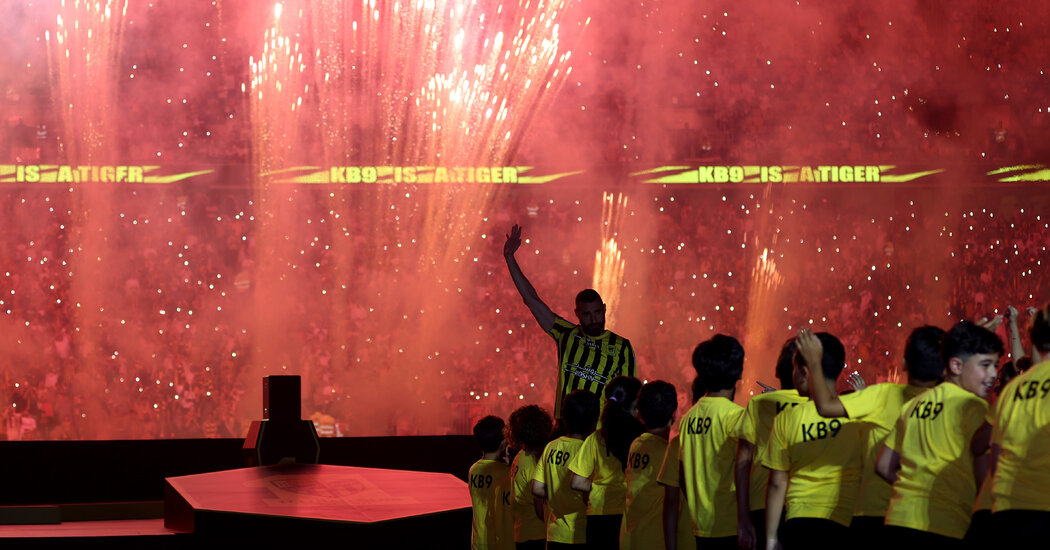
It did not take long for Saudi Arabia’s bold vision of the future to bear fruit. A couple of days after the Public Investment Fund’s announcement, Karim Benzema — the reigning Ballon d’Or winner — was on a private jet to Jeddah, where he would sign with Al-Ittihad. In the weeks since, a half-dozen other pros who played in Europe have followed, among them N’Golo Kanté, Rúben Neves and Roberto Firmino.
That is probably only the start. Saudi Arabia’s sports ministry has reportedly set aside about $800 million to beef up the league’s rosters this summer, with the aim of making at least 18 high-profile signings. Philippe Coutinho and Jordan Henderson may join Al-Ettifaq, now coached by the former Liverpool and England star Steven Gerrard. The Colombians Radamel Falcao and James Rodríguez and the Brazilian midfielder Fabinho are considering lucrative offers, too.
The speed at which the Saudi league has been able to cherry-pick such familiar, if fading, names from Europe’s elite clubs has made the country’s ambition feel like an inevitability. In conversations with two dozen agents, coaches, officials and executives with firsthand experience of Saudi Arabia’s transfer dealings this summer, a very different picture emerged.
The Saudi intervention, as one agent put it, has unleashed a “free-for-all” in soccer’s transfer market. An executive at a major European club described the last few weeks as “chaos.” Like most of the people interviewed for this article, they agreed to speak on condition of anonymity because they were not permitted to discuss commercially sensitive matters publicly.
And it is not just Van Winckel who has been inundated with requests in the search for contacts. Staff members at Saudi clubs have been “bombarded” by unsolicited connections on their LinkedIn profiles, several said. Agents with relationships in the country have been pressed for information and introductions.
Clubs in Europe, meanwhile, have been contacted by fixers with dubious claims to represent Saudi teams. Major agencies have found their inboxes clogged with apparent offers for their players from Pro League teams. At least one has had to spend hours performing due diligence on each approach, trying to separate the genuine from the spurious.
Even current and former employees at Newcastle United — the Premier League team majority owned by the Public Investment Fund — have found their phones unexpectedly busy. Some calls come from agents with players to hawk. Others are from teams desperate to offload their surplus to Saudi Arabia. Far too many come from self-appointed rainmakers of indeterminate credibility.
Nobody, though, has been quite so affected by the maelstrom created by Saudi Arabia’s vision of the future — either carelessly or inadvertently — as the Saudis themselves.
Going Rogue
It took months for the Saudi Pro League, the Ministry of Sport and the Public Investment Fund, or PIF, to draw up a plan to change Saudi soccer. External consultants, paid princely sums for their advice, were hired to make sure the venture felt “authentic.”
The country did not, it made plain, want to repeat the myriad mistakes made by the Chinese Super League in its brief, dazzling moment in the sun in 2016. The intention, as with many of the projects linked to Crown Prince Mohammed bin Salman’s Vision 2030 program, was to build something sustainable.
Saudi Arabia’s teams are among the best in Asia, but many of them have only the loosest internal structures. Few have sophisticated recruitment departments: For years, they have been “passive” purchasers, one executive said, reliant on agents to pitch players to them.
The clubs’ finances, too, can be surprisingly fly-by-night. At one point this season, Al-Ittihad — now home to Benzema and Kanté and their nine-figure contracts — failed to pay some of its employees for three months. Even as those recent signings were being announced, the club had not yet fulfilled its bonuses for what had been a title-winning campaign last season.
Several of those issues remained unresolved as a fresh wave of stars was starting to arrive in Jeddah and Riyadh. Until the cases are settled, the accused clubs cannot register their showpiece signings on the FIFA mechanism that authorizes cross-border transfers.
The Saudi authorities, then, realized that they would have to oversee player recruitment directly. The government would provide the money — as a gift, rather than a loan — but the league would have some central control over how it was spent, in order to make sure it was used to help the competition improve.
“They are very smart,” said Van Winckel, who remains in contact with many of the executives tasked with implementing the new vision for the league. “They are not just splashing money around. There is a strategy.”
To that end, the Pro League issued its clubs a list of a couple dozen recommended signings, mainly players in their early 30s, many of them out of contract at European teams, and a set of relatively simple ground rules.
Any player commanding an annual salary of more than $3 million would have to be approved by the league. Teams were not to negotiate against one another, and any player found to be using one team as a bargaining chip to elicit a more lucrative salary from a rival would be immediately blacklisted. The teams were urged to think collectively. The idea of appointing a sporting director to work across the league as a whole was suggested. The role may soon be handed to Michael Emenalo, who once held that post at Chelsea.
For the time being, though, the clubs were granted a degree of autonomy. They would be able to pursue the targets they felt best suited their needs. They would not have to accept players against their wishes.
Al-Hilal, for example, one of the four clubs slated to be taken over by the PIF, elected against signing Luka Modric when it became clear he would consider only a one-year contract. (Most of the deals being offered run for three years, ensuring that players who sign will be in Saudi club colors in the run-up to the 2026 World Cup.)
It did not take long, though, for the opportunists who populate the shadier corners of the transfer market to spot the cracks in the system. Saudi executives, unaccustomed to the active pursuit of players, found themselves flummoxed by the sheer number of agents claiming an exclusive mandate to negotiate on behalf of clients or to act as the sole representative of a European club.
At the same time, the league found that its valuations at times varied wildly from those of its team presidents, who were apparently more than happy to use government money to pay well above market value. When Al-Hilal submitted a bulk offer for five Chelsea players, officials privately fumed at what they perceived to be a massively inflated fee, one that might drive up prices elsewhere.
Within a couple of weeks, the league realized it needed to change its approach, to find a way to impose some sort of order on the chaos. The job of doing so would fall to an official who had built an influential, if low-profile, career in Saudi sports. That man, Saad Al-Lazeez, was about to become arguably the most important person in European soccer.
Receipts
One of Van Winckel’s tasks after taking on a post as the technical director of the Saudi Arabian soccer federation in 2015 was to arrange a tour of a handful of major European clubs. He took, as his guests, a number of officials from the federation and a couple of team presidents. The aim was to see what Saudi Arabia could learn from Europe’s most famous talent factories.
Van Winckel booked the hotels, organized the visits and arranged the travel. Although he was traveling with influential Saudis accustomed to a certain standard of luxury, he made a point of operating on what he describes as a reasonable budget. “We were not in five-star luxury hotels,” he said. “It was nice, but we did not have Mercedes drivers or anything. I drove myself from Dortmund to Ajax, for example.”
It was a good decision. At the end of the trip, Van Winckel not only gave a detailed presentation to a hundred or so staff members at the Saudi federation, showcasing what he and his cohort had learned, but he also submitted a full set of receipts for the trip.
He had been sent by Prince Abdullah bin Mosaad, the minister for the General Sports Authority, the precursor to the Ministry of Sports. But it was his vice president for technical and investment affairs who signed off on the expenses: Al-Lazeez.
Al-Lazeez has taken the same fastidious approach since replacing a British executive, Garry Cook, as chairman of the Saudi Pro League in May. Colleagues describe him, variously, as urbane, effective and smart. His English is “impeccable.” He is, as Van Winckel put it, “someone who thinks in the macro.”
Precise biographical details, though, are scant. Al-Lazeez is said to be an ardent N.F.L. fan. He has, according to a Pro League statement, a master’s degree in project management from the University of Liverpool. He has had spells as the Pro League’s chief executive and vice chairman, too, and has had places on the boards of a number of European teams owned by Prince Abdullah, including Sheffield United.
Quite how much any of those roles prepared him for his current task — managing the flow of hundreds of millions of dollars and the acquisition and dispersal of some of the world’s best soccer talent — is unclear.
At Sheffield United, he helped allocate the budget and assess performance, but staff members at the club during his yearlong spell as a director do not recall him helping with player recruitment or attending board meetings. This summer, then, his learning curve has been steep.
In an attempt to streamline the Pro League’s attempts to sign players, Al-Lazeez relocated to Europe. Splitting his time among London, Paris and Spain, he did all he could to cut through the noise and keep Saudi Arabia’s carefully curated plans on track.
As such, access to him is tightly controlled. He deliberately maintains a low public profile, including to the news media, and did not respond to requests to be interviewed for this article. To obtain a meeting, agents claiming to represent a player must produce either a printed mandate or, better, the player himself, in flesh and blood. Al-Lazeez does not want to talk to middlemen. The policy, one agent said, is “only to go direct.”
Even the most powerful agents in European soccer have been told that the Saudis will be in touch if one of their clients is required. There will be no preferential treatment for one stable of players over another, a key lesson that the Saudis have taken from the Chinese experience.
Instead, two European agencies have been unofficially appointed to act as his Sherpas through the morass of misinformation in the market, to make sure Al-Lazeez can pitch straight to the players what the league and its clubs want. His focus is on players who can “help develop the league,” an official close to the league’s management said. “They have to complement the master plan.”
It is Al-Lazeez, now, who ultimately controls access to the Saudi market. He chooses which players, which agents and which clubs profit from the gold rush.
He is the person all of those people — the agents and the intermediaries, the fixers and the fantasists — must talk to if they are to stake their claim. His is the one phone number everyone wants. For most, it is the one number they will never get.