

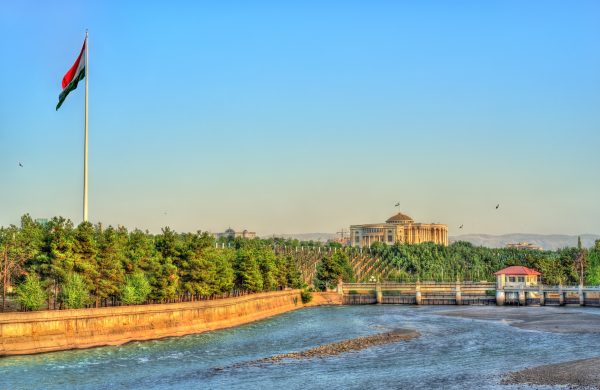
Reflecting on the Soviet Union’s collapse 32 years ago and attempting to draw any sort of conclusion is often a matter of perspective. In his new book, “Moscow’s Heavy Shadow: The Violent Collapse of the USSR,” Dr. Isaac McKean Scarborough, an assistant professor of Russian and Eurasian Studies at Leiden University, writes of the collapse from one of the Soviet Union’s most distant peripheries — Dushanbe. In doing so, he highlights a perspective not often taken into account in Western understanding of the collapse, charting how Moscow’s reforms — glasnost and perestroika — played out in the far-flung Tajik context and ultimately resulted in rapid change, economic collapse, and violence, as they did elsewhere.
But the violence did not end with the collapse in Tajikistan. As Scarborough told The Diplomat’s Catherine Putz, “In Tajikistan, moreover, this collapse was made longer and more visceral by the civil war that followed, and I think we need to keep in mind that for the majority of the citizens of Tajikistan, there is no clear line between the two. The collapse of the USSR became the civil war; one moved smoothly and quickly into the other.”
In the following interview, Scarborough explains the state of affairs in Soviet Tajikistan in the years leading up to the collapse, discusses the effects of reforms on the Tajik economy, the republican government’s reliance on and loyalty to Moscow, and how Tajikistan continues to wrestle with the unresolved tensions of the late 1980s and early 1990s.
Your book “Moscow’s Heavy Shadow: The Violent Collapse of the USSR” focuses on the collapse of the USSR from one of its most distant peripheries: Soviet Tajikistan. In this corner of the Soviet Union in 1985 as Moscow was starting to push reforms you note that “Tajikistani politicians and average citizens alike” viewed the Soviet economic and political system with a “modicum of satisfaction.” For readers who may be surprised by that assessment, can you explain what you mean?
I think there is a general feeling in the West that life in the USSR was fundamentally bad – poor, dirty, devoid of modern amenities – and that most Soviet citizens essentially wished for the Soviet system to collapse. But this really wasn’t the case. Although significantly falling behind European or American standards of living, life in most parts of the USSR was in fact quite decent by the 1970s and 1980s. As the economic historian Robert Allen has shown, for example, if compared to almost any country outside of Europe or the “West,” the economic outcomes achieved by Soviet citizens in this period are amongst the world’s best. Dissatisfaction, then, was driven not by actual economic degradation – but rather by the sense that life was no longer improving by the late 1970s in ways that it previously had. And in Moscow, or Leningrad, or perhaps Kiev, this was true: Soviet economic life had reached a certain plateau, beyond which the state seemed unable to provide much more in terms of goods, or services, or basic entertainment.
For people in Tajikistan, however, this saturation point had not yet been reached. Life into the mid-1980s was continuing to improve, and the basic amenities of life, such as refrigerators, or cars, or air conditioning units, or children’s theaters, were still spreading and providing tangible and real improvements to standards of living. There were, of course, endemic problems – from the lack of housing available in cities to the cotton monoculture retarding economic growth to Tajikistan’s pitifully low standing in the USSR – but there was no denying that life was all the same getting better, year after year. And this, I think, is what drove the general sense of sanguinity: it wasn’t that things couldn’t have been better – they certainly could have been – but that as it was, the system worked, and there was no obvious reason to change it.
How were Gorbachev’s reforms — glasnost and perestroika — carried out in Tajikistan? What were some of the initial economic and political consequences of the reforms?
One key distinction that should be made between “perestroika” and “glasnost” is that these were legally quite different processes, although in retrospect we tend to clump the two together. Perestroika, in the sense of economic reforms meant to restructure the Soviet Union’s enterprises and consumer sector, was made up of a series of laws that changed the rules governing state-owned production and private enterprises. Glasnost, on the other hand, constituted a more amorphous series of changes – legal amendments changing the legislative system in Moscow, but also informal directives and administrative shifts in policy and tone that were aimed at fomenting criticism of the Communist Party of the Soviet Union and promoting social change.
Perestroika’s legal backing meant that changes to production and enterprise activity were unavoidable, and the leadership of the Tajik SSR had no choice but to implement them across Tajikistan. Loyal to Moscow, they did so very thoroughly, which led to factories lowering production (to save roubles), private businesses being founded, and, by 1989, the initial signs of recession.
With glasnost an administrative policy, however, there was much more room for local interpretation. Individuals like Kahhor Mahkamov, the leader of the Communist Party of Tajikistan in the late 1980s and a generally conservative figure, used this to their advantage, avoiding any criticism of the state and promoting their own candidates in the new electoral system. When change did occur in terms of political liberalization, it was often the result of direct intervention from Moscow: when Gorbachev’s advisor Aleksander Yakovlev visited Dushanbe in 1987 and caused a local Communist Party shakeup, for example, or when he later helped to push through Tajikistan’s Law on Language in 1989. But the overall situation in Tajikistan by 1989 and early 1990 was both paradoxical and confusing: on the one hand, perestroika’s reforms had led to economic change and even inflation and recession, while on the other the republican government was avoiding glasnost as much as possible and trying to pretend like life was continuing as before.
In Chapter 5, you discuss the unexpected and bloody riots that took place in Dushanbe in February 1990 and remark that “the idea that the events could have been spontaneous or uncontrolled is frequently dismissed outright.” I see parallels to that in modern Tajikistan, and elsewhere in Central Asia. Why do you think it’s so difficult to digest the idea that a situation, or a series of cascading events, might not have some specific hand behind them?
There’s an understandable temptation, I think, both in Tajikistan and elsewhere (and in fact in the West, too), to find a simple and identifiable cause of political violence or negative political outcomes. And it’s always much simpler to point to particular “bad actors,” or “organizers,” or “outside forces” directing the actions of crowds, rather than to pick apart the motivations of the many people involved and the ways in which their actions came together to instigate violence. This also helps to avoid giving legitimacy to the motivations of those involved, which is emotionally easier – we don’t generally want to justify violence, or to ascribe violent motives to average citizens. So instead of considering how economic recession or the loss of jobs can lead to frustration, mass action, and ultimately violence in a collective way, we blame some unseen individuals. Someone lied to the rioters, someone misled them – they themselves are not to blame, nor do we have to deal with their actual motivations or frustrations.
Immediately after the February 1990 riots, this was the dominant discourse in Dushanbe about the riots: from all sides, politicians found it much simpler, emotionally preferable, and politically more useful to blame each other or outsiders than to ask the rioters why they had been on the square, or how the violence had begun. But by refusing to ask these questions, they unfortunately not only failed to undermine the roots of conflict, but in practice tipped the situation even closer to the edge.
Tajikistan’s Soviet leadership seemed to be in denial that the union was collapsing, but ultimately declared independence as did the other republics. What was the root of the Tajikistani leadership’s reluctance to let its connection to Moscow go? And in what ways did that shape the circumstances which gave rise to the civil war?
A number of years ago, Buri Karimov, the former head of Tajikistan’s State Planning Committee (Gosplan) was kind enough to grant me a long interview in Moscow. I asked him then how he had experienced the move to Russia in the early 1990s after his loss of political power during the February 1990 riots – to which he just shrugged. “We were already here every week,” he said, explaining that government work in Dushanbe essentially meant coordinating nearly everything through Moscow; there wasn’t much for him to adjust to afterwards.
I think this is very representative of how the leadership in Dushanbe viewed their positions of power: as an extension of Moscow’s. Because of the place of the Tajik economy in the Soviet Union as a provider of raw materials (primarily cotton, of course), the state relied even more than most republics on centrally organized financial flows. Institutionally, there was also a clear culture of deference to Moscow – much more than in other small Soviet republics, such as Lithuania, where the historian Saulius Grybkauskus, for example, has done important work demonstrating the local party’s independence and sense of local identity. But the Communist Party of Tajikistan and government leaders in Dushanbe could hardly conceive of operating outside of the Soviet remit – it just didn’t compute.
This didn’t change even after the collapse of the USSR, as the new president of Tajikistan, Rahmon Nabiev, continued to defer to Moscow and largely failed to develop important elements of statehood, including any semblance of a military. No one, in fact, seemed to have developed a clear notion of what the independent Tajikistani state should look like at that point – a muddled situation that created additional space for populist mobilization in the face of non-existent state capacity to oppose it.
In some ways, your book serves as a prologue for the Tajik Civil War — we see the advent of some of the major players and the roots of the conflict to come. How does the history as you’ve laid it out, contrast with the narrative in modern Tajikistan about the civil war?
Curiously enough, there is less of an active debate about the civil war in Tajikistan than might be expected, a few decades after it ended. During and immediately after the civil war in the mid-to-late 1990s, there were a number of memoirs/political treatises published by those involved in the war, which were often largely focused on blaming the opposing side for the war’s initiation and extremes. In the years after 2000, moreover, some very important work was done by Tajikistani scholars to delve into the structural and social causes of the war, and I would highlight the work of the historian Gholib Ghoibov and the journalist Nurali Davlat, upon which I draw extensively. For the most part, though, the narrative has gone fallow since then, leaving an incomplete discussion about the causes, start, and course of the war – but one that tends, in some ways similar to my own work, to situate the war in its immediate context of perestroika, reform, and Soviet collapse. Which exact factors – Gorbachev’s reforms, the breakup of the Soviet Union, the breakdown of political authority – then led to war are argued over to this day, but most people in Tajikistan, I think, would also associate the war with this period immediately prior.
So in many ways where my work may differ, I think, is more with the established Western narratives of the Tajik Civil War. These tend to look for causes either in earlier history – for example, in the experiences of forced resettlement and larger socialization in Tajikistan’s south from the 1930s to the 1950s – or in the “particularities” of life in Tajikistan, from its relative religiosity to local norms of honor and masculinity. By returning to the historical and archival record of the years immediately before the civil war and first months of war itself, however, I found that these elements of unusualness were neither terribly present nor particularly helpful in terms of explaining politicians’ behavior or the reactions of the people who then participated in violence. As Ted Gurr has argued, it can be quite tempting to appeal to “aggressive instincts” or elements of otherness to explain one or another example of political violence, but in practice war is largely the result of human commonalities across time and geography. In the case of the Tajik Civil War, I found that the common experience of Soviet collapse and populist mobilization led to violence – in fact as it did in many other parts of the former USSR. I’m hopeful that this is a story that will resonate with people in Tajikistan, who know far better than I the cost of this violence.
How can this history help us understand modern Tajikistan?
Like much of the former USSR, I think, Tajikistan is still living out the consequences of the Soviet collapse, in the sense that not all the final choices seem to have yet been made about what the proper status quo ante should be. In Tajikistan, moreover, this collapse was made longer and more visceral by the civil war that followed, and I think we need to keep in mind that for the majority of the citizens of Tajikistan, there is no clear line between the two. The collapse of the USSR became the civil war; one moved smoothly and quickly into the other. The civil war then defined the country’s political order in both the 1990s during the conflict and in later decades, notwithstanding the formal end to the war in 1997. Violence in fact continued for many years in a variety of forms, and the state’s moves to first incorporate former opposition fighters into the government after 1997 and then remove most of them in the following years meant that the resolution of the conflict started in 1992 stayed immediate for decades.
Where this has left Tajikistani society today, I think, is in a continuing quandary about how to deal with the unresolved tensions of the late 1980s and early 1990s. There has essentially been no opportunity to collectively decide on matters like language policy, or city development, or the privatization of industry, or broad economic modernization, and there remains a great deal of debate and disagreement on all levels about these matters. Should Dushanbe be rebuilt in steel and glass in an attempt to remove the vestiges of colonial Soviet material culture? Should Russian be encouraged in Tajikistani schools as a way of helping the country’s labor migrants in Russian workplaces? When people tell the stories of their lives since 1992 in Tajikistan, it comes out rushed and running together – “in a single breath” (na odnom dykhanii), as they say in Russian. Tajikistanis haven’t had time to breathe since 1992, let alone to answer these questions or to try to comprehend everything that has changed since the collapse of the USSR.