

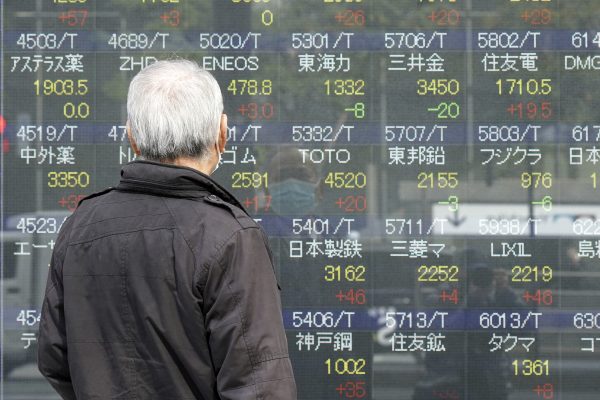
Japan’s newly nominated central bank governor, Ueda Kazuo, faces a baptism of fire when he takes the reins of the world’s third-largest economy in April. With the market already signaling an end to Abenomics’ ultra-easy monetary policy, any missteps by the surprise appointee could spark a harsh financial reaction.
After nearly 10 years in office, finding a suitable replacement for the Bank of Japan (BOJ)’s longest-serving governor, 78-year-old Kuroda Haruhiko, was never going to be an easy task for the Kishida administration.
Market watchers pointed to Deputy Governor Amamiya Masayoshi as reportedly the government’s pick, with other potential candidates including former deputy governors Nakaso Hiroshi and Yamaguchi Hirohide.
News that 71-year-old Ueda, an academic economist and currently dean of the business studies department at Kyoritsu Women’s University, had won the race stunned financial markets. The Japanese yen surged in value against the U.S. dollar, while Japanese government bond yields also jumped as traders digested the news.
BOJ governors are usually chosen from the ranks of former Ministry of Finance (MOF) bureaucrats or long-serving BOJ officials. Nevertheless, Ueda is not a complete newcomer to the central bank, having served on the BOJ’s nine-person policy board from 1998 to 2005.
Ueda’s deputies were named as former Financial Services Agency (FSA) chief Himino Ryozo and BOJ executive Uchida Shinichi, replacing Amamiya and Wakatabe Masazumi. Amamiya reportedly declined the opportunity to become governor, citing the need for a new approach.
In a blow to gender equality, outside contender, economist Okina Yuri missed out. Unlike its counterparts in Europe and the United States, the BOJ has never had a female governor or deputy.
Nikko Asset Management’s chief global strategist, John Vail, described Ueda’s appointment as “a large change in tradition, as normally BOJ professionals alternate with MOF ones as governor, but not in terms of continuity.”
“Not only does Mr. Ueda have strongly dovish perspectives, but the deputy governor for monetary affairs, Mr. Uchida, was the chief designer of YCC [yield curve control] and the negative interest policies,” Vail pointed out. “So, policy should not change too much in the short to intermediate term.”
The BOJ’s YCC policy aims to maintain the yield on 10-year Japanese government bonds within 0.5 percentage points of zero, while keeping short-term rates negative. However, the BOJ has been forced to ramp up bond buying to defend its policy cap, while attracting criticism for distorting market pricing and crushing banks’ margins.
Inflation Test
Like other central bank governors worldwide, Ueda’s first challenge will be restoring confidence in the bank’s ability to control inflation.
BOJ policymakers have repeatedly stressed the need to maintain the ultra-loose policy until consumer prices consistently reach the bank’s 2 percent target – a pledge that formed part of Kuroda’s 2013 “accord” with former Prime Minister Abe Shinzo.
Yet in January, nationwide core consumer prices hit a 41-year high, rising by 4.2 percent from a year earlier, while wholesale prices jumped by 9.5 percent.
While core consumer prices in Tokyo cooled slightly in February, rising by 3.3 percent compared to January’s 4.3 percent gain, the index has exceeded the central bank’s target for nine straight months.
With the yen under pressure due to Japan’s widening interest rate differential with the United States, December 2022 saw the “Kuroda shock,” when the governor decided to allow 10-year bond yields to reach 0.5 percent, double the previous upper limit of just 0.25 percent. The decision was seen as the start of an exit from its long-held easy money policy, with speculation of further rate hikes in 2023.
Under Kuroda, the BOJ has become the owner of more than half of all government debt and the biggest single owner of Japanese stocks, holding around 7 percent of total shares outstanding. The bank’s balance sheet has swollen from around 200 trillion yen in total assets in 2013 to around 700 trillion yen, surpassing Japan’s gross domestic product in 2018.
Unwinding the BOJ’s massive asset purchases and hiking negative or near-zero interest rates, therefore, risks creating major imbalances in bond, currency, and stock markets.
Although the BOJ kept policy steady at its January meeting, Kuroda still has another policy meeting ahead of him on March 9-10, before his second five-year term ends on April 8.
The engineer of the Abenomics “bazooka,” Kuroda’s policies helped bring an end to Japan’s post-bubble deflationary downturn, with the BOJ’s unprecedented purchases of bonds and other financial assets pushing the yen lower and lifting corporate profits and stocks.
However, the creation of a “virtuous cycle” of rising wages and profits eluded Kuroda, who blamed the nation’s stubborn deflationary mindset. Ueda, who oversaw the BOJ’s first experiment with radical monetary easing, has inherited the same challenge but amid vastly different circumstances.
A “Problem Solver”
Japan economist Jesper Koll describes Ueda as a “brilliant theoretical economist, who has been extremely influential in providing the theoretical backbone for the BOJ’s progressive adventures into unconventional monetary policy ever since the fight against deflation became serious.”
Having taught most of the current top bureaucrats at the BOJ and MOF, Ueda has “never been shy to point out to even most senior leaders the unintended consequences of their inherent institutional bias and intellectual rigidity.”
“Designing a thoughtful and theoretically sound exit from the ‘Kuroda-Abe Accord’ will be an overarching agenda item,” Koll added.
“Like Prime Minister Kishida’s ‘New Capitalism,’ this ambition for a new grand design is unlikely to result in significant policy action in the immediate future.
“There is neither the urgency for it – inflation rates are poised to be coming down in coming months – nor is there pressure to spend political capital: When Governor Kuroda took over, Japan was in a crisis and led by an impatient and demanding Prime Minister Abe who needed to prove that ‘Abenomics’ can create growth.”
Other commentators have suggested Ueda will act as a “problem solver” with a mission of unwinding his predecessor’s unorthodox policies.
“Unlike Abe, Kishida isn’t trying to revive growth through monetary policy,” Nomura Research Institute executive economist Takahide Kiuchi told the Nikkei.
Ueda told lawmakers at his confirmation hearing that he would not rush to change policy, with a hurried tightening having a potentially negative impact.
“Monetary policy should be managed based on the current situation and the outlook of prices and the economy,” he told the lower house of Japan’s Parliament on February 24.
“It is necessary to continue the easing policy to sustain the economy and help companies raise wages,” he added.
Ueda said January’s surge in inflation likely was “the peak,” suggesting prices would start cooling from February and fall below 2 percent by around the middle of fiscal 2024.
“Markets seem to be already factoring in the ending of the YCC policy, but I think [Ueda] will take some time to do so while introducing some policy changes in a natural manner,” Daiwa Securities chief economist Toru Suehiro said in a research note.
Kishida’s focus on structural issues such as worsening demographics and lagging productivity has put the emphasis on economic policy rather than monetary, argues Osaka University of Economics Professor Wataru Takahashi.
“The BOJ should not be the main player in the economy,” Takahashi told the Nikkei. “Its role should be to remain in the background to support the economy. That’s what policy normalization should mean.”
Exiting Easy Money
With inflation pressures still apparent, the clock may be ticking on the BOJ’s YCC policy.
“YCC is on counted time and the key question is not if but when it will be abandoned. The bank could wait until … Ueda becomes governor in April. But given that this risks another speculative attack on the yield target accompanied by another round of large bond purchases, we now expect this to happen this month,” Capital Economics’ Marcel Thieliant, head of Asia-Pacific, said in a March 3 report.
Thieliant argues the case for abandoning the policy “remains compelling,” with the central bank now owning a record 54 percent of outstanding government bonds. Price pressures have increased, while there are “early signs that the virtuous cycle between prices and wages the bank is aiming to generate is starting to form.”
“Even though the labor market is still not as tight as it was before the pandemic, wages have recently been growing by around 1.5 percent [year-on-year], the strongest pace since the mid-1990s,” he said.
In its January statement, the BOJ board’s median forecast for inflation in fiscal 2024 rose to 1.8 percent, its highest since 2018.
Thieliant also suggests the government is “pushing for a policy change.” Abandoning YCC would strengthen the yen, helping to curb imported inflation and potentially boosting the government’s approval ratings.
Yet with Ueda’s first policy meeting as governor not scheduled until April 27, Thieliant says he expects Kuroda to spring “one last surprise” and end YCC at its March meeting.
“Given that the government is pressing for a policy shift, Mr. Kuroda might prefer to embrace the change rather than having a signature policy overturned the moment he walked out the door. Markets may also respond with more composure to a shift delivered by Kuroda, rather than by an untested new team,” he said.
Both the International Monetary Fund and the OECD see Japan’s economy posting real GDP growth of 1.8 percent in 2023, aided by increased government spending, while price caps on energy prices are expected to help contain inflation.
Yet with China reopening from its COVID-19 curbs and amid increasing business investment at home, Koll points to potentially even stronger GDP growth for Japan, together with an appreciation of the yen and a reduction in the trade deficit.
“Japan hosts the G-7 summit in May and by that time there’s every chance of Japan being the fastest growing of the advanced economies,” Koll said.
Can Ueda manage the difficult balancing act of withdrawing monetary stimulus, without sparking another economic downturn and damaging financial markets?
The internationally experienced academic, who earned his economics doctorate at MIT under the famous Stanley Fischer, will need all his intellectual prowess and communication skills – as well as a large dose of luck – to prevent a volatile transition.