

In Washington, D.C., federal lawmakers from both parties are debating ways to make it easier to build wind turbines, solar panels and transmission lines at a fast enough clip to meet growing demand, reverse the nationwide trend toward worse blackouts and offer a serious enough alternative to fossil fuels to bend the curve on planet-heating emissions.
Yet in town halls and county legislatures across the country, local governments have worked to counter those efforts, with rapidly multiplying zoning restrictions on wind and solar that threaten to shrink how much land is actually available for generating zero-carbon electricity.
In 2018, when researchers at the National Renewable Energy Laboratory first surveyed nearly all the roughly 3,100 counties in the contiguous 48 states using search engines and legal databases, they identified 105 municipalities with siting ordinances on wind turbines. Because counties tended to have more than one ordinance on the books, the total number of regulations was 286, with as many as three separate regulations per jurisdiction.
By 2022, when the federal laboratory in Colorado updated its database, the number of counties with zoning rules on wind turbines had more than quadrupled to 461, with roughly four ordinances per jurisdiction. Municipalities with curbs on solar panels — which wasn’t measured in the 2018 survey — numbered about 315, with about more than 2 regulations per county.
“We redid the study and we were pretty surprised at how much they grew,” said Anthony Lopez, a senior researcher at NREL’s Strategic Energy Analysis Center and the paper’s lead author. “This is almost a daily occurrence that some level of government is issuing some kind of ordinance or guidance for renewable energy development.”
If anything, Lopez said the study, which wasn’t designed to be “exhaustive,” may lowball the total number of ordinances. But the peer-reviewed findings, published Thursday in the journal Nature Energy, show how much power local governments wield over the future of the nation’s two fastest-growing sources of electricity — a variable that has, until now, not factored into most forecasts of the growth of renewables.
The results illustrate the limits of how much renewable energy the hundreds of billions of dollars of tax credits in President Joe Biden’s landmark Inflation Reduction Act can really buy.
In some cases, new regulations may simply be codifying an official process and make clear to energy developers that a county is open for business.
But “they’re mostly intended to be restrictive,” said Michael Gerrard, an environmental lawyer and the founder and faculty director of Columbia University’s Sabin Center for Climate Change Law. The strictest ordinances for wind, in fact, slash the areas open to turbine developers by 87%.
“A lot of it comes from NIMBY opposition,” he said, using the acronym for “not in my backyard.”
The fossil fuel industry and its allied network of advocacy groups have promoted misleading or false information about renewables on social media, suggesting that the rival energy sources don’t work or exact greater environmental tolls than oil, gas or coal. In states like Ohio, where the fracking boom has rapidly expanded the gas-drilling sector, Republican state leaders are ratcheting up restrictions on renewables. While polls show those efforts have done little to turn Americans against renewables, signs of the campaigns’ success, Gerrard said, can be found in the swift propagation of ordinances across the country.
“We have an organized campaign partly coming from the fossil fuel industry to resist renewables,” Gerrard said.
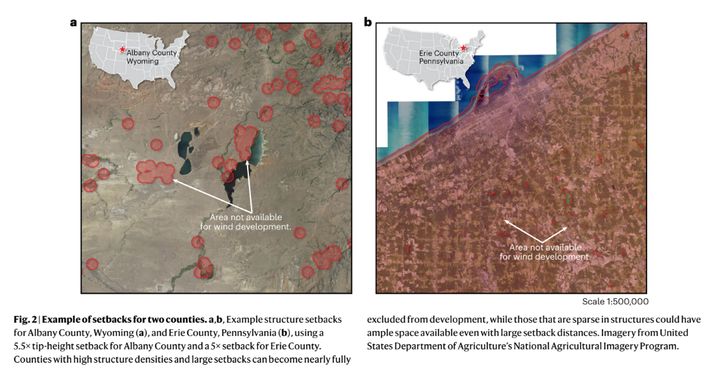
The zoning rules come in many forms. The most common policies in the 2022 survey were what’s known as “setbacks,” rules banning energy infrastructure within a certain distance of structures, roads or property lines, thus shrinking the amount of space available to site those projects. Setbacks are determined by multiplying a set distance by the total “tip-height” of the turbine, a measure taken by adding the rotor radius to the height of the tower holding up the blades.
Identical restrictions can have dramatically different outcomes. Albany County, Wyoming, required a setback equal to 5 times a turbine’s tip-height. Erie County, Pennsylvania, enacted an even stricter version — at 5.5 times the tip-height. But the sparse population in Wyoming left plenty of space for developing turbines. In denser Pennsylvania, the ordinance banned wind energy virtually everywhere in the county.
Solar energy, which Lopez’s team did not track in 2018 because the initial study was funded by the Energy Department’s Wind Energy Technologies Office, tends to be less sensitive to changes in local zoning policies. Unlike turbines, which are typically built as large industrial projects, the solar panels that can be arrayed in utility-scale megaprojects are the same as the consumer products mounted atop homeowners’ roofs. Given that photovoltaics — the fancy word for the technologies that convert light into electricity — take up less space than giant rotating blades mounted atop structures as tall as skyscrapers (and growing), even the most severe setbacks only reduce the total amount of land available for solar by 38%.

But when it comes to wind, the ordinances have proliferated most quickly in places that built turbines before the rest of the country — which tend to be regions with some of the highest-quality wind resources, such as in Iowa.
A study last year by the energy think tank ClearPath found that local restrictions on wind in the Hawkeye State slash the total acreage of land that’s both suitable and available for turbines by about half.
“The most prohibitive ordinances are in areas that have experienced wind development, and the areas that have experienced development previously tend to be areas with the best wind resources,” said Casey Kelly, a senior research associate at ClearPath who co-authored that paper. “Because the best wind resources have seen the earliest development, the fact that there’s ordinances popping up there will have an asymmetric effect.”
In a study in the early 2010s, Uma Outka, a professor at the University of Kansas School of Law, found that when it came to siting renewable power plants, local governments had a “significant” role in the process, even in places where the state government had final say.
Revisiting the issue nearly a decade later, not much has changed. “Moreover, new wind and solar facilities will continue to face local opposition in some communities, blocking or delaying development even on sites that are otherwise environmentally suitable,” she wrote for the Kansas Law Review.
Not everywhere. Data from Columbia University’s Sabin Center for Climate Change Law show as of August at least 12 states have granted statewide agencies the power to set aside local ordinances on renewable energy siting: California, Connecticut, Florida, Iowa, Maryland, Massachusetts, Minnesota, New Mexico, New York, Rhode Island, Wisconsin and Vermont.
Illinois, on the other hand, capped the maximum setback a county can require for wind turbines.
Federal permitting reforms could prove crucial to building more interconnections between the country’s patchwork of power grids and making it easier to ship solar power generated in the sun-soaked Southwest to the energy-hungry cities on the coast. But unless the project crosses a federally regulated wetland or needs facilities on public lands, few solar and wind farms require federal approval, limiting the impact of changes to bedrock laws like the National Environmental Policy Act.
But the Telecommunications Act of 1996 offers a model for how the federal government could tamp down local restrictions on clean energy, Gerrard said.
“They’re mostly intended to be restrictive. A lot of it comes from NIMBY opposition.”
– Michael Gerrard, Columbia University’s Sabin Center for Climate Change Law
The legislation passed at a time when mobile phones were starting to proliferate, and towns began banning the cell towers needed to expand wireless coverage. In response, Congress stripped local governments of their right to regulate electromagnetic frequency radiation from cell towers, designating that as the jurisdiction of the Federal Communications Commission. The law also required municipalities to respond to applications for a cell tower with a “reasonable” period of time — which FCC regulators ultimately determined to be 150 days.
“Localities still had authority, but there were limitations on it. And that law turned out to be fabulously successful and there was a rapid increase in the rate of cell tower construction after its enactment,” Gerrard said. “I could imagine something like that here.”
But the immediate task ahead is to begin integrating data like NREL’s into federal models that track and forecast the expansion of renewables and the effect that has on grid reliability and U.S. carbon emissions. The results could change planners’ calculus on what kinds of generation are needed for the future.
Limited space for onshore turbines and solar panels may put a premium on zero-carbon sources of electricity that require less land, such as nuclear, geothermal or gas plants equipped with carbon capture technology, said Seaver Wang, co-director of the climate and energy team at the Breakthrough Institute, a California-based climate think tank, and the author of a recent paper critiquing efforts to build only renewables.
“All of this speaks to the differences in the relative value proposition of clean-energy technologies that we perhaps don’t always appreciate, especially if we’re only thinking in simple modeling terms,” Wang said. In other words, if it’s too difficult to find space for one type of clean energy, it might create a shift in favor of technology that’s more flexible in terms of location.
Mark Jacobson, the Stanford University researcher whose controversial modeling work showing the feasibility of a 100% renewable grid has made him the go-to scientist for environmental groups opposed to nuclear and carbon capture, said he had identified some ordinances the NREL study missed and still found that “there is still plenty of wind to power the whole U.S. for all purposes with wind alone.”
Challenges for onshore wind could, in fact, be a boon to offshore wind developers, who site their turbines in ocean areas regulated almost entirely by the federal Bureau of Ocean Energy Management. While not as bullish as Jacobson, a report released this week by the nonprofits GridLab and Energy Innovation and the University of California at Berkeley found that offshore turbines may be able to provide as much as one-quarter of U.S. electricity needs by 2050.
“Offshore wind has a fundamentally different relationship to the findings in that study, as the federal government is the main permitting authority for offshore wind projects,” said Luke Jeanfreau, a spokesperson for the trade group Business Network for Offshore Wind, referring to the NREL study.
But even federal officials might be underestimating how large an area is needed for offshore turbines.
But it’s important to keep in mind, Lopez said, that these siting issues are all connected. “You may in practice have to deploy wind and solar farms in somewhat less optimal areas, resource wise, maybe a little further away.” He added, “it shows how important it is to capture these local siting conditions at national scales, because this is what’s going to give us the most accurate representation and quantification of wind and solar potential.”