

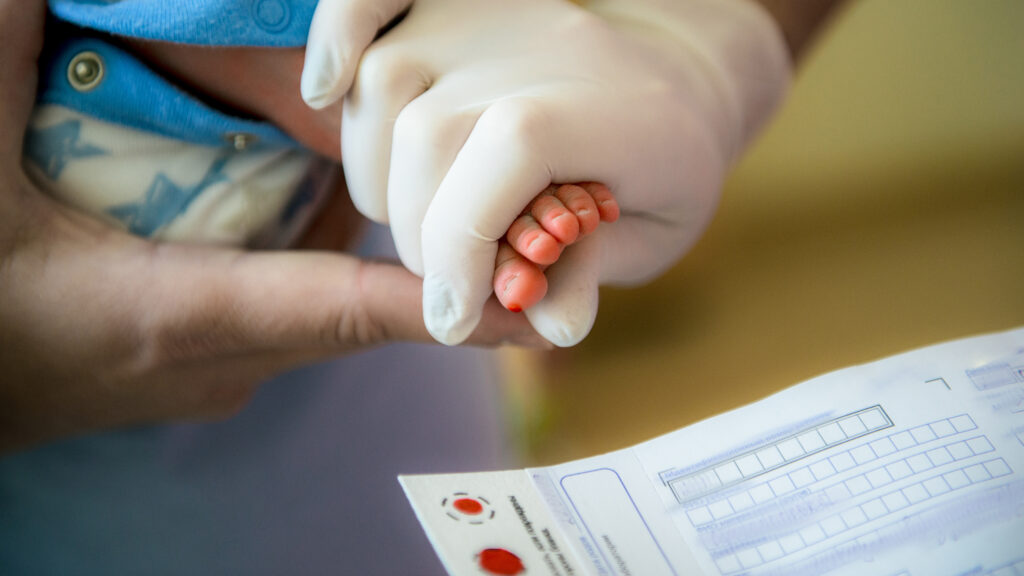
Ten years ago, clinicians in a handful of hospitals around the United States began sequencing the genomes of apparently healthy babies, seeking to understand how the technology might turn up hidden genetic disorders that aren’t being caught by routine newborn blood testing. New research from one such trial suggests the impact of having that kind of information extends far beyond the baby whose DNA is being decoded.
In a study published Monday in the American Journal of Human Genetics, researchers from Mass General Brigham and Boston Children’s Hospital reported that of the first 159 infants to undergo screening through genomic sequencing, 17 were discovered to have unanticipated mutations in disease-associated genes.
Over the next three to five years, in the majority of the 17 infants’ families, these discoveries prompted parents and other relatives to get additional testing that led to uncovering the cause of diseases running through their family trees. In three cases, mothers who learned they carried a gene that drastically elevated their risks of certain cancers chose to undergo prophylactic surgeries to reduce those risks — a finding that the lead researcher says undercuts ethical objections to informing families of genetic findings even when they aren’t immediately actionable for the newborn.
“This is a real-world rebuttal to the prevailing notion that we should not be sharing adult-onset disease-risk variants in children,” said Robert Green, a medical geneticist at Harvard and Brigham and Women’s Hospital who leads the BabySeq study that produced the new research. “There are ethicists who say a child should not be used as a genetic canary in a coal mine — that one member of a family should not be used without their consent as the access point for a whole family, but I’d like to challenge that. Look at these mothers. We arguably saved their lives. Are you really going to put that up against a theoretical loss of autonomy at some point in the child’s future?”
As the cost of DNA sequencing plummets, the prospect of whole-genome screening of millions of newborns has raised profound concerns about how helpful that information really is. Experts are divided on whether the benefits of catching diseases early outweigh the added costs and burdens to the health care system, as well as the potential psychological impact on families of knowing they carry disease-risk genes and for the child, of having that decision made for them before they’re old enough to walk, talk, and give consent.
There are other clinical trials underway evaluating the health benefits, financial costs, and ethical implications of sequencing versus the standard blood tests all newborns get to identify a limited number of inherited conditions. They include a number of federally funded studies in the United States as well as a pilot program in the United Kingdom that will sequence the genomes of 100,000 newborns over the next two years. They each return different amounts of genetic information to families and their physicians. But only BabySeq provides a look at what’s lurking in 78 genes associated with increased risk of diseases that develop in adulthood.
BabySeq is a clinical trial involving several hundred families, some with sick babies, some with healthy ones; half the children received standard newborn screening and half received screening plus sequencing. When the trial was first launched back in 2013, Green and his colleagues went back and forth about how much genetic information to return to parents about their new child. Initially, they decided to disclose only genetic variants implicated in a range of childhood-onset conditions. But around that time, two important things happened that made them change their minds.
The first was that the American College of Medical Genetics and Genomics came out with a new recommendation that the incidental finding of any of 56 genes for “highly actionable” conditions — meaning things you could diagnose and treat, or if not treat, at least monitor — be reported back to all individuals undergoing clinical genomic sequencing, regardless of age. Three of those conditions only appeared in adulthood: cancers caused by variants in the BRCA genes and an aggressive form of colorectal cancer called Lynch syndrome.
The second was what happened with one of the first participants enrolled in the sequencing arm of BabySeq. The baby boy had been born with a serious heart issue, and he soon passed away. But lurking in his DNA data was the finding of a BRCA variant associated with a 45% increased risk of breast cancer in women as well as an elevated risk of other cancers in both sexes. The BabySeq team was able to deduce from saliva samples collected from the parents that the mutation had come from the mother. But because of the study protocol, they were not allowed to tell the family what they had found.
The uncomfortable situation caused them to rethink their strategy, and rework their protocol. As a consequence, all the subsequent families enrolled in BabySeq were given the option to receive information about adult-onset disease-risk genes. According to the latest data from the trial, most families opted in. In 13 of the 17 infants discovered to have disease-associated mutations, the information they received prompted additional screening for at-risk family members. The experience has had a big impact on how the BabySeq project is now being expanded.
Green and his collaborators recently began recruiting for a second phase of the trial, which aims to enroll more than 1,000 babies and their families from racially, ethnically, and socioeconomically diverse communities in Boston, New York, and Birmingham, Ala. The first BabySeq study overwhelmingly featured wealthier, college-educated people with European ancestries, making findings not very generalizable to the wider U.S. population. Other changes to this phase include recruiting slightly older babies — up to 6 months in age.
Parents who sign up for this phase are informed they will receive genetic information about their child related to adult-onset conditions, but there is not a way to opt out without declining to participate altogether.
“What this whole thing is helping us to think about is different ways that we consider benefits to families,” Green said. “I think it’s a good thing to find these variants in babies for the benefit of the entire family.”