

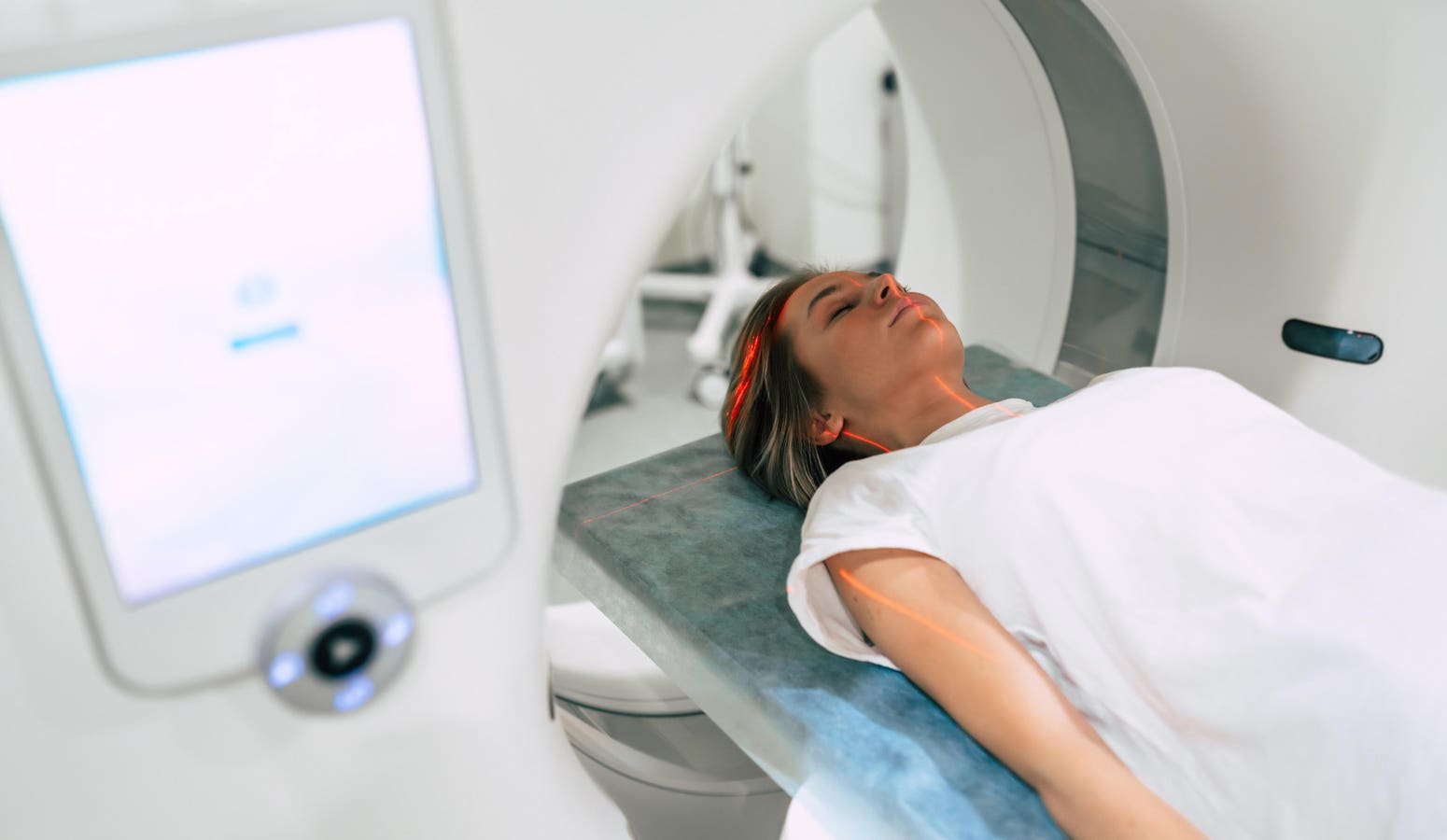
Full-body MRIs for preventive health are becoming more common as consumers seek ways to optimize their health and well-being.
getty
The demand for personalized health tracking shows few signs of abating. What began with smartwatches that tracked your sleep, continuous glucose monitors and gut microbiome tests, has progressed to full-body MRI scans, with the average consumer paying somewhere between $1,000 and $2,500 out of pocket for a window into their internal organs.
But while an increasing number of concierge medical providers are offering such scans on an annual or biennial basis, the question of whether you should get one is more nuanced than it might seem.
On the one hand, the promise is tantalizing. Full-body MRIs offer the possibility of detecting a whole range of invisible and often symptomless ailments, whether that’s worrying levels of visceral fat, inflammatory processes or tumors. The thinking behind regular scanning is to spot issues at an early and more treatable stage before they develop into serious health concerns.
“Medicine is shifting towards prevention instead of fixing things once they’re broken,” says Valeria Grijalva, an internal medicine specialist at The Mount Sinai Hospital in New York. “If there is something there, we can hopefully catch it on time, for example, in the sense of a tumor, before it becomes metastatic.”
This has been made possible by significant advances in imaging quality. MRI scanners use large magnets to manipulate hydrogen atoms within the body, causing protons to emit radio signals that can be used to create images of the body’s soft tissues, ones that are far clearer than CT scans or X-rays.
These images can be further enhanced through the use of contrast agents, which can be administered either intravenously or injected directly into a body part to help visualize certain structures. In June, the FDA approved a new contrast agent called gadoquatrane, developed by Bayer, which is now the lowest-dose macrocyclic gadolinium-based contrast agent approved in the U.S. Contrast-enhanced MRI can play an important role in detecting abnormalities, monitoring disease progression and informing treatment decisions.
Grijalva suggests that the rising popularity of full-body MRIs is linked to the limitations of conventional cancer screening. While there are well-established screening programs for some cancers, there are still no recommended ways of screening for many deadly diseases such as pancreatic or liver cancers which are often detected late.
MRIs can also pick up other potentially life-threatening issues such as aneurysms, enlarged blood vessels within the brain which increase the risk of a potentially fatal hemorrhage. “Once an aneurysm is detected, patients can speak with their primary care doctor and a neurologist, and they’ll be able to monitor that aneurysm to ensure that the diameter doesn’t get larger,” says Grijalva. “When that happens, we would be able to offer a preventative procedure to repair this aneurysm before bad things happen.”
But what many consumers might not realise, is that being scanned comes with unexpected risks of its own.
The Consequences of Overdiagnosis
Research suggests that 15-30% of all diagnostic imaging scans reveal at least one incidental finding or small abnormality in a particular patient. “Nobody is perfect and whenever you do whole body MRI screening, you are going to find more abnormalities,” says Rajendra Kedar, a radiology professor at the University of South Florida. “But that isn’t necessarily the same as creating better health.”
This is because not every abnormality needs to be treated. Unbeknown to them, many people are living with benign organ cysts, while the likelihood that an asymptomatic person actually has an undetected cancer is very low. When a group of oncologists from Italy and the UK carried out a review of more than 6,000 whole-body MRI scans, they found that while 95% of the people scanned had some form of abnormality, and 30% were recommended for further investigation, just 1.1% actually had cancer.
Even when cancers are identified, early diagnosis does not always save lives because it’s not always possible for radiologists to distinguish between slow-growing tumors which are unlikely to ever cause harm, and aggressive malignancies. When South Korea launched a government-sponsored screening program for thyroid cancer, this failed to improve survival rates. However, the 15-fold increase in diagnoses did result in many thousands of patients undergoing unnecessary surgery to remove their thyroid gland and requiring lifelong thyroid hormone replacement treatment.
The possibility of needless interventions, which can come with their own side effects and risks, is why Matthew Davenport, a radiologist at the University of Michigan, describes whole-body MRI screening as being “probably harmful on average,” when offered to the general public.
Davenport argues that it’s unlikely that the average person being screened will actually have an invisible, underlying disease. His view is that it’s far more likely that regular MRIs will flag benign growths, resulting in unnecessary anxiety, and requiring further follow-up testing.
Instead, the people most likely to benefit from regular scanning are those who are already at a higher risk of disease. Grijalva suggests that brain MRIs could be useful for people with a family history of aneurysms, for example, while Kedar says that whole-body MRIs could benefit people with neurofibromatosis type 1, a genetic condition which makes people 10 times more likely to develop any type of cancer during their lifetime compared with the rest of the population.
But where does this leave the rest of the population? It’s plausible that in future AI will be able to offer better recommendations about who can benefit most from regular MRI scanning. In years to come, Kedar predicts that algorithms will be able to combine information about a person’s family history with biomarker data to identify hidden patterns of disease risk.
In the meantime, however, concierge medicine and full-body MRI scans are here to stay. For those who wish to undergo this kind of testing, Grijalva’s advice is to limit scans to once every two years, and to be aware that the results could open the door to a need for further check-ups.
“For me, it’s about being direct with patients, and from there they should make their own decision about what’s in their best interest,” says Davenport. “Right now, if you’re an average 40, 50, even 60-year-old patient and you’re going to roll the dice on taking this test, I can’t give you any promises whatsoever that you’re helping yourself.”
My own personal recommendation is that for the average person, whole-body MRIs for preventive health are very much optional and should only be undertaken with a clear understanding of the risks and benefits. The most important things you can do to protect your health remain the well-established basics: exercise, eat well, don’t smoke, limit alcohol, and stay on top of recommended check-ups like colonoscopies and mammograms.
Lastly, make sure that you take any symptoms seriously and seek medical counsel when concerns arise. In our high-tech era, the simple reminder to listen to your body remains some of the wisest advice of all.
Thank you to David Cox for additional research and reporting on this article.