

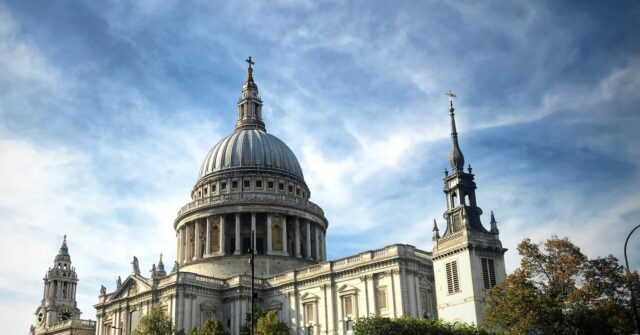
St Paul’s Cathedral in London has agreed to become a music venue for DJs in a four-year partnership with a controversial nightclub group, a move critics say shows disrespect for the holy Christian site and the historically significant figures buried in its crypt.
The mother church of the Diocese of London in the Church of England said this week that it has agreed to partner with the Fabric nightclub to host musical “gigs” inside the 18th-century cathedral until 2030, the BBC reported.
St Paul’s director of visitor engagement, Sandra Lynes Timbrell, said that she hoped the modern events would help encourage people to “discover and engage with this historic building in new and exciting ways”.
She said that the events would serve as a “showcase world-class talent and create unforgettable experiences for audiences within one of London’s most iconic spaces.”
Fabric co-founder Cameron Leslie said the events could serve as a way to see the “coming together of two very different parts of London”.
Fabric has previously been the subject of controversy, having been stripped of its license in 2016 following the deaths of two teenagers on its premises as a result of drugs.
While the first event is scheduled for the end of October, it has yet to be revealed who will be performing. However, the Times of London reports that the nightclub-led events will feature “contemporary music by the capital’s most prominent DJs and musicians.”
Opponents of the move have pushed back against the notion that the Cathedral was just another architecturally interesting space for events, given that it is a major centre of Anglican worship and national ceremonial life.
Former Brexit Party MEP Alex Phillips remarked: “You don’t get Mosques, Temples, Gurdwaras and Synagogues abused in this way, taken as empty vessels to be abused.”
She said that it was imperative that churches not be turned into “mere beautiful buildings without substance nor meaning, exploitable by any heathen that fancies an architecture upgrade for their event.”
“The magnificence of religious buildings is testament to belief in the divine, their architects were devotees to the splendour of their faith, with churches and cathedrals built over many centuries by hands that prayed, often in dangerous conditions and with maximum focus and skill as well as cutting edge hard labour by master craftsmen and labourers who were also sincere worshippers.”
The move was also criticised by the Nelson Society, which seeks to preserve the legacy of Britain’s great maritime war hero Admiral Lord Nelson, who is buried in the crypt under the central dome of St Paul’s Cathedral.
Nelson Society President Peregrine Hood, who is a descendant of the elder brother of the national hero, said: “Nelson came from a family steeped in the church, and perhaps it is this misuse of a holy site that would have caused him even greater unease than the prospect of masses dancing above his grave.”
“This extends far beyond Nelson. St Paul’s is one of the great sacred spaces of Christianity and a place of enormous significance to our national life and history.”
Queen Elizabeth’s former chaplain, Dr Gavin Ashenden, who left the Anglican Church in 2019 and converted to Catholicism, said that the planned raves at the Cathedral would represent “a sign of degraded apostasy which is a betrayal of all the faithful Christian people who said their prayers there.”
Dr Ashenden also questioned why the Anglican community would allow its possessions to be “prostituted” out in such a manner.