

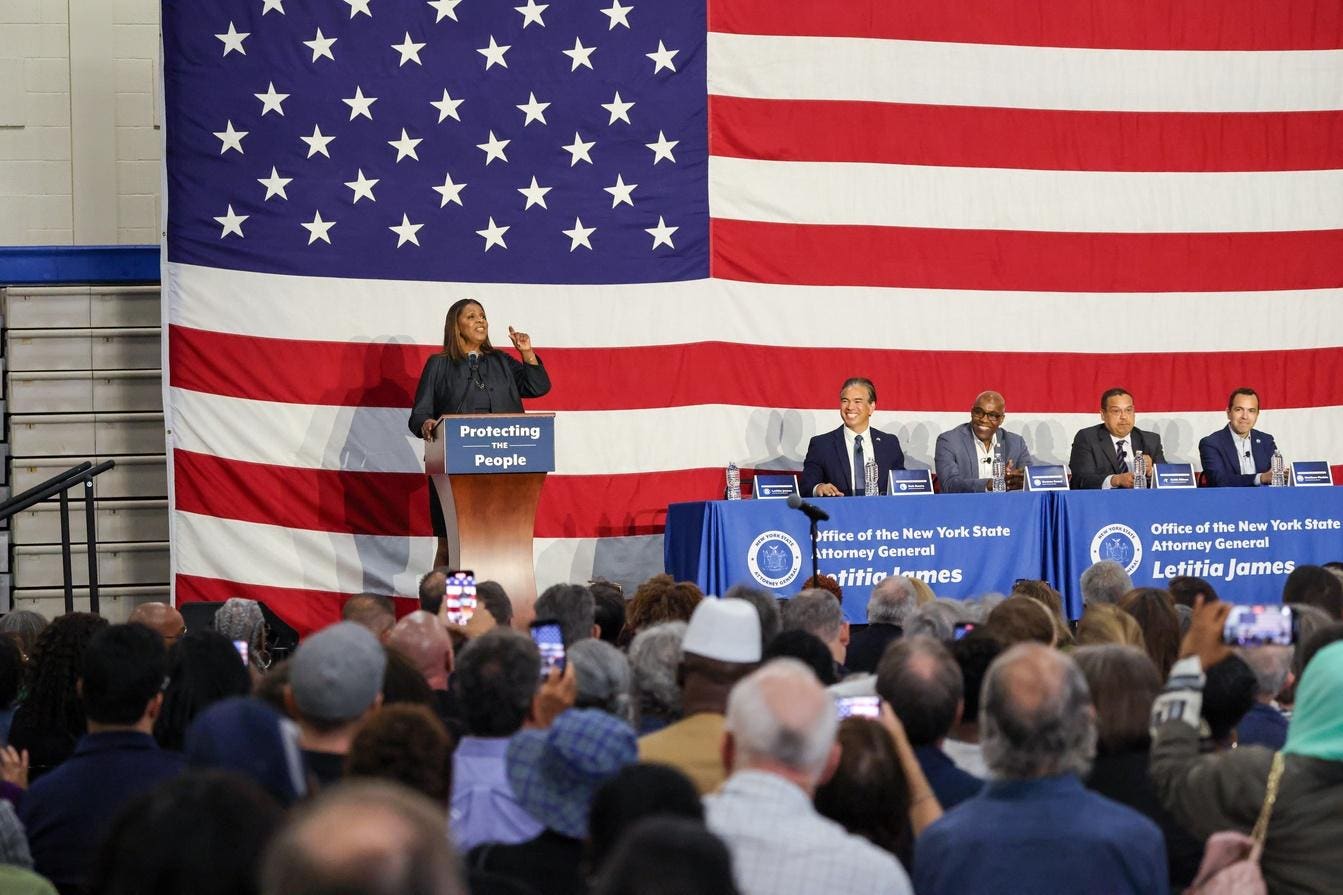
VALHALLA, NEW YORK – MAY 08: NY Attorney General Letitia James hosts a town hall at SUNY Westchester Community College to hear from residents about the impact of former President Donald Trump’s policies on their lives on May 08, 2025 in Valhalla, New York. James, along with her counterparts from New Jersey, California, Illinois, and Minnesota, will listen to New Yorkers from across the state about safeguarding civil rights and pushing back against federal policies they deem harmful. (Photo by Spencer Platt/Getty Images)
Getty Images
A new fight over Medicaid is beginning not in a hospital room or statehouse, but in the space between a statute and the rules written to carry it out. When Congress passed H.R. 1 in 2025, it created new work requirements for millions of adults with low-incomes who receive coverage through Medicaid expansion. Some enrollees will soon have to prove they are working, in school, volunteering or participating in other qualifying activities to keep their health coverage. But Congress also created exemptions for people it did not intend to subject to those requirements. Now, a new federal lawsuit asks whether the agency responsible for implementing the law narrowed those protections in the process.
The Lawsuit
On June 29, a multi-state coalition of 24 attorneys general and two governors sued the Centers for Medicare & Medicaid Services and the U.S. Department of Health and Human Services over the federal government’s implementation of Medicaid work requirements under H.R. 1. The lawsuit challenges the Interim Final Rule issued by CMS, which the states argue added new limits Congress did not write into the statute.
The states are not asking the court to decide whether Medicaid work requirements are good policy. Their claim is narrower, but no less consequential. They argue that CMS redrew the boundaries of who can be exempt, particularly for people Congress described as “medically frail or otherwise have special medical needs.” In court, that dispute may turn on statutory text, agency authority and administrative procedure. For Medicaid recipients, it may come down to a more human question: who is considered “sick enough” to keep coverage without proving work?
The “Sick Enough” Fight
The case turns on a phrase that sounds simple until it has to be administered by state agencies, doctors, computer systems and eligibility workers: “medically frail.” According to the complaint, CMS says its implementation of H.R. 1 will help “prioritiz[e] coverage for Medicaid’s most vulnerable.” But the plaintiff states argue the rule does the opposite by creating new requirements that make medically frail people jump through added administrative hoops to get and keep coverage.
Under the rule, individuals with significant health conditions must also be found significantly impaired in their ability to meet work requirements. The complaint argues that H.R. 1 does not condition medical frailty, or the existence of a serious or complex medical condition, on a person’s ability to work. In the states’ view, Congress created a medical exemption, while CMS converted it into a test of work capacity.
Why States Object
The complaint says CMS adopted this new approach after months of communications and preliminary guidance that led states to prepare for a different implementation structure. States argue they had already spent time and money modifying systems, designing workflows and preparing notices based on the statute and CMS’s earlier guidance. That timing is significant given that states must notify Medicaid members of the new requirements by August 31, 2026, before work requirements take effect on January 1, 2027.
The California Attorney General’s office made that reliance point directly in its press release. It said Medi-Cal had warned CMS about “significant concerns” if the agency materially changed its earlier guidance, and that California had “relied extensively” on preliminary guidance to design and build major systems and staffing changes before the January 2027 deadline.
SACRAMENTO, CALIFORNIA – OCTOBER 28: Attorney General Rob Bonta speaks during a press conference about ‘legal action against Trump administration’ at the Office of the Attorney General in Sacramento, California, United States on October 28, 2025. (Photo by Tayfun Cokun/Anadolu via Getty Images)
Anadolu via Getty Images
California Attorney General Rob Bonta framed the issue as one of congressional intent. “People with serious illnesses or disabilities already face major challenges in their daily lives,” Bonta said in his office’s press release. “They shouldn’t also have to worry about losing their healthcare because of work requirements or related barriers. That was Congress’s will, and it must be respected.”
Arizona Attorney General Kris Mayes used a similar frame in her office’s press release, saying Medicaid exists to protect vulnerable Arizonans and that otherwise eligible people “shouldn’t lose access to their healthcare because of unnecessary red tape.”
The Paperwork Trap
The lawsuit is not only about the definition of medical frailty. It also challenges limits on self-attestation, how states may use claims data, hardship exceptions and the administrative burden created by the rule. Medicaid is not implemented in the abstract, but through state agencies, vendors, eligibility systems, notices, call centers, claims data and clinical records. At the heart of the case is the concern that a person may remain legally eligible for coverage, yet still lose it because the process becomes too difficult to complete. That is the paperwork problem at the center of the dispute.
The Illinois Attorney General’s office said in its press release that CMS’s rule would require even people with serious conditions such as cancer or quadriplegia to prove their condition makes them too sick to work. If they cannot find the right paperwork or otherwise prove their case, the office said, they risk losing coverage.
Illinois Attorney General Kwame Raoul speaks during a press conference in Chicago, Illinois, on August 25, 2025. (Photo by KAMIL KRZACZYNSKI / AFP) (Photo by KAMIL KRZACZYNSKI/AFP via Getty Images)
AFP via Getty Images
The New York Attorney General’s office put the same concern in its press release. Attorney General Letitia James said New Yorkers “battling cancer, living with a disability, managing a serious mental health condition, or recovering from addiction” should be able to get care “without being buried in paperwork.” Maryland Attorney General Anthony Brown’s office framed the issue as coverage loss despite eligibility. In its press release, Brown said the rule would narrow exemptions and strip coverage “not because they fail to qualify, but because the administration has rewritten the rules to exclude them.” That concern turns on proof as much as eligibility. A person may still qualify under the law, but if the rule changes how eligibility must be proven, coverage can become harder to keep.
The Risk For Patients
The complaint argues that added administrative burdens will cause eligible people to lose or be denied Medicaid. It says that earlier Medicaid work requirement experiments showed people can lose coverage even when they are working or should qualify for an exemption. The states argue CMS was required to consider that history and failed to do so adequately.
The North Carolina Attorney General’s office gave that concern a human face in its press release. DeAnna Brandon, a North Carolinian being treated for blood cancer, said chemotherapy left her with short-term memory issues. “Now, I’m afraid I could lose Medicaid coverage because I accidentally missed paperwork,” she said. “Even though I’m still eligible. Forgetfulness is not fraud.”
The dispute is not only whether someone has a qualifying diagnosis. It is whether that person can track the notice, obtain the records, secure the doctor’s note, meet the deadline and satisfy the state system before coverage is interrupted.
The complaint also argues that coverage loss does not make health needs disappear. It can delay treatment, push people from routine care into emergency care and increase costs for states, hospitals and healthcare systems. A law can define who qualifies, but a rule can determine how hard it is to prove it.
Doctors In The Middle
The lawsuit also raises a practical question for doctors. If a medical condition cannot be verified through data, someone may need documentation from a provider. But the complaint argues CMS has not explained why community healthcare providers are equipped to evaluate whether a patient’s condition significantly impairs their ability to comply with work requirements. That kind of determination may involve job duties, transportation, treatment side effects, fluctuating symptoms and the difference between working sometimes and working consistently.
The North Carolina Attorney General’s office included a statement from Dr. Casey A. Jeffreys, a neurologist and multiple sclerosis specialist, that speaks directly to that problem. Jeffreys noted that multiple sclerosis can fluctuate, with some patients able to work full time, some able to work flexibly and others unable to work at all. “An overly restrictive definition of medical frailty jeopardizes healthcare access for patients whose condition does not fit neatly into a ‘sick enough’ label,” Jeffreys said.
That is why the dispute reaches beyond a single phrase and into how medical complexity is recognized in practice. A person can have cancer and still be trying to work. A person can have a chronic condition that appears stable because treatment is working. A person can live with a mental health condition or substance use disorder that changes over time. A person can be medically fragile without fitting neatly into a form that asks whether they are unable to comply with work requirements. The complaint argues that CMS’s rule risks turning those medical realities into paperwork disputes.
What Happens Next
The states are asking the court to halt the challenged provisions and ultimately remove them from the rule. They argue that CMS acted contrary to law, arbitrarily and capriciously, and beyond the lawful bounds of Congress’s spending power. They also warn that the rule will shift new costs and confusion onto states while placing medically frail people at greater risk of losing coverage.
The federal government will have the chance to defend its interpretation, and the court will decide whether CMS acted within the authority Congress gave it, adequately explained its choices and should be allowed to move forward with the challenged provisions. Even at this stage, the lawsuit shows how much law can be reshaped once it enters the machinery of implementation.
Congress made Medicaid work requirements a major policy choice. This case asks what happens next, when that choice leaves the pages of a statute and moves into the systems that determine access to care. The question is not only whether CMS can implement the law, but whether implementation can narrow the protection Congress created. For Medicaid expansion enrollees with serious health conditions, the answer may decide whether an exemption functions as a real safeguard or remains only a promise on paper.