

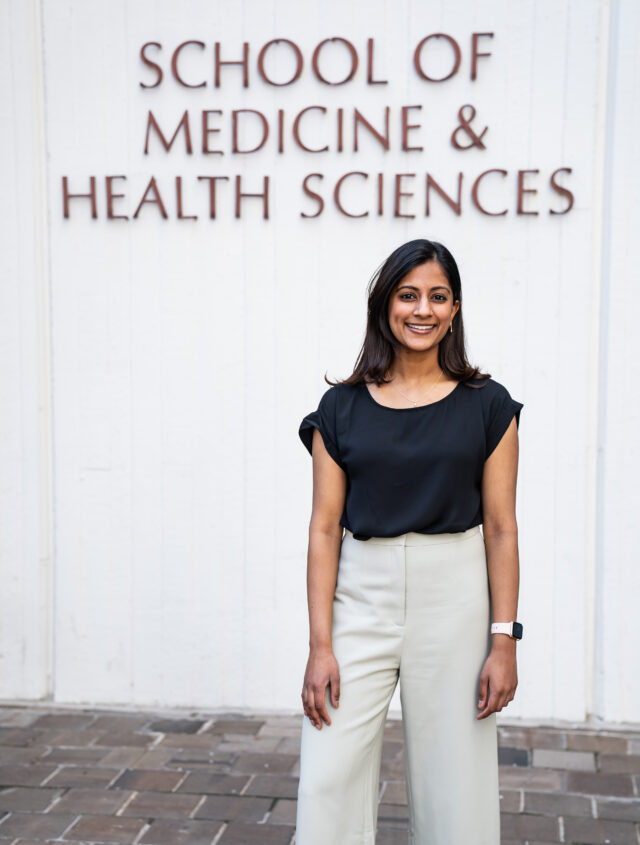
When Cecilia Sorensen was an emergency medicine resident practicing at Denver Health in Colorado a few years ago, summer was known as “trauma season.” Gunshot and motor vehicle accident victims, people with heart attacks and COPD would stream into the ER. Later, on a fellowship, she witnessed the health impacts of drought in Syria.
The common driver, she realized, was climate change and its impact, both locally and globally.
“How did I hear nothing, nothing, about this during my entire medical training?” Sorensen found herself wondering. “Literally nothing.”
It’s a question many medical students and recent medical school graduates are asking. Today, Sorensen directs the Global Consortium on Climate and Health Education and teaches courses on climate and health impacts at Columbia University. She’s one of a growing number of committed young doctors and medical students across the country who aim to address that glaring oversight in their training, working to incorporate climate change into medical education.
Sorensen and her counterparts plan to carry their efforts well beyond academia. They want to figure out how best to prepare the health care system for the onslaught of health problems climate change is likely to create in coming years, and to change how the practice of medicine contributes to global warming and waste.
Others in the health professions are also taking up the cause, including pharmacy students and dental students, often working with faculty mentors. And nursing students and nursing faculty say it’s natural to include what some are calling “planetary health” in their curriculum, noting that their profession’s approach to health has been holistic since the days of Florence Nightingale.
The movement is still nascent, but it has already made an impact. In January, Harvard University’s medical school committed to embedding climate and health in its curriculum. At George Washington University, students this year finally managed to get the school to adopt a “climate theme” that will weave learning objectives into all four years of medical school; it is expected to debut for this fall’s incoming class. And at Emory University, pediatrics professor Rebecca Philipsborn in 2020 taught an elective course, “Climate Crisis and Clinical Medicine,” virtually, to third- and fourth-year students, kickstarting what has turned out to be a broad integration of climate and health into Emory’s curriculum over the last three years.
“It’s so rewarding to make change happen in a relatively short amount of time,” said Savita Potarazu, a fourth-year med student at GWU. “It’s an adrenaline rush.”
Potarazu is the current chair of the national student group Medical Students for a Sustainable Future (MS4SF). “The push to say that this is something really important has come from the students,” said Neelu Tammalu, an assistant professor of surgery at GWU and co-director of the university’s Climate and Health Institute. Potarazu, classmate Taylor Brewer, and others were “instrumental” in making change happen at GWU, said Tammalu, who was a faculty adviser to the students.
Still, even if administrators are receptive, students and faculty acknowledge that some schools might find it challenging to include climate impacts in their curriculum — especially coming so soon after other nation-shaking events that demanded other changes. The Covid-19 pandemic forced medical schools not only to be virtual, but also to make instruction relevant in the context of the most challenging global public health crisis in decades. The murder of George Floyd pushed medical schools to sharpen their course offerings on social determinants of health and take a closer look at health equity and justice.
That was the right thing to do, some climate activists acknowledge, and they add that these issues are in many ways related. “There is a ton of overlap between climate change, health, and health equity,” said Allan Ndovu, a fourth-year medical student at the University of California, San Francisco, who served on a faculty-student team to develop climate and health learning objectives at UCSF. That overlap allowed for the first inclusion of climate-related materials into UCSF’s medical school courses, as part of units focused on structural determinants of health and disparities, Ndovu said. For instance, a discussion of redlined communities might introduce research on how some experience worse outcomes from heightened heat and pollution levels than other communities in the same city, he said.
Beyond the interplay of social determinants of health and climate, there is a wealth of information linking climate and its physiological impacts on health that medical and allied health students need to learn about — and how to ameliorate and treat, experts say. And that’s where medical and other professional schools face a bandwidth problem.
Faculty are often reluctant to add material about which they don’t feel knowledgeable. The Association of American Medical Colleges says 55% of schools it surveyed are including the health effects of climate change as a topic in their courses, but at some institutions this may amount to brief lectures tacked onto existing courses. Rather, say students and their mentors, the content needs to be woven into the four-year medical school curriculum. Doing that “signals that the material is not separate from what we are already learning,” said Natasha Sood, a fourth-year medical student at Penn State and a co-founder of MS4SF.
Developing this foundational material can be a heavy lift. In response, Sood and other med students and faculty from various universities started Climate Resources for Health Education (CHRE) to crowdsource and vet an evidence-based and open-source repository of climate- and health-related learning objectives, slides, and case studies. The resources will cover all the organ systems medical students learn about, and the goal is to tackle the bandwidth problem by offering faculty members at medical, pharmacy, dental, and nursing schools an easy way to incorporate into their classes materials that document, for instance, how extreme heat aggravates asthma or worsens pregnancy outcomes.
For skin cancer, CRHE’s slides teach that increased temperatures can have a “synergistic, carcinogenic effect with UV exposure.” Another set of slides, analyzing the adverse effect of higher particulate levels on birth weights, describes the mechanisms by which this can happen, including impaired maternal cardiopulmonary function, direct transplacental toxin exposure, and changes in blood viscosity during placental transfer.
Hayley Blackburn, associate professor at the University of Montana Skaggs School of Pharmacy, is tailoring some of CRHE’s material for pharmacy students.
Her interest in climate impacts on health is not just professional, but personal: For a couple of years after graduating from pharmacy school, she worked in southern Oregon, close to wildfires. Then, just as she returned to her home state of Montana for the teaching job at the pharmacy school, a bad wildfire raged close to where she grew up, threatening her parents’ home. “I watched them struggle through smoke exposure and it felt like a very urgent event,” said Blackburn. “I thought OK, I am here, I am a pharmacist, what can pharmacists do, what should be my professional role?”
Blackburn developed a climate health elective course at the school, which eventually was offered in collaboration with Monash University in Australia and pulled in students from nursing and other schools in Montana and Colorado. She advised students like Amelda Klink, who’s doing her pharmacy residency at St. Patrick Hospital in Missoula, where she’s a member of the green committee and is working on a research study looking at heat-related illness and medication risk.
Klink and other students at the University of Montana’s pharmacy school rated the school in a “planetary health report card,” a scoring system initially developed by medical students to grade their school’s climate awareness in a variety of areas: curriculum, research, support of student-led initiatives, and campus sustainability efforts. The rating system has been taken up by nursing and pharmacy students, and dental students will soon follow, said Donna Hackley, assistant professor of oral health policy and epidemiology at the Harvard School of Dental Medicine.
Dental students on Harvard’s sustainability committee, including third-year student Yuying Guo, have adopted some of the committee’s recommendations from a waste audit conducted in 2019, reusing gowns where possible in their preclinical space, and giving patients in the clinic toothbrushes and toothpaste in paper bags rather than plastic bags. Because dental students at Harvard are required to take medical school classes for their first two years, the incoming class will benefit from the changes underway at the medical school.
Perhaps no allied health profession stands to have greater influence on the health care system’s adaptation to climate stresses than nursing, based on sheer numbers. There are 4 million nurses working in the U.S., and their knowledge and attitudes about climate change can disseminate through the health care system. Katie Huffling, executive director of the Alliance of Nurses for Healthy Environments, said that over the last two years, AHNE has gotten 65 nursing schools to sign up to include climate in their curriculum.
Kasey Bellegarde said it was the fact that the University of Minnesota had made planetary health a critical part of the overall curriculum that drew her to the doctor of nursing practice program. Earlier, as a nurse working in a county health department in Colorado, she’d seen the poor birth outcomes associated with extreme heat, and recognized that “maternal child policy is climate policy,” she said. While studying at the University of Minnesota, she attended the COP27 climate talks in Sharm el-Sheikh, Egypt, last November, and produced “The Climate Action Guide for Nurses,” a workbook that was released in December. It’s already been picked up by other nursing schools and shared among some nursing organizations. “It’s not necessarily a road map, but a first step,” said Bellegarde.
The changes happening in medical and allied health education promise to equip a new generation with knowledge they will need when the impacts of climate change — already tangible — become more extreme. But it’s coming too late for many doctors, nurses, and pharmacists who are already working in health care.
The answer for some is continuing education. This month, the Global Consortium on Climate and Health Education that Sorensen directs is unveiling updated recommendations for core competencies in climate and health for all health professionals. The consortium, a network of nearly 300 member institutions around the world, offers numerous free courses, including an eight-week climate and health responder course for health professionals and a boot camp in life cycle assessment to help medical professionals quantify emissions in health care workplaces. Online classes have drawn participants from local and state health departments, as well as health officers and government officials from around the world, Sorensen said.
The body of research and evidence about the health impacts of climate continues to grow, she said. The challenge in the years ahead will be how to respond when, say, ERs have to cope with numerous victims of heat stroke, the treatment for which is cold water immersion.
“You literally have to take a person and submerge them in a bathtub of ice water,” said Sorensen. “How are you going to do that in an emergency room? And if you don’t cool them in under 30 minutes, they’re going to suffer organ damage. So how can we prepare our systems to be ready for these events when they happen?”
This story is part of ongoing coverage of climate change and health, supported by a grant from The Commonwealth Fund.