

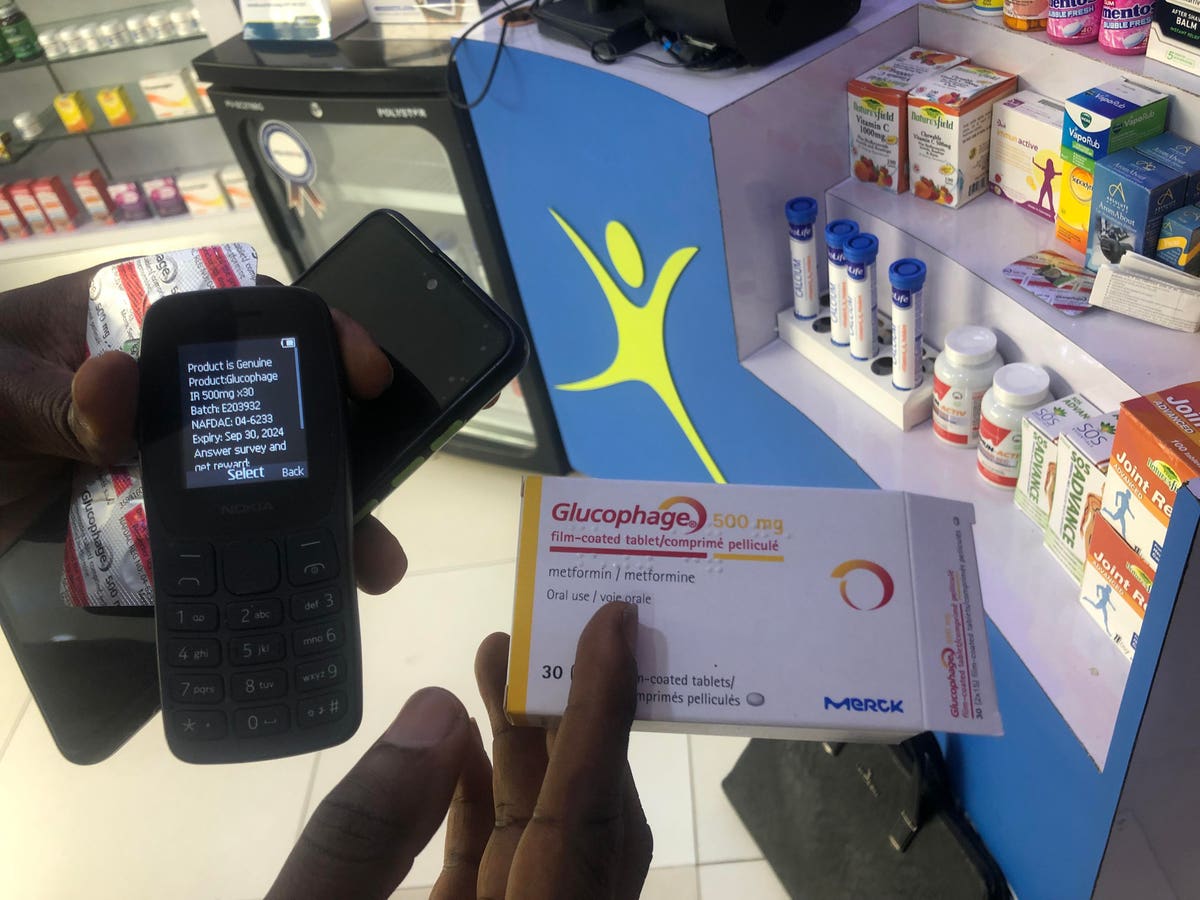
John Okpe of Chekkit verifies the authenticity of a diabetes medication.
Personal tragedy has motivated a number of people fighting bad medicines in Nigeria. Jessica Osita, one of the Nigerian teenagers who developed a prize-winning app called FD-Detector (Fake Drug Detector), lost her brother to a fake medicine after an accident.
The founder of the online pharmaceutical market Medsaf, Vivian Nwakah, was shocked when a friend died after taking a fake malaria pill.
Dora Akunyili was the revered head of NAFDAC, the Nigerian government agency responsible for monitoring the quality of foods and medicines, during the height of the country’s fake-medicines crisis. Akunyili lost her sister Nwogo to a fake insulin injection at the age of 21. Akunyili would go on to survive arson and assassination attempts in her work to stamp out the widespread circulation of ineffective or harmful medicines.
And for John Okpe, it was a sister of a close friend who died after taking a tainted cough syrup. Okpe is the business development manager for the health tech firm Chekkit Technologies, a four-year-old company that authenticates medicines. Okpe says that Chekkit was the first traceability service provider in Nigeria to be approved by NAFDAC and GS1, a global nonprofit that sets medicine standards. And Chekkit allows verification in more ways than competitors – through a mobile app, SMS, and USSD (another form of text messaging that is faster than SMS).
Some of what Chekkit does is a more sophisticated version of an already commonplace activity. Nigeria is the first country to widely mandate Mobile Authentication Service (MAS) for medicines (specifically antimalarials and antibiotics, though other medicines now use it as well).
MAS is a system of phone-based verification of goods. In Nigeria it typically takes the form of adhesive labels with scratch-off components that reveal a code. Individuals can then send a text message with the code, which should swiftly generate a message about whether the medicine is authentic.
“It’s basically just a track-and-trace system,” explains Margaret Ilomuanya, the acting head of the Department of Pharmaceutics and Pharmaceutical Technology at the University of Lagos (who herself has had to advise people impacted by poor-quality medicines). In other words, MAS doesn’t give details of the biological composition of each drug checked, but it enables some tracing through the supply chain.
It’s been suggested that MAS has been linked to the curbing of falsified medicines, although it’s been hard to assess the exact impact.
For one thing, it’s common not to bother using MAS even if available. Many people trust the place selling the medicines, more than the tech. A 2016 study by Ilomuanya and Aisagbonhi Justine, of customers of licensed pharmacies, found that while over ¾ knew of the Mobile Authentication Service (MAS) on antimalarials, just over ¼ were using it regularly. And use varied by the part of the country and education level.
Olusesan Makinde, a physician and the CEO of the health and development consultancy Viable Knowledge Masters, says that he would use MAS if he had doubts about a particular medicine. But for the most part, “I would rather trust the kinds of facilities I go to…That can also serve as assurance.”
Pharmacists aren’t always enthusiastic about MAS either. One study of community pharmacists’ perceptions found for instance that Nigeria’s persistent power outages affected telecom networks, and thus the speed and usefulness of the service.
Yet Nelly Okpako, a pharmacist at the upmarket pharmacy chain HealthPlus, says that it makes good business sense to stock MAS-enabled products. Some of her customers have had bad experiences with poor-quality medicines. Those who have good results will come back. MAS helps with this because “when they’re able to do this, they trust your brand, and they trust the authenticity.”
Chekkit verification labels on diabetes medication.
And even if people aren’t regularly using MAS, it can still be worthwhile. “I think MAS is very useful,” says the pharmacist Ilomuanya. “One of the things that MAS has done is to improve the consumer acceptance of the products.”
So when someone sees that products have MAS, they have more trust in the individual products and in the overall pharmaceutical system. That helps Nigeria’s pharma sector even when people don’t check the labels.
Okpe says that counterfeiters have started faking MAS labels, making some companies interested in solutions that are more resistant to fakery. Chekkit’s labels use security features like taggants. This is a chemical coating, also used on some currencies, that manufacturers can scan with special devices to check the authenticity. The label lights up green for an authenticated product and red otherwise. Thus it provides some quality assurance before the medicines reach the consumers, who themselves can check the authenticity on their end.
Makinde and colleagues have also developed an app where members of the public can report unlicensed medical facilities, including pharmacies and medicine vendors. They’re seeking investment and working with state government on how to roll it out, to ensure that the public reports will translate into action.
While useful, this sort of consumer tech remains beyond the reach of many. By one estimate, approximately 35% of Nigerians don’t own cell phones. Of those that do, only a small minority have smartphones, which are needed to access apps.
Nor do all Nigerians have access to licensed pharmacies. Particularly in informal settlements or remote areas, there are limited choices of medicines – if medicines are available at all, apart from herbal and traditional remedies. Where medicines are accessible, it may be most convenient and affordable to obtain a few tablets or a sachet at a time, rather than purchasing a full package. Yet it’s the full packaging that would usually carry the MAS label.
Patent medicine sellers can fill the gap in places without formal pharmacies. Patent medicine outlets are authorized to sell only over-the-counter medicines, but commonly sell other medicines as well. In reality they’re operating in a legal vacuum, as most places selling patent and proprietary medicines are unregistered.
It would be easy to condemn the patent medicine vendors who are selling medicines illegally, without necessarily having knowledge about medicine interactions. The quality of medicines in these outlets is often dubious. But with their convenience and availability, these largely informal businesses undeniably fill a gap. And some informal sellers of medicines aim to be responsible, even if they’re unlicensed.
A poster warning of fake medicines at Lagos University Teaching Hospital.
Yet even people who can access medicines with MAS often don’t bother to use it. And this is where Chekkit has innovated a way to inculcate the habit.
Its clients provide questions that Chekkit turns into optional surveys. These are simple surveys of two or three questions that customers can fill out, even on feature phones, or using an Android app. Filling out a survey gives customers access to rewards, like points that can be converted into cellular airtime or bank transfers. However, these rewards are not attached to over-the-counter products, Okpe says, because while they want to incentivize verification of medicine they don’t want to encourage overuse.
The incentive is also a motivating factor for the pharmaceutical manufacturers, because they gain access to the information provided through surveys. “Currently we are the only company that provides this level of information and insight,” Okpe says. “We’ve had brands that work with us as a company because of the rewards.”
Thus the business has two sides: the authentication of medicines, and the data generated in the process. Okpe believes that while Chekkit’s labels are a bit more expensive than standard labels, “manufacturers understand the added value.”
On the other side, “Customers are starting to have the habit,” Okpe comments. He says that 60–80% of the time, customers are authenticating the products they purchase.
According to Chekkit’s CEO, Dare Odumade, there have been over 1 million consumer authentications, and there are over 30,000 users of the app, verifying an average of one product a week.
Ilomuanya acknowledges that MAS isn’t perfect. She says there have been some cases where MAS wrongly identified products as inauthentic, harming the reputations of medicine providers. And some of the less established tech companies providing MAS services have had issues with their software, according to Ilomuanya.
Indeed, users sometimes complain that when they attempt to verify a message using MAS, nothing happens.
But given the benefits of MAS – which Nigeria has been on the vanguard of, and which other countries are keeping an eye on – this is a promising tool to keep bad medicines at bay. It can’t be the only tool, but it’s a useful part of the arsenal.
The end goal for such tools is complete traceability of pharmaceuticals in Nigeria. Okpe is extremely optimistic that whenever the goal is reached, it will be a gamechanger. “Right now, the pharma industry in Nigeria is really fragmented,” he says. It will be highly challenging if not impossible to cut out all pharma crime and informality, but Okpe is shooting for the stars: “I think if this is implemented, counterfeiting will be basically eliminated.”
Overall, technology has limitations in reaching this goal. Good intentions haven’t been able to stop a graveyard of apps and detection devices from littering this field, ultimately getting discarded after having little effect.
“I’ve seen some very expensive detection devices sit on a shelf and just gather dust,” noted Pernette Bourdillon Esteve, who leads a World Health Organization team working on falsified and substandard medical products, while speaking at a Fight the Fakes Alliance event. “You need a round peg for a round hole.”
If Chekkit can indeed be a round peg for the round hole represented by the complex challenges of ensuring medicine quality in Nigeria, many lives will be saved.
See also: a companion article on manufacturing of medicines within Nigeria.
This project was funded by the European Journalism Centre, through the Global Health Security Call. This program is supported by the Bill & Melinda Gates Foundation.