

SNAP CONCUSSION DEVICE
DR. ROSINA SAMADANI, CEO OCULOGICA
Sideline concussion diagnosis has relied for over a century on subjective clinical signs — finger tracking, orientation questions, symptom checklists — that a motivated athlete can suppress in seconds. As an emergency physician who has stood on NFL sidelines, I can attest to the discomfort of that moment: adjudicating brain safety on signals an athlete controls. SNAP, a portable eye-tracking device developed by Oculogica, and FDA cleared on June 5th, 2026, is engineered to close that gap by introducing an objective physiologic measure at the point of injury.
Mechanism and performance
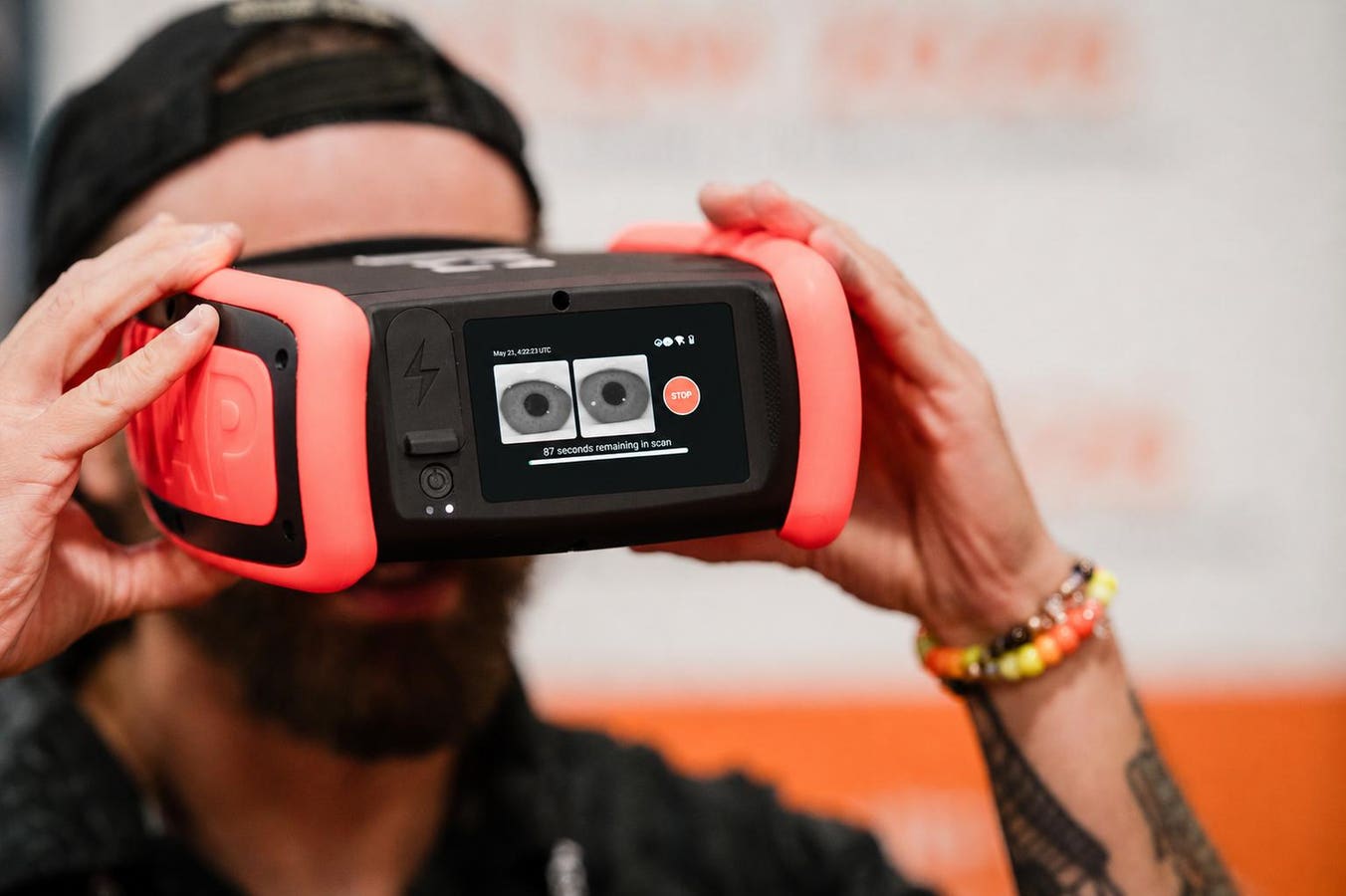
SNAP records eye movements via high-speed camera while the athlete watches a brief video stimulus traverse a screen. The device captures involuntary oculomotor metrics — exploiting the fact that concussion disrupts cranial nerve–mediated gaze coordination, producing dysconjugate eye movements below the threshold of clinical detection — and integrates them with symptom input to generate a composite SNAP Score in approximately 90 seconds.
Carrying Case for SNAP with SNAP concussion device displayed
Dr Rosina Samadani, CEO Oculogica
“This is our 6th FDA clearance for concussion, our first for a sideline-capable test. SNAP is the fastest, most accurate concussion test cleared by the FDA: 90% sensitive, 94% specific,” according to Dr. Rosina Samadani, CEO of Oculogica.
The platform was validated in studies led by Dr. Christina Master, a pediatrician and sports medicine specialist and founding co-director of the Minds Matter Concussion Program at Children’s Hospital of Philadelphia, and Kenneth L. Cameron, PhD, MPH, ATC, FNATA, Director of Orthopaedic and Sports Medicine Research, John A. Feagin Sports Medicine Fellowship, Keller Army Hospital, United States Military Academy, West Point, New York.
Demonstration of a SNAP Concussion device
DR. ROSINA SAMADANI, CEO OCULOGICA
“The premise is elegant and rooted in neuroanatomy,” explained Dr. Christina Master. “For years, sideline concussion assessment has been built almost entirely on what the athlete reports. That is a subjective foundation, particularly in young patients. The eye-tracking component of devices like SNAP provides something the patient cannot manufacture or suppress: a direct window into neurological function at the time of assessment.”
“When you combine that with symptom data, you get a far clearer clinical picture which matters enormously in pediatric sports medicine, where the stakes of a missed diagnosis are high and the reliability of self-report is variable,” added Master.
Neuroanatomic basis
Concussion disrupts cranial nerves governing extraocular muscle coordination, producing subtle vergence and saccadic errors — disconjugate gaze — invisible to bedside examination but detectable at a 500 Hz sampling rate. Because these micromovements are involuntary, the measurement bypasses the volitional underreporting that compromises symptom-based assessment.
“Subjective symptom reporting is the current standard, but it has real limits in concussion assessment,” said Dr. Kenneth L. Cameron. “Patients minimize, forget, or simply can’t articulate what they’re experiencing, especially in the acute phase.”
“What makes SNAP compelling is that it combines those subjective inputs with an objective, eye-tracking measure that the patient cannot consciously influence. That combination gives clinicians something they haven’t had on the sideline or in the field before: a fast multi-modal assessment that includes a critical objective component,” added Cameron.
Regulatory foundation and baseline independence
SNAP’s underlying platform, commercialized initially as EyeBOX, received de novo FDA authorization in December 2018 — cleared without a predicate device as the first objective, baseline-free aid in concussion diagnosis. Subsequent clearances include a 2025 label expansion encompassing the broadest indications in the field across age range, time since injury, injury type, and a new indication for longitudinal recovery tracking.
Baseline independence is a critical differentiator. Established tools– ImPACT, King-Devick, Sway— require pre-injury baseline testing, a model that degrades in practice: athletes transfer, baselines expire, youth and recreational athletes go untested, and deliberate baseline sandbagging is well documented. SNAP compares the injured athlete against a normative population, making it equally deployable in organized and unorganized sports venues.
Competitive landscape
ImPACT, the computerized neurocognitive battery administered over 17 million times across the NFL, NHL, MLB, and most collegiate programs, remains the de facto standard but functions primarily as a return-to-play management tool dependent on baseline comparison. King-Devick and Sway share that baseline dependency. SyncThink’s EYE-SYNC offers objective, baseline-free eye tracking but delivers it through a virtual-reality headset. SNAP converges three properties in a single device — objective physiologic measurement, baseline independence, and a portable 90-second format — a combination no current competitor replicates.
“Concussion has been an underserved area in medicine for a long time, not because clinicians don’t care, but because the tools haven’t been there,” said Dr. Rosina Samadani, CEO, Oculogica. “SNAP closes a real gap — It pairs the subjective symptom picture with an objective eye-tracking measure that the patient cannot influence, and it does it in 90 seconds.”
“Our goal is straightforward: make objective concussion assessment available wherever an athlete gets hurt, whether that is a high school football field, a military installation, or an emergency department,” explained Samadani.
Limitations and independent evidence
The manufacturer-reported sensitivity and specificity derive from controlled validation cohorts. A 2025 study in Brain Injury evaluating the Eyebox platform in a sport-related concussion population found high specificity at the recommended cutoff but reduced sensitivity — missing a substantial proportion of clinically diagnosed concussions — a gap that contrasts with performance in earlier emergency-department cohorts with more severe injuries. The device carries an FDA indication as an aid to diagnosis, not a standalone diagnostic, and is optimally deployed as an adjunct to structured clinical assessment.
Future directions
The broader trajectory of the concussion diagnostics — toward objective, portable, baseline-free measurement — positions oculomotor-based diagnostics as a likely component of next-generation concussion protocols.
“We built EyeBOX to establish an objective aid in diagnosis of concussion,” Samadani emphasized. “That was a needed step forward for the entire field.”
“SNAP takes that proven platform and makes it practical for the clinician at the point of care. The science did not change. What changed is that a sports medicine physician, an athletic trainer, or perhaps even a military medic can now use it in the field, in 90 seconds, without interrupting care. That is the difference between a technology that advances the field and one that changes practice,” she added.
A 90-second test that reads the brain through the eyes will not, by itself, settle every sideline decision. But it shifts the clinical question from what do you think happened to what does the data show — and in medicine, that is always the better question to be asking.