

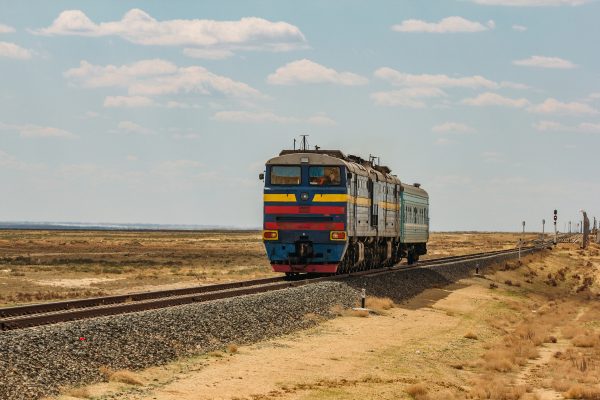
High-speed train travel can be a challenging prospect for any nation. To achieve speeds of 250 kilometers per hour, high-speed rail (HSR) requires wide expanses of flat, unpopulated land to barrel through, something that has seen such attempts flounder recently in the United States and the United Kingdom.
However, if there is one thing that Kazakhstan is not short of, it is wide expanses of flat, unpopulated land.
Traveling between its far-flung cities is an exercise in endurance, with even the “express” service traversing the 1,200-kilometer distance between the capital, Astana, and Kazakhstan’s largest city, Almaty, taking a minimum of 15 hours.
It was unsurprising therefore, when a north-south high-speed link was proposed in January 2013. Kazakhs were promised that six trains a day would ferry passengers between Almaty and Astana in 5.5 hours, cutting at least 10 hours off the grueling journey.
At the time it did not seem so bold. In 2011, China had recently opened its first high-speed line, with trains taking just under five hours to cover the distance between Beijing and Shanghai – almost the same as that between Almaty and Astana.
Kazakhstan’s initial plan included a bridge spanning 20 kilometers across Lake Balkhash, Asia’s third largest lake, and was intended to be completed before the 2017 Astana Expo.
More schemes followed, including a high-speed line to Russia. At a press conference held in Astana in 2014, Russian Railways President Vladimir Yakunin was full of optimism: “I personally do not see anything futuristic in the project to create high-speed traffic from Minsk to Almaty through the territories of Russia, Belarus, and Kazakhstan,” he proclaimed.
As it turns out, this future has taken a while to materialize. Indeed, even at the time, Kazakhstan’s then-President Nursultan Nazarbayev was already backtracking on the Astana-Almaty line.
“I would like to have such a railway,” he stated. “But this idea requires careful calculation before we begin financing.”
Rationalization
Population has turned out to be a key sticking point. Beijing and Shanghai may be separated by a similar distance as Astana and Almaty, but they are both megacities, with populations in excess of 20 million people, more than the entirety of Kazakhstan.
“The reason HSR worked in China and Uzbekistan has to do with the population density: between major urban areas, the distances are shorter,” said Dennis van der Laan, editor of RailFreight.com. “Almaty is a big city of 2-3 million people, Astana about 1 million, but with such a large distance between them, I think they’ve calculated that the amount of passengers traveling on that line is not going to be big enough to justify the immense costs that you’re going to incur.”
But a rational, penny-pinching Nazarbayev was not what people were used to. This was a man who, after all, had overseen the relocation of the country’s capital city from Almaty to Akmola in 1997 (renamed Astana in 1998) and spent two decades furnishing it with a series of extravagant eyesores – a $400 million shopping mall in the shape of a tent, or the $652 million presidential palace, for example.
Unfortunately, by 2014, Kazakhstan had entered a brave new world. Shale oil producers in the United States created a supply glut, which sent the price of crude oil down 60 percent between June 2014 and January 2015. For Kazakhstan, whose largesse had been underpinned by sky-high oil prices, the effects were ruinous. Indeed, it was only this year that Kazakh GDP regained the levels of 2014; GDP per capita has still yet to recover.
Over the past decade, Kazakhstan has increasingly drawn on its sovereign wealth fund for day-to-day running of the country. With money tight, awareness of unscrupulous officials using these kinds of large projects for graft has also grown.
“Obviously I’d be happy to see fast trains like in China,” said Asem Bolatbekova, a producer living in Almaty, who prefers to fly when she returns to her hometown in the eastern city of Öskemen. “But I’m not sure if it’s the priority; there’s always the likelihood that the money for these projects will end up in someone’s back pocket.”
Prioritization of Freight
Some investment has nevertheless made its way into the railways. Indeed, over the last six years, the country’s track and rail operator, Kazakhstan Temir Zholy (KTZ), has added 2,500 kilometers of track to its network, costing over $35 billion.
In March, Nazarbayev’s successor, Kassym-Jomart Tokayev, inaugurated a KTZ facility in Xi’an, China. There also is a grand plan to redevelop over 200 stations, to build a new generation of diesel locomotives, as well as investing another $2.9 billion in building four extra lines – two to increase supply from China; another to bypass Almaty; and new line to the Uzbek border, better connecting Kazakhstan to the Eurasian heartland.
It’s all part of a strategy to modernize the railway network.
“Kazakhstan is trying to position itself as a transit hub between East and West,” said van der Laan. “There are two main routes for China-Europe traffic: one is the so-called Northern Route, which goes from China to Russia and then through Belarus into Poland; the other is the so-called Middle Corridor, which goes through Kazakhstan, across the Caspian Sea and into the Caucasus. From there you can either cross the Black Sea or go through Turkey.”
While the Middle Corridor is longer and more complex, the war in Ukraine has made Western countries less willing to use a Russia-dominated route, and instability in the Red Sea has also helped people view it as a viable alternative. Volumes have grown significantly, from 1.5 million tons in 2022 to 2.7 million in 2023 and 1.6 million in the first six months of 2024.
“This year they are actually aiming to hit 5 million tons,” said Rauf Aghamirzayev, an independent Azerbaijani expert in the field of transport and logistics. “The potential is great, but there are nuances. The Northern Route was expanded before the war; we are not yet their competitors.”
That said, even the route from China via Russia often passes through Kazakhstan. In all, some 80 percent of Europe-China land freight at some point transits through the country.
This means that when it comes to building new lines, high-speed rail for passengers is not the first item on the Ministry of Transport’s to-do list.
“Freight is the one that generates most revenue. So that’s likely to have priority,” said van der Laan.
This is demonstrated by a simple statistic: rail is responsible for transporting over 50 percent of freight around the country, but it only accounts for 15 percent of passengers.
Competition From the Sky
Meanwhile, the need for high-speed rail is further mitigated by the growth of domestic air travel. A key factor in this has been the emergence of low-cost carriers, particularly FlyArystan, which now accounts for 37 percent of the domestic market. Air travel in Kazakhstan saw 14 percent growth between January-July 2024 compared to the same period last year.
FlyArystan’s parent airline, Air Astana, floated on the London Stock Exchange earlier this year, showing investor confidence in the sector. Until that point, it had been owned jointly by Kazakhstan’s sovereign wealth fund, Samruk Kazyna (51 percent), and British defense firm BAE Systems (49 percent), and had been accused of monopoly pricing.
Both of these developments suggest that prices for flights should fall in the coming years. Right now, air travel is expensive compared to rail. When purchased a week in advance, a one-way plane ticket from Almaty to Astana costs around $50-60; a third-class sleeper train ticket costs $20, while a seat on the 23-hour stopping service is as low as $15.
“Flying is a bit expensive for most of the population, especially if you book last-minute,” said Bolatbekova. “If you book a month in advance, it’s okay, but last-minute the price for a round trip can go up to $200. For a lot of people that is simply not affordable, even if it might sound cheap to a Western traveler.”
If You Can’t Beat ‘em, Join ‘em
That said, part of the success of HSR in neighboring Uzbekistan is that foreign travelers have proven to be reliable purchasers of tickets. Bullet trains ferry visitors between the cities of the ancient Silk Road, with many happy to pay $50 for the convenience and comfort of a four-hour trip between Tashkent and Bukhara.
This has not gone unnoticed in Kazakhstan. So while the grand route connecting Kazakhstan’s two main cities may appear far off, a shorter, more feasible route has been proposed to link Shymkent and Turkestan (the site of Kazakhstan’s most famed religious shrine) with the Uzbek capital, Tashkent. Announced in 2021 by Tokayev, it was set to be in operation by 2024.
However, that too has stalled. The Kazakh Deputy Minister of Transport Maksat Kaliakparov stated in February that the cost would be some 322 billion tenge (around $660 million), with “the sources of financing to be determined.”
He went on to say that, as a result, “the project has been suspended for now.”
In essence, when it comes to transport, freight remains the priority. For those wanting to get around the country, a slow train or an expensive flight is about as good as its going to get for the foreseeable future.