

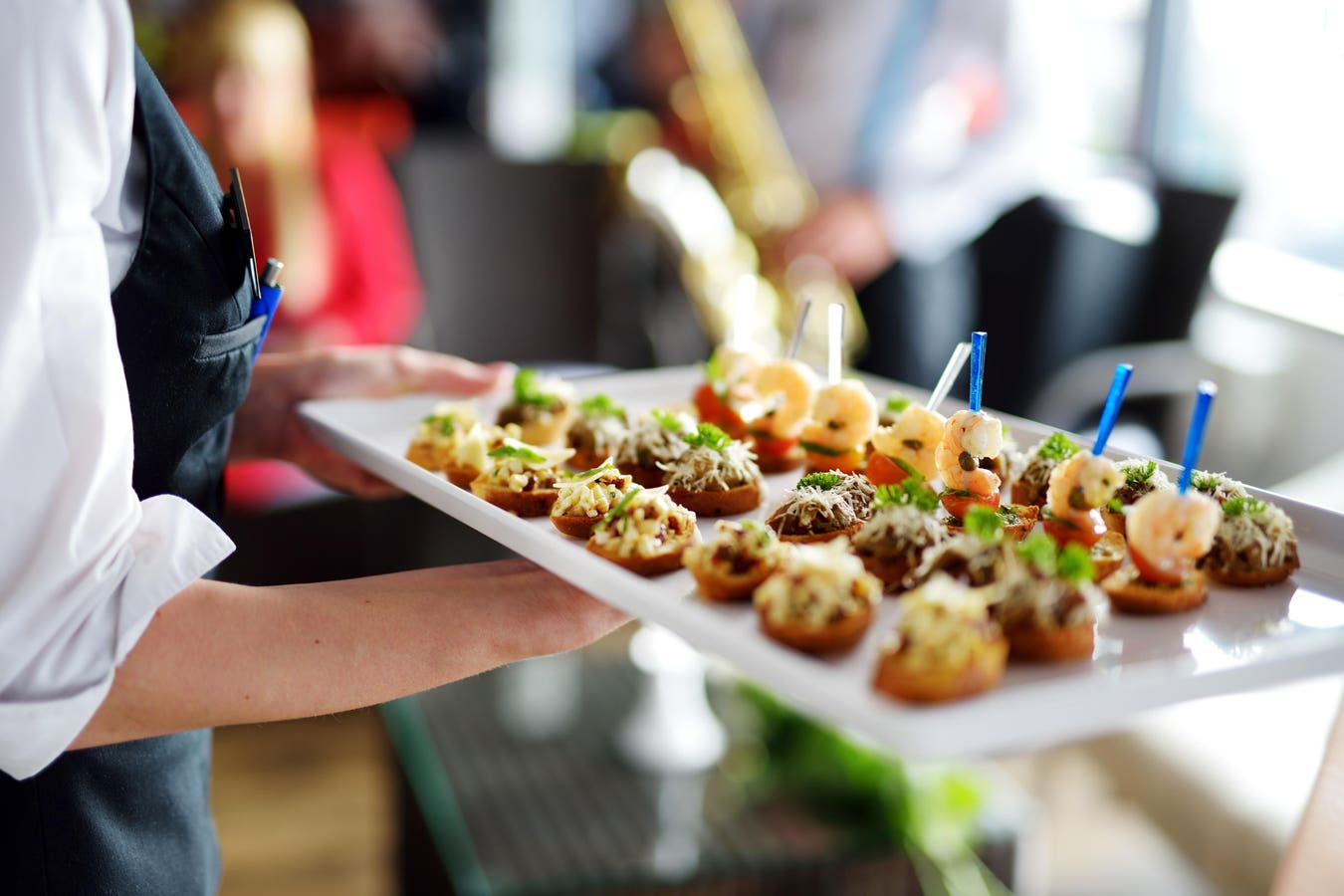
A waiter serves a tray of appetizers. Summer heat and travel disruptions increase the risk of foodborne illness at buffets and catered events.
getty
It starts with a plate of shrimp at the resort buffet. It’s pink and chilled—or at least, it’s sitting on a bed of ice. You eat it and you feel fine.
But six hours later, you’re on your knees in the bathroom of your hotel, and your vacation is over.
Late summer is the peak season for culinary hazards, and if you’re not careful, you could be heading for a gastrointestinal disaster. This heightened risk is amplified by combining record-breaking heat with the operational meltdowns plaguing the travel industry, such as delayed flights, understaffed hotels and power outages.
While travelers focus on visible issues like cancellations and lost bags, a more dangerous threat is invisibly brewing in galley carts and buffet lines. The breakdown of temperature controls is the mechanism turning otherwise ordinary vacation meals into medical emergencies.
Think about this—boiling water is 212 degrees, but a comfortable bath temperature is around 100. If you could take a bath in it, bacteria can rapidly multiply.
Why You Need To Worry About The Cold Chain This Summer
The travel industry’s food safety relies on a temperature-controlled supply chain that ensures your food stays safe from farm to fork.
But when the temperature spikes, the cold chain can fail.
“Cold chain breakdown during summer months increases the risk of foodborne illness mainly through inadequate refrigeration at restaurants and food service establishments,” says Robert Glatter, an emergency physician in private practice in New York City and an editor at large for Medscape Emergency Medicine.
Glatter warns that even high-quality restaurants and resorts sometimes lack proper refrigeration and food safety training.
Here’s the science that should keep you up at night: When refrigerated foods are exposed to room temperature for even short periods, the clock starts ticking twice as fast.
“The time for pathogens such as Listeria monocytogenes and Yersinia enterocolitica to reach infectious levels may be up to 50% less compared to continuous refrigeration,” Glatter says.
That’s not a margin of error you want to mess with when you are 3,000 miles from your primary care physician.
The Danger Zone Is Real In Hot Weather
But it is not just about the food getting warm—it’s how long it stays warm.
Trisha Pasricha, a gastroenterologist and assistant professor of medicine at Harvard Medical School, defines the “danger zone” for bacterial growth as between 40 and 140 degrees Fahrenheit.
“Think about this—boiling water is 212 degrees, but a comfortable bath temperature is around 100,” she says. “If you could take a bath in it, bacteria can rapidly multiply.”
Pasricha warns that summer travel creates lots of opportunities for this to happen, from hot outdoor markets to food trucks without adequate refrigeration.
And if you think you can taste the danger, think again.
Mario Hupfeld, the CTO of NEMIS Technologies, holds a Ph.D. in microbiology. He notes that this growth happens quietly and invisibly.
“You won’t smell or taste it, but the risk is right there,” Hupfeld says.
Hotel Buffet Food Safety Tips To Avoid Illness
Let’s talk about that buffet, the staple of the vacation experience. It’s a minefield.
Dean Harper, a private chef in London, has a front-row seat to the problem. He identifies a specific behavior that turns a mediocre meal into a medical emergency: grazing.
“People graze for hours at a buffet, effectively turning a short exposure into a long one as food sits in the danger zone,” Harper says.
Harper points out that guests often judge food by looks rather than temperature, trusting shallow ice baths, barely warm chafers or heat lamps that don’t actually hold food at the required 135 degrees Fahrenheit.
But the real concern happens in the kitchen. It is called topping up.
Saifur Rahman, the head chef at Tower Tandoori in London, explains that in an effort to keep the buffet looking full, staff often make a critical error.
“Staff may top up fresh food onto older batches instead of swapping the whole pan, which keeps the core in the danger zone,” Rahman says.
This practice seeds fresh products with high bacterial loads, Harper adds.
So that scoop of “fresh” potato salad you just took might be sitting on top of a three-hour-old batch that is teeming with Staphylococcus aureus.
High-Risk Foods To Avoid On Vacation
Is sticking to simple starches safe? Probably not.
Rahman warns that sitting in the danger zone lets Bacillus cereus and Clostridium perfringens multiply in cooked rice, curries, stews and gravies.
Sharon Nachman, chief of pediatric infectious diseases at Stony Brook Children’s Hospital, calls out rice and mayonnaise as high-risk items.
“Both are at high risk for food poisoning,” Nachman says. These bacteria produce toxins that lead to vomiting and diarrhea, often striking just a few hours after ingestion.
So, the fried rice at the airport lounge that has been under a heat lamp since 10 a.m.? Bad choice.
How Flight Delays Affect Airline Food Safety
This summer, the risk is compounded by the chaos of travel itself. When the airline system melts down, the food safety system melts down with it.
Rahman notes that airline catering getting caught in prolonged tarmac delays chips away at safe temperatures without obvious warning signs.
Allan Hou, a sales director who oversees temperature-sensitive goods through Asia and Australia, has data to back this up.
“A single hour at an airport or hub can put perishable foods into the danger zone,” Hou says.
He recounted an incident with a shipment of chilled seafood delayed by extreme heat at a coastal airport. “Although the shipping container remained sealed, the internal data loggers recorded temperatures exceeding 50 degrees F within 2 hours,” he recalls.
“As soon as temperatures are above this level, bacterial growth increases exponentially,” Hou adds.
Now apply that logic to the turkey wrap on your flight that has been sitting on the tarmac for three hours while the mechanics fix the air conditioning. The cold chain has snapped.
The Backpacker’s Fallacy
It is easy to blame the hotels and the airlines for the breakdown in food safety—and often, it is on them. But travelers play a role in this biological threat, too.
Hupfeld calls it the backpacker logic.
“You’ll see a lot of backpackers walking to and fro from convenience stores, thinking that the food was only out for 20 minutes and that it’s safe,” Hupfeld says.
“But even those 15 minutes out in the summer heat is more than enough for bacteria to get a head start,” he warns.
Are Hotel Mini-Fridges Safe For Leftover Food?
Another area of concern is the mini-fridge.
Meridan Zerner, a dietitian at the Cooper Clinic in Dallas, warns that some hotel mini-fridges simply aren’t cold enough.
Hupfeld agrees.
“The mini-fridges back at the hotels are just as much of a problem because they’re not going to sufficiently cool your food like the ones you have in your kitchen,” he says. “Especially if the fridge is packed full.”
Zerner advises avoiding storing perishables on the doors or top shelves of these units. If you are relying on a lukewarm hotel fridge to save your leftover sushi, you are gambling with your gut.
How To Protect Yourself Against A Broken Cold Chain
So, how do you avoid turning your stomach into a war zone? Here is what the experts suggest.
Audit The Buffet
If you must eat at the buffet, take Harper’s advice: “I take small portions from a pan that’s just been swapped in, avoid anything sitting low in the well, and skip items without visible heat or solid ice underneath.” Avoid the last, tired pan right before closing.
Watch The Clock, Not The Cooler
Don’t trust your hand to tell you if something is cold enough. Trust the clock. “Avoid consuming any food item that has been left outside for more than 2 hours in warm temperatures,” advises Hou. If the ambient temperature is over 90 degrees, that window drops to one hour.
Go Sealed Or Go Home
If you’re facing a delay, stop looking for a hot meal. “Seek sealed items like yogurt, milk or whole fruit rather than mixed, mayonnaise-based or creamy dishes,” says Harper. Fruits with a peel you can remove yourself, like bananas or mangoes, are better.
Medicate Yourself
Pasricha suggests a proactive approach: “Studies have found that taking bismuth subsalicylate (Pepto-Bismol) before and during travel can reduce the risk of traveler’s diarrhea by 65%.”
Finally, Check Your Insurance Coverage
If you do get sick, it might cost you more than just time. Lauren McCormick of Squaremouth notes that travel medical insurance can cover the costs of urgent care for food-borne illnesses. If you are too sick to fly, trip interruption coverage can pay for your extended stay.
Is It Safe To Eat?
We want to believe that the travel industry has our back. We want to believe that the restaurant is following code, that the airline is checking the catering carts, that the hotel fridge works.
But during this summer of chaos, blind faith is a shortcut to the emergency room.
The heat is on. The systems may start breaking down. And the only person who is going to make sure your food is safe is you.