

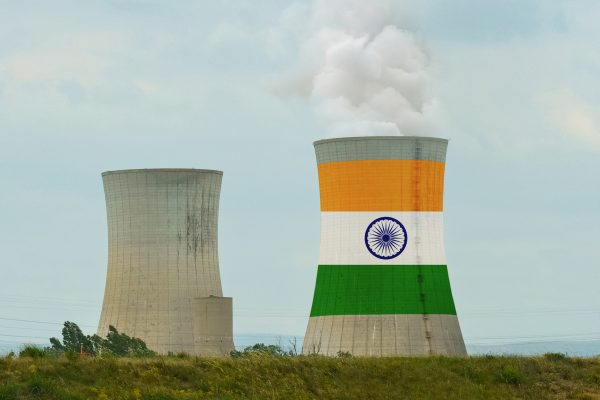
It’s been almost 20 years since India and the United States announced the launch of a civil nuclear cooperation initiative. That laid the framework for the epochal India-U.S. nuclear deal, a watershed moment in the bilateral relations between the two countries. The deal ended India’s decades-long nuclear isolation, allowing it to resume civil nuclear cooperation while implicitly being recognized as a responsible nuclear-weapons state outside the Nuclear Nonproliferation Treaty (NPT) – a big shift in U.S. policy that drew sharp criticism for undermining long-standing nonproliferation norms.
This agreement is now back in the spotlight after many lost years of unrealized potential. A United States firm, Holtec International, has been greenlit by the U.S. Department of Energy to jointly build and design nuclear reactors in India. This is a significant breakthrough, since under the deal, U.S. firms could only export nuclear reactors to India and not engage in any design or manufacturing process.
This important regulatory clearance for Holtec International comes against the backdrop of recent high-level meetings between Indian Prime Minister Narendra Modi and U.S. President Donald Trump, during the former’s visit to the United States in early 2025. In a tacit acknowledgement of the lack of progress to date, both sides expressed their renewed commitment to the full implementation of the agreement. In addition, both sides welcomed New Delhi’s decision to take up amendments to its Atomic Energy Act of 1962 and the Civil Liability for Nuclear Damage Act (CLNDA) of 2010 as part of India’s broader efforts to advance its new Nuclear Energy Mission, announced as part of the country’s 2025-2026 Union Budget.
Twenty years on, while it is clear that the India-U.S. nuclear deal has not weakened the global nonproliferation regime as claimed by critics, the full potential and promise of it is yet to be realized. Most significantly, the deal did not lead to the set-up of U.S.-designed reactors in India. Among the many hurdles, a key issue has been India’s nuclear liability law. Amending the long-controversial CLNDA, the nuclear liability law of India, is a welcome move that could be the key to fully reviving the deal by aligning it with international norms and restoring the confidence of U.S. suppliers entering the Indian nuclear energy market.
The Nuclear Liability Backdrop
If foreign suppliers, particularly private cooperatives, were to enter the Indian nuclear energy sector, India needed a clear framework for dealing with liability issues in the event of a nuclear accident. Until then, it was understood that all liability issues were the responsibility of the central government, as it owned and operated all nuclear facilities. In signing the nuclear deal with the United States, India agreed to first sign and ratify the Convention on Supplementary Compensation (CSC), which required the establishment of a clear domestic liability framework. In addition, since India is not a party to the NPT or any of the international nuclear liability conventions, the government felt it necessary to draft legislation to incentivize both domestic and foreign suppliers to participate in the country’s nuclear power expansion.
The Indian government passed the CLNDA in September 2010. However, this act went beyond the international standards such as those set by the CSC, which requires all liability burdens to be placed solely on the power plant operator (not the supplier) to provide compensation to victims in case of a nuclear accident. The CLNDA also holds suppliers liable. What this means is that operators have the right to seek legal recourse against its suppliers in case of a nuclear accident on grounds of faulty or defective technology or components.
It was not the original intention of the Manmohan Singh government at the time to enact such a unique law. The Singh government had initially sought legislation in line with the said international standards. On May 7, 2010, the bill was introduced in the Lok Sabha, the lower house of the Indian Parliament. Coincidentally, at the same time, the Supreme Court delivered a decision on the deadly 1984 Bhopal gas tragedy. This decision brought back painful memories for the public, and the fact that there was no regulatory framework in place to hold the U.S. company Union Carbide accountable was uncomfortably glaring.
The timing of the decision allowed the opposition, the Bharatiya Janata Party (BJP), to press for more accountability for suppliers. Arun Jaitley, leader of the BJP opposition, stated in Parliament:
As long as these plants are to be operated… either by the government or by the public sector, why must the government of India and the public sector take the liability if the mistake is committed by some third party? The equipment may be defective; the equipment may have a latent or patent defect…that is why, it compelled me to say that we turn our law upside down.
The draft bill was hotly debated in the Parliament on several issues such as liability thresholds of the operator, maximum liability, and exemption of suppliers from liability charges. In the end, Section 17 of the Act provided the operator the “right to recourse” from suppliers. The Bhopal gas tragedy was the primary reason for the inclusion of Section 17(b). It says:
17. Operator’s right of recourse. – The operator of the nuclear installation, after paying the compensation for nuclear damage in accordance with section 6, shall have a right of recourse where –
…
(b) the nuclear incident has resulted as a consequence of an act of supplier or his employee, which includes supply of equipment or material with patent or latent defects or sub-standard services;
Since the Singh government lacked an absolute majority in the Parliament, the bill was subject to many revisions on account of the BJP. The resulting law now accepted the supplier’s liability: “Thus, Section 17(b) of the bill introduced the concept of supplier liability, a ‘watershed moment in international nuclear liability jurisprudence,’ given the current norm of assigning nuclear liability ‘exclusively to operators.’”
After establishing its domestic liability framework, India signed the CSC in October 2010 and ratified it in February 2016.
Aftermath
The resulting law drew widespread criticism from foreign suppliers as well as supporters of India’s nuclear power expansion. It raised doubts about how India would secure the advanced reactors and components that were initially expected to be the early results of the India-U.S. nuclear deal.
U.S. suppliers like GE Hitachi and Westinghouse were hesitant to engage in nuclear commerce in India for fear of liability claims and did not want to undertake any risk. They argued that such a law set a wrong precedent by allowing the operator to sue the supplier “for absolute, unlimited, and non-delegable liability that could prevent them from taking insurance cover and bankrupt them in case of a nuclear accident.” It was not just private U.S. suppliers who opposed the act, but also suppliers from France and Russia as well.
To ameliorate these concerns, the Indian government created the Indian Nuclear Insurance Pool (INIP) “with a capacity of 1500 crore [15 billion] rupees to provide insurance to cover the liability as prescribed under the CLNDA 2010.” In 2015, the government tried to provide a workaround to the act by claiming that the supplier’s liability would not be a mandatory part of the contracts signed with foreign suppliers. While the Russian state-owned Rosatom has accepted these assurances due to protections from their government, U.S. suppliers do not enjoy the same immunity and have still been hesitant.
Moving Forward
The recent approval for Holtec International to build its flagship small modular reactors in India is a long-awaited breakthrough – an early but significant sign that the original promise of the deal is finally beginning to be realized. The online readout announcing the authorization also showcases this optimism:
We understand that the GOI is actively working on legislation to permit private sector investment in the nuclear sector and to align the suppliers’ financial exposure with global norms… With the necessary legislation passed by Lok Sabha, we believe that the nuclear renaissance, now sweeping the world, will arrive in that vast land transforming its clean energy generation landscape.
The Modi government currently enjoys a majority in both houses of the Parliament. Continuing the momentum created by the government’s Union Budget speech, the amendment process has already begun – the Department of Atomic Energy has set up committees to discuss and propose amendments to the Atomic Energy Act and the CLNDA. However, the opposition has a relatively stronger presence compared to previous terms and opposes the amendment. The opposition accuses the BJP government of taking a “U-turn” from its previous stance. Despite the unfortunate likelihood of a repeat of debates on the same issues discussed almost 15 years ago, it seems unlikely that the amendment will not be adopted.
There is more to look forward to soon. In December 2024, there were some intermittent discussions between the Indian government and Westinghouse to finalize the construction of six AP1000 reactors for the Kovvada nuclear power plant in the Indian state of Andhra Pradesh. This interest in collaboration traces its origins back to the nuclear deal itself but has been slow in materializing, particularly due to concerns on India’s liability laws. Hopefully, the proposed amendment can provide the necessary impetus to fast-track this dialogue.
Similarly, in February 2025, India and France signed a declaration of intent to partner on advanced and small modular reactors. On India’s side, “it will be necessary to communicate transparently with the private sector on the progress of proposed changes and the regulatory process so that they can better plan for implementation and potential obstacles.” This will set the stage for more suppliers to win contracts in India’s nuclear sector and allay previous fears about liability.
Originally conceived in the late 1940s and 1950s to financially protect and encourage supplier participation in the nascent nuclear sector, operator liability is now firmly established as a global norm. As India seeks to multiply its nuclear power output from 8,180 MWe to 100 GWe by 2047, the full implementation of the India-U.S. nuclear deal has never been more timely or crucial. Fifteen years ago, it was the BJP that opposed the CLNDA in its nascent stages, and 10 years ago it said there was no proposal to amend the law. Now, one can only hope that the change in stance reflects the government’s full commitment to expanding India’s nuclear energy program for a cleaner and a more sustainable future.