

The Maldives finds itself at a critical juncture, navigating the turbulent waters of great power competition in the Indian Ocean as India and China vie for influence. Once as reliable as the calm Maldivian sea in March or as predictable as rain on a July day, Maldivian foreign policy now appears to leave local observers and foreign diplomats racking their brains over which way incoming governments will turn, and by just how much.
Recent developments highlight the contradictions inherent in the country’s attempts to balance its strategic interests amid the intensifying rivalry between India and China, all while grappling with a mounting public debt crisis.
Political Landscape and Strategic Realignment
The September 2023 presidential election saw the victory of Dr. Mohamed Muizzu, marking a significant shift away from the previous administration’s foreign policy orientation.
Muizzu’s flagship election promise was removing Indian troops from the Maldives, which raised alarm bells in New Delhi while being welcomed by Beijing. The new government also vowed to review more than 100 agreements with India.
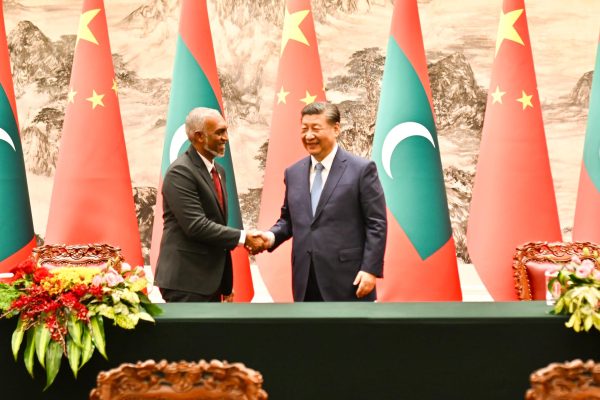
Muizzu’s inaugural state visit was to China, where he announced increased financial and military cooperation, and signed some 20 “key” agreements. Perhaps both as a symbol and a signal, the two sides agreed to “elevate China-Maldives relations to a comprehensive strategic cooperative partnership.”
The Maldives seemed to have swiveled, once again, from “India First” to “India Out.”
This strategic pivot was not without forewarning, nor has it been without critics. Muizzu campaigned on an “India Out” platform. His party and affiliated political backers often cite financial over-reliance on New Delhi. Opposing viewpoints highlight India’s dependability as a development partner and the “debt-trap” risks with Beijing.
Others question just how authentic or widespread the anti-India sentiment among Maldivians might be, or whether the India-baiting was just setting up a strawman to attack during campaign season. That being said, ask any Maldivian on the streets and you will hear genuine and growing resentment over Prime Minister Narendra Modi’s treatment of Indian Muslims – perhaps even more than over China’s continuous and brutal repression of Muslims.
That said, many voices – local and otherwise – express concerns about the rapid shifts in the Maldives’ foreign policy orientation every time the government changes hands.
Traditionally, India has been a very close ally for the Maldives, due to geographical proximity and dense exchanges in many fields. Key aspects of Indian assistance over the past three decades have touched nearly all aspects, including security cooperation, financial and development assistance, and good governance.
However, since the Maldives joined China’s Belt and Road initiative in 2014, China has become the biggest investor in the country, funding infrastructure projects including bridges, airports, and housing developments.
Both Chinese and Indian tourists are a crucial source of revenue for the Maldivian economy, giving both Beijing and New Delhi significant economic leverage.
Economic Challenges
On June 27, Fitch Ratings downgraded the Maldives’ long-term credit rating to “CCC+,” citing the “increased risks associated with the country’s worsening external financing and liquidity metrics” amid “weakening foreign-reserve buffers and rising external government debt.” Fitch raised concerns over the Maldives’ ability “to meet its substantial upcoming external debt-servicing obligations,” saying, “We expect the Maldives’ foreign reserves to remain under significant stress in the coming year.”
Before the downgrade, on June 10, the World Bank warned on X (formerly Twitter), “For decades, #Maldives has been spending beyond its means. Sharp spending rise & subsidies have widened [the] deficit, leading to a vulnerable fiscal situation & unsustainable debt.” The World Bank projects the Maldives’ average annual debt payments to reach $512 million this year and in 2025, before spiking to over $1 billion in 2026.
In May, the IMF had flagged “the need for immediate policy adjustments to safeguard macroeconomic and financial stability, restore debt sustainability, and support sustained strong and inclusive growth.”
No one in the Maldives will dispute the international experts’ findings. The dollar shortage is felt by anyone trying to do business here or trying to gather enough for medical or tuition fees abroad. Fisherfolk are protesting, and government payments to local contractors are withheld; small businesses are struggling with cash flows, and no medium-sized business will say they are thriving.
As Fitch, the IMF, and World Bank released their opinions, the government immediately announced several spending cuts, tax hikes to come, and new revenue measures, while the Parliament chatter turned to the need for financial reform.
However, daily headlines still bring in news of appointments of more political posts, with little news on tangible reform of state-owned enterprises or of any of the IMF and World Bank recommendations such as streamlining subsidies.
Governments in the Maldives have prioritized re-election over prudent financial choices. This has meant soaring and wasteful expenditure including on state-sponsored salaries, an airport for each island, and lavish use of subsidies. This cannot continue.
The China-India Factor in the Maldives’ Debt Crisis
Maldives’ external debt servicing will peak at $1.07 billion in 2026, and despite government efforts to downplay the looming crisis behind state-sponsored news headlines, Maldivians understand the debts are due. Maldivians watched Sri Lanka’s shambolic descent into financial and economic collapse with deep grief, and with an understanding of the poor governance choices that led our neighbors to the brink.
The Maldives’ mounting debt is the most central issue in its relations with both India and China.
Over the past decade, the Maldives has borrowed some $1.5 billion from Chinese sources, which now makes up 20 percent of its public debt. As repayment questions mount, China, as the largest bilateral creditor, has announced a write-off of just $50 million in loans. The Chinese ambassador said debt restructuring is not the solution for the Maldives, as it will hinder future aid from Beijing.
Meanwhile, India extended budgetary support of nearly $50 million, and increased the export quotas of essential commodities. The Maldives government said it is “highly appreciative of the generous support that Government of India has been providing to the Maldives in the form of budgetary support,” and acknowledged India’s significant assistance in infrastructure projects, much of which is funded by grants rather than loans.
In contrast to Muizzu’s choice of China, Foreign Minister Moosa Zameer’s first bilateral visit was to Delhi, where he and his counterpart, Dr. S. Jaishankar, discussed ongoing Indian- backed projects in the Maldives.
Security Dynamics and Maritime Cooperation
The shifting balance in the Maldives’ foreign relations also has significant implications for regional security dynamics. The Maldives government’s decision to review its defense cooperation agreement with India will be unsettling for New Delhi; the Maldives is a crucial maritime and security neighbor for India. Terrorism, human trafficking and drug smuggling are serious threats. The move also creates uncertainty about the future of joint patrols and maritime domain awareness initiatives.
In contrast, China has proposed enhanced maritime security cooperation, including joint naval exercises and the potential establishment of a maritime research station in the Maldives. These proposals can only be viewed as part of China’s broader strategy to establish a permanent presence in the Indian Ocean.
Other Great Power Interests in the Maldives
The Maldives’ location along critical sea lanes has made it vital geopolitically, for as long as people have traded, and as long as military leaders have sought to overpower one another in these waters. Chinese Admiral Zheng He crossed Maldivian waters in his treasure voyages in the 1400s. In the colonial era, the Europeans who sought to exert dominance in the Indian Ocean, whether to control maritime trade or assert political hegemony, made attempts to occupy the islands, set up proxy rulers, or deny access to their rivals.
Today, Maldives is crucially located for global trade and navigation and maritime security, with a significant portion of the world’s oil shipments passing through. Given issues of extremist recruitment and violent extremist attacks in the country, with growing concerns about radicalization in South Asia, the United States and other partners view the Maldives as central for counterterrorism and security efforts.
After decades of a predictable “non-aligned” policy under one strong-man leader, Maldivian foreign policy has taken many recent turns. As a result, not only India and China but also other global and regional powers have needed to continuously assess their engagement with the country.
Over the last decade, China has developed close economic and security ties with many developing countries, including in the Indian Ocean region. Beijing’s growing sway in the region has raised concerns in Washington, London, and beyond, and the Maldives is unquestionably central to any challenge the West puts up.
The United States seeks to maintain its influence in the Maldives as a counterweight to China’s growing presence in the Indian Ocean region. In response to the shifting dynamics, Washington opened its first embassy in the country in 2023.
The United Kingdom, with its historical ties to the Maldives and role as a major development partner, has been working to maintain its influence through aid programs and support for democratic institutions.
The EU has been focused on supporting the Maldives’ democratic reforms and addressing climate change concerns, while also seeking to balance China’s economic influence.
All three actors – the U.S., the U.K., and the EU – have maintained maritime security and counterterrorism programs in the country. Japan and Australia are also key development and security partners, with Saudi Arabia and the UAE increasing their investments in the country.
However, the only foreign powers anyone would mention in the Maldives’ context are India and China. Journalists, politicians, civil society, and academics all understand that the Maldives is now an arena for a brawl between the two main contenders.
Navigating Choppy Waters
As the Indo-Pacific strategic landscape continues to evolve, the Maldives’ ability to pursue its national interests will be severely tested. Muizzu’s administration must navigate a precarious path between fulfilling electoral pledges, economic development needs, security concerns, and debt sustainability. The coming months will also be crucial domestically, as the Muizzu administration attempts to lay out the announced spending cuts, restructure its debt, balance its foreign relations, and chart a course toward economic development.
The Maldives’ attempts to leverage its strategic location and balance competing interests between India and China have yielded mixed results, often exacerbating domestic political divisions and economic vulnerabilities. The “soft power” traditional Western partners yielded – from scholarships and infrastructure projects to building democratic institutions – has now given way to a simple contest of who will pump in the most cash.
As the post-war era of Western hegemony gives way to a realignment of power, including a firm South-South bloc, the Maldives’ experience offers a stark illustration in small state diplomacy and the limits of strategic hedging. As the rivalry between the Asian giants in the Indian Ocean intensifies, the choices made by the Maldives government will have significant implications not just for regional stability and the emerging order, but also, and more crucially, for its own people.
Maldivians will thank a government that averts a financial collapse. The Muizzu administration currently has the political stability and the time to prioritize financial recovery over political expediency, and indeed to make foreign policy choices that reflect the long- term fiscal and economic health of the Maldives. In balancing China and India, the Maldives must be transparent in all its dealings and arrangements, diversify partnerships to avoid over-reliance, sustain engagement in multilateral forums to strengthen ties with other regional players, and above all, and at all times, pursue the long- term national interest and security of the Maldives.
This article was previously published by the Maldives Policy Think Tank and is reprinted with permission.