

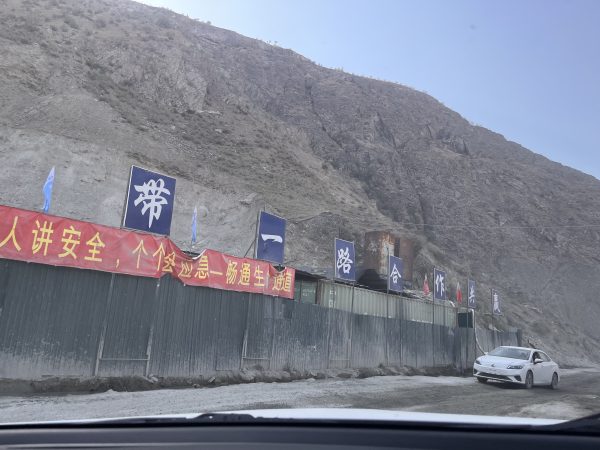
In the middle of the Pamir mountains, near the remote Tajik-Afghan border area of Badakhshan, I find myself staring at a large red banner with Chinese text that says “China Aid: Shared Humanity.” The phrase lands with a soft thud. The intensity of the banner’s red color stands boldly against the dusty gray mountain rock. You couldn’t miss it.
This was not the first time I saw banners promoting the building of China’s “community of common destiny.” Not only in Tajikistan but in the rest of the “Belt and Road cities” across South and Central Asia, the Chinese presence was notable and poignant. Although often limited to infrastructure construction sites, industrial zones, and Chinese restaurants, huge logos with Chinese characters also hung on unfinished buildings.
The “China Aid: Shared Humanity” slogan comes from the Chinese President Xi Jinping’s concept for a “community of common destiny for mankind” (人类命运共同体). As I found, the strategic branding of Chinese Belt and Road projects were not the only tactics being deployed by China to build influence in the South and Central Asia region.
First announced in Kazakhstan in 2013, China’s Belt and Road Initiative (BRI) is made up of two parts: The “Belt” seeks to connect the Eurasian continent from East Asia to Western Europe, while the “Road” (in full, the “Maritime Silk Road”) attempts to link the Western Pacific, the South China Sea, and the Indian Ocean. The BRI is China’s global economic strategy and is frequently asserted by observers as Xi’s grand strategy.
Based on my conversations on the ground and research in the region, I observed three general tools China has adopted in its strategy with foreign governments in South and Central Asia: strategic messaging; adapting to local customs; and flexible repayment of loans.
China’s strategy in South and Central Asia differs between nations as each have different requirements, history, and developments. For instance, economic value plays a primary factor in the Central Asian nations, each to a differing degree. In Afghanistan, ensuring security and stability in Xinjiang and China’s western border region have greater weight over economic considerations.
These observations aim to explain how China is adapting its policies to each country and their needs – or more so how China is making its presence in the region both visible and tangible. Understanding China’s multifaceted approach and tools of influence matters because its engagement in the region is increasing and often overlooked. It is important to understand how Chinese policy is impacting realities on the ground.
Strategic Messaging
It quickly became clear that an important part of Chinese activities in the South and Central Asia region revolved around the manner in which their activities communicated a narrative – in particular with the messaging and marketing of Chinese infrastructure projects. This seemed to be the core of China’s strategic approach.
Indeed, few can miss the highly visible improvements that China has made in the region. China is South and Central Asia’s primary source of development finance and its largest source of foreign direct investment (FDI), mostly through China’s state-owned enterprises. Statistics show that China has become the main export destination for the region’s commodities and goods; it also provides a significant share of Central Asia’s total imports. Earlier this year China’s General Administration of Customs (GTU) published trade data for the first half of 2023, which revealed that China exported about $26.4 billion in goods to Central Asia during the first six months of the year, while registering almost $13.5 billion in imports, led by oil and natural gas. However, high volumes of informal trade mean that these figures may vastly underrepresent the true total trade flows.
In Afghanistan, China has communicated its engagement through pragmatically and cautiously accepting the Taliban regime, demonstrating a greater degree of humanitarian concern, and shaming the West for forfeiting responsibility. But at the crux of this, Beijing’s core marketing strategy in Afghanistan and the wider region has a much broader message: to compete with the United States in the Indo-Pacific and showcase China as the more reliable global partner.
In order to understand the “why” behind this, one must go back to the early days of the People’s Republic of China. Premier Zhou Enlai first proposed the “Five Principles of Peaceful Coexistence” in the Sino-Indian agreement of 1954 and this has formed the basis of Chinese foreign policy to date. The five principles include: mutual respect for territorial integrity and sovereignty, mutual non-aggression, mutual non-interference in internal affairs, equality and cooperation, and peaceful coexistence.
Xi has carried the principles of his early predecessors in his own foreign policy. For instance, in Xi’s speech in June 2018 he urged Chinese diplomats to “continuously facilitate a favorable external environment for realizing the Chinese Dream of national rejuvenation and promote the building of a community of common destiny.”
Adapting to Local Customs
China also extends its influence by working through local actors and institutions, adapting and assimilating with local and traditional practices.
Views on China’s attempt to assimilate vary across the region; some skepticism around China’s intentions remains. For example, in Kyrgyzstan, a recurring response from well-informed individuals across both government and business circles was the rumor that the Chinese government was intentionally sending Chinese businessmen into the region to marry local women in a cynical play for better business. The local wife would then double as a business partner. The rumor of economically motivated marriages and the spread of cultural influence seems quite sensational but is strongly believed among the political elite.
Cross-cultural marriages would come as no surprise. China’s relationship with the region has been decades in the making and significantly expanded following the announcement of the Belt and Road Initiative in 2013. It is a common phenomenon in other parts of the world too where China’s BRI projects are taking place such as Ethiopia.
Flexible Solutions to Repayment of Loans
A common aspect of Chinese loans and development assistance is that it is often packaged as “no strings attached.” However, there are in fact two strings attached: economic and political.
On the economic side, much of the loans and aid must be used to finance the projects built by Chinese laborers, and the repayment conditions are often opaque. Despite this, the Taliban leadership and local Central Asian elites find the Chinese principle of non-interference and the opaqueness of these contracts appealing and tend to be more receptive to aid provided by China. Often the state budgets for the countries of South and Central Asia are not made publicly available or when they are, are not up to date. As such, any issues repaying debt to China remain largely a secret.
What is clear, however, is that problems in repaying debt do exist – particularly in Tajikistan, Afghanistan, and Kyrgyzstan. The two largest economies of the region, Uzbekistan and Kazakhstan, have diversified their debt portfolios. In economic terms, this means they have managed to balance their loans relatively better.
The loan-for-resources scheme, whereby loans are repaid in the form of natural resources, is very popular in the region. As a recent Carnegie report demonstrated, Tajikistan has pursued this repayment style the most by indefinitely leasing two gold ore deposits to Chinese companies to pay for the construction of the Dushanbe-2 thermal power station. Tajikistan, relative to its regional peers, has opened up other potentially sensitive and strategic sectors of the economy to Chinese companies.
However, in Kyrgyzstan similar instances of loan-for-resource have cropped up, only to be faced with significant protest from the public. As such, any type of natural resource swap is avoided or at the very least not made public. Kyrgyzstan has a track record of civil unrest against foreign-owned assets and has experienced various moments of upheaval since it gained independence in 1991. With that in mind, the Kyrgyz government and China would wish to avoid triggering a rerun of old tapes.
But Kyrgyzstan’s repayment problems persist. In 2021, the Kyrgyz government requested a six-year delay in repaying its debt to China. The request was granted at a 2 percent interest rate, which cost the state budget an additional $3.8 million.
Seeking alternative ways to repay its growing debt to China, without triggering any unrest, the Kyrgyz government has floated a variety of innovative ideas, including an appeal in November 2020 for private citizens to contribute to a special bank account that would be dedicated to servicing the debt.
On the political side, the buy-in from these contracts is that China has been able to shape its narrative as a reliable and trustworthy economic partner without interfering in domestic affairs.
Conclusion
China’s growing footprint in South and Central Asia has been made possible by the influx of grants, loans, mergers, and economic concessions for projects that are either currently under way or awaiting implementation. All these moves are combined under the overarching narrative that China’s rise is a model of “peaceful development.” This theme is plastered, physically, on Chinese projects across South and Central Asia, but also rhetorically through China-led institutions, speeches, and policy documents.
But it is also important to note that China’s rise in the region has not happened in a vacuum, nor is it linear. With Russia’s invasion of Ukraine, elections and domestic problems in the West, and the Middle East in turmoil, China has been able to adapt to local realities, build a degree of trust, and gain significant economic weight.
China has adopted three general tools in this effort: strategic messaging; adapting to local customs; and flexible conditions on the repayment of loans. From many local policymakers there is a degree of caution but with some degree of realization that certain sacrifices will have to be made. What this means in political terms is that the more financially tied to China a nation becomes and the higher the share of its gross domestic product is made up of Chinese investment, the higher the likelihood that China will be able to expand its economic and political influence. This is true not just for the South and Central Asia region, but in other areas of the globe that China is focusing its efforts on.
This offers some important development lessons for the West. It underlines two key messages: first, that we live in a world that is more interconnected than ever, with “far off” cities exposed just as much to the flux and flow of geopolitics. Second, credibility rests on doing just as much as saying. In other words, bridging the gap between foreign policy strategy and the expressed needs on the ground and making it visible and tangible to the foreign government and people.