

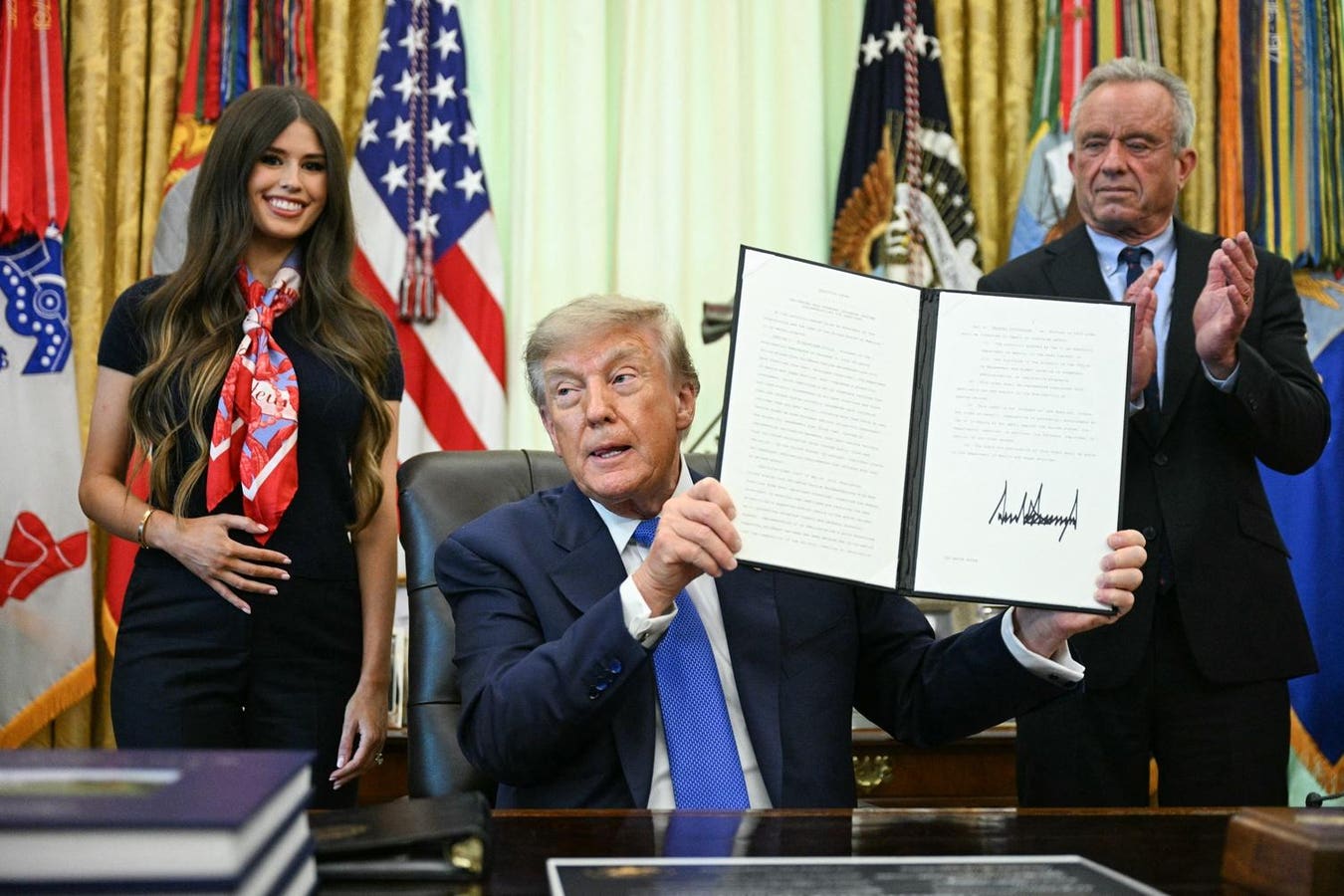
US President Donald Trump signs an executive order calling for more research and flexibility on vaccines, alongside US Secretary of Health and Human Services Robert F. Kennedy Jr. (R) and Jayme Leagh Franklin (L), founder of The Conservateur, in the Oval Office of the White House in Washington, DC, on August 10, 2026. Trump signed an executive order Monday pushing for a rethink of school vaccine mandates and repeating calls for the measles-mumps-rubella vaccine to be separated into three individual shots. Curbing vaccines has been a key priority for Health Secretary Robert F. Kennedy Jr, who founded an anti-vaccine nonprofit and has long promoted a disproven link between immunization and autism. (Photo by Jim WATSON / AFP via Getty Images)
AFP via Getty Images
President Donald Trump issued an executive order on vaccines August 10th that establishes a new federal framework on vaccines. The administration now identifies only 11 diseases for children to be administered routine vaccination; including but not limited to measles, mumps, rubella, polio, pertussis and chickenpox. In addition, the order calls for the combined MMR vaccine to eventually be offered as three separate vaccines administered at separate doctor visits. According to the White House, this offers parents greater flexibility.
Here are the concerns from a public health standpoint.
MMR Vaccine Is Safe And Effective
The MMR vaccine is administered as a single shot twice; once between the ages of 12-15 months, and again between the ages of 4-6. It protects against three separate diseases— measles, mumps and rubella. Decades of research has shown it to be safe and effective, without any link to autism. Separating the vaccine into three separate shots will not make it any more safe or effective. In addition, separate formulations of the vaccine for all three diseases currently do not exist in the market within the United States.
More Appointments Create Unnecessary Barriers For Vaccinating Children
The executive order would effectively allow one doctor visit from the MMR vaccine to become three separate visits, with one shot given for each of the three different diseases. More appointments create unnecessary barriers for kids to get vaccinated. Additional appointments open the opportunity for a parent to delay a pediatric visit and ultimately miss vaccinating their child.
This comes at an inopportune time when measles is currently surging in America, with more cases this year than any year in over three decades. Measles cases have been driven largely by decreased vaccination rates, with 93% of cases occurring in children unvaccinated or vaccination status unknown, according to the CDC. President Trump’s executive order risks further declining vaccination rates with more appointments for parents and kids, which could worsen the measles outbreak in America.
Kids Will Be Susceptible To More Infectious Diseases
Splitting the MMR vaccine into three separate vaccines will unnecessarily put children at risk for a number of infectious diseases. As an example, if the MMR vaccine is split, if a child comes to get vaccinated for measles, they would need to wait some time before getting vaccinated for mumps and then rubella. That would put a child at risk for contracting those diseases until they get vaccinated. Childhood is a vulnerable time to catch infectious diseases since the immune system has not fully matured. By vaccinating for all three diseases at once, children will be more protected against all three infectious diseases.
Combined Vaccines Do Not Overload The Immune System
A common critique of vaccination is that a child’s immune system has not matured and may not be able to handle a combination vaccine at once like the MMR vaccine. In fact, a baby can respond to about 1 million antigens or foreign proteins at once, and research shows that the MMR vaccine only exposes a child to 24 viral proteins or antigens, which is a small fraction of the total antigens a baby or child encounters daily. Thus, combination vaccines do not overload a child’s immune system.
Confusion And Trust
Perhaps most concerning could be erosion of trust as well as confusion with respect to vaccines for parents. Since the start of the Trump administration, there have been significant attempted changes to the childhood vaccine schedule, with the reduction of the number of routine vaccines recommended for children and now possibly spacing out certain combination vaccines like the MMR vaccine. In response to the changes, a number of professional medical societies like the American Academy of Pediatrics have published their own childhood vaccination schedule for parents and kids to use.
If federal recommendations diverge from those of pediatric organizations, physicians and individual states as well as families could receive conflicting advice about which vaccines their children need and when they need them. This uncertainty could translate into delayed or missed vaccinations.
Vaccine policy requires transparent evidence, rigorous safety monitoring as well as epidemiologic data. Parents deserve informed consent, but informed consent only works when the information being provided is scientifically sound.