

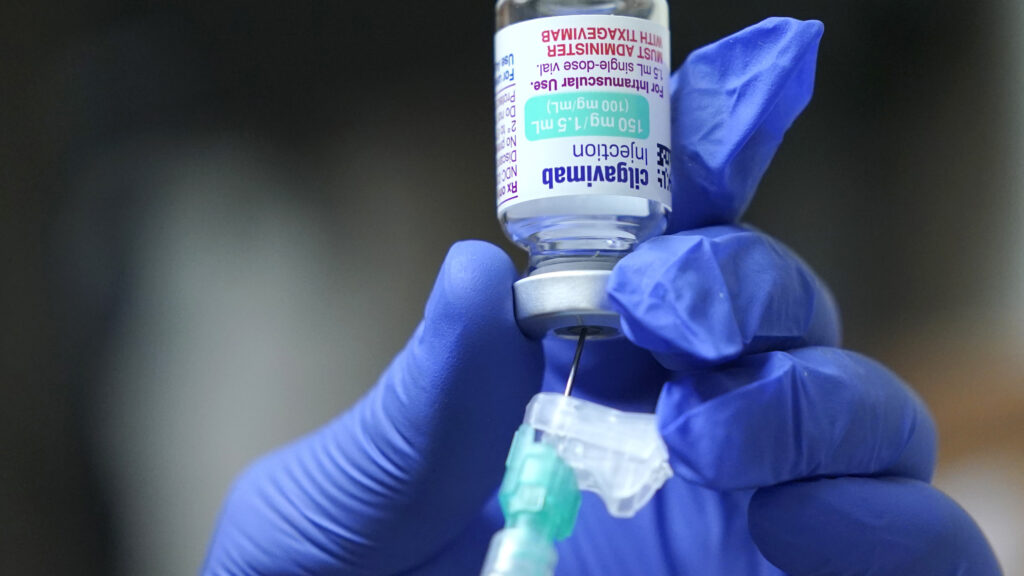
In the midst of the Covid-19 surge during the winter of 2021, the Pittsburgh-based UPMC health system received 450 doses of Evusheld — a scarce antibody cocktail being used at the time to prevent immunocompromised patients from being infected by the coronavirus. But those doses were just a fraction of a percent of what the sprawling 35-hospital system needed to protect its 200,000 immunocompromised patients.
“It was quite frankly a double-edge sword. Yes, we have a great therapy, but oh my gosh, how are we going to get this to all of our patients and make sure everyone has equitable access?” said Erin McCreary, an infectious disease pharmacist at UPMC and the lead author of a paper out Friday describing the approach her team devised to distribute the drug fairly — especially to disadvantaged patients.
They were fully aware that the virus was disproportionately taking the lives of people who were lower-income and were Black and brown, and that those people were less likely to receive Covid therapies. And they knew if they used a first-come, first-served approach, or let clinicians dole out the drugs, the treatments would be more likely to go to the system’s most privileged patients, McCreary said.
So in just two weeks, at a time when patients were being hospitalized and dying in high numbers, the researchers put together a plan to use a weighted lottery — giving higher odds of receiving the scarce drug to patients who lived in disadvantaged neighborhoods — in an attempt to more equitably allocate the drug.
As they reported in JAMA Health Forum, the lottery worked as they’d hoped — but only to a certain extent. Residents of disadvantaged neighborhoods were far more likely to be allocated Evusheld in the weighted lottery — 29% vs. 17% — than if an unweighted lottery had been used. And among the lottery winners, the same proportion — 28% — ended up receiving the drug in disadvantaged neighborhoods as in more advantaged areas, a finding researchers considered a success.
There are barriers beyond scarcity to getting an infusion of Evusheld, which typically is administered in a doctor’s office or clinic, so many patients lucky enough to be picked in the lottery didn’t get it. Only 7% of Black patients allocated the drug received it, compared to 29% of white patients.
What the researchers did was first winnow the list of eligible patients from 200,000 to fewer than 11,000 of UPMC’s most immunocompromised patients — such as recent lung transplant recipients or those receiving chemotherapy for acute leukemia — including 1,800 who were from the most disadvantaged neighborhoods. Those disadvantaged patients were then entered into the lottery twice.
McCreary, who is director of infectious diseases improvement and clinical research innovation at UPMC, said she hoped people would not see the work as unfairly putting some patients ahead of others for lifesaving treatments. “When you give increased odds to people who may be more impacted by a disease, you are not putting any one group in front of the other, you are weighting the odds to makes sure no one group is being left behind.”
The research establishes that weighted lotteries are a feasible and relatively simple and effective way to allocate scarce resources, she said. They can also help by alleviating the burden on physicians to decide who among their patients should receive treatments in short supply.
The project had a head start because UPMC has a robust data infrastructure and had already scored patient home addresses by how adverse their neighborhoods were, using the University of Wisconsin’s Area Deprivation Index, which ranks neighborhoods based on factors such as housing quality, poverty, and employment.
UPMC had used lotteries previously to ration other Covid treatments in short supply, such as remdesevir and monoclonal antibodies, McCreary said. Those projects weren’t as challenging because patients were within the hospital and easier to contact and inform about the drugs. The Evusheld project involved working with outpatients, who are harder to track down, and thus was a more rigorous way to assess if weighted lotteries might be feasible for large health systems.
AstraZeneca’s Evusheld became less scarce a few months after it was authorized, removing the need for a lottery, and is no longer offered because the virus has mutated enough that the drug is no longer effective. But McCreary said weighted lotteries could be used for other drugs that have recently become scarce, such as the chemotherapy drug carboplatin.
UPMC was among the first hospital systems to distribute Evusheld after it received emergency use authorization from the Food and Drug Administration on Dec. 8, 2021, McCreary said. The times were so frantic and the drugs so scarce that month that pharmacists and nurses were terrified of breaking a vial or syringe and losing a dose. In case that happened, the system set aside six extra doses it unexpectedly received. “You don’t want to not be able to give it to a patient expecting the drug because of something that is our fault,” she said.
Despite the success of the project in increasing access to those from lower-income neighborhoods, it is clear that the lottery did not do enough to help end racial disparities.
Only 3 of the 41 Black patients who were allocated the drug ended up taking it compared to 118 of 402 white patients. One issue was trust. Since the drug had not yet been fully approved, hesitation in taking it was understandable, McCreary said. Another major reason fewer Black patients received the drug was because they did not answer or return calls to the phone number the system had on record — possibly because those numbers were incorrect, though further study is needed to figure out why. (The researchers did not examine the issue in other groups disproportionately impacted by the virus, such as Hispanic people, because the sample size was too small.)
Studies show low-income and non-white patients, who are less likely to have a primary care physician or receive health care regularly, are less likely to have updated contact information in their medical records or may not understand messages left in English — an important reason there may be disparities in who receives timely treatment. Boston’s Mass General Brigham hospital system, for example, found many patients were not returning for cancer screening followup visits because they had not understood messages left for them in English.
The UPMC team made many efforts to make receiving the drug easier for patients, from offering transportation, waiving infusion fees, calling health insurers because the drug had not yet even been given a billing code, and even offering home infusion, but this work did not help erase the treatment gap.
“Disparities aren’t caused by one factor, they are layered throughout the health care system,” said Utibe Essien, a co-author of the paper who was at the University of Pittsburgh School of Medicine helping treat Covid patients in 2021 and is now an assistant professor of medicine and a health disparities researcher at UCLA.
Essien said he was concerned that the political climate and the recent U.S. Supreme Court decision to ban the use of affirmative action in college admissions might make some health systems hesitant to use race-conscious methods to be more equitable. In that case, he said, systems could use, as UPMC did, neighborhood disadvantage scales or could focus on getting treatments to those who live in areas with higher chronic disease risk and mortality.
The UPMC group did not use race to weight treatment odds because the commonwealth of Pennsylvania does not allow race to be used as a standalone factor, McCreary said. She also said people were not more likely to get Covid because of their race, but because of other variables associated with race, such as whether people could work from home, relied on public transportation, or lived in crowded households.
Genevieve Kanter, an economist and associate professor at the USC Price School of Public Policy who focuses on medical ethics and was not involved in the research, said a weighted lottery was a better and more equitable approach than many alternatives, but “its effectiveness — as with all lotteries — depends on making sure there are no biases in the list you are drawing from for the lottery. There may be structural reasons preventing marginalized populations from getting on these lists in the first place.”
Kanter said the finding that more Black patients refused the drug even if it was offered revealed “deeper structural issues that are out-of-scope for a weighted lottery,” suggesting that far more than a lottery was required to achieve equity and that consideration should be given to the bias “baked into the fact that doses were given to academic medical centers or large health systems” in the first place.
McCreary agreed the strategy could be refined and improved over time but said she’s proud her health system was able to implement a program that helped make difficult decisions in the midst of a pandemic and the crushing hospital workload. “Nobody goes into medicine to not take care of all their patients,” she said. “That’s why this was so hard.”
She hopes other health systems will follow UPMC’s lead, but added there was more work to be done. “Despite unbelievable efforts made to meet patients where they were,” she said, “we didn’t meet all patients.”
This is part of a series of articles exploring racism in health and medicine that is funded by a grant from the Commonwealth Fund.