

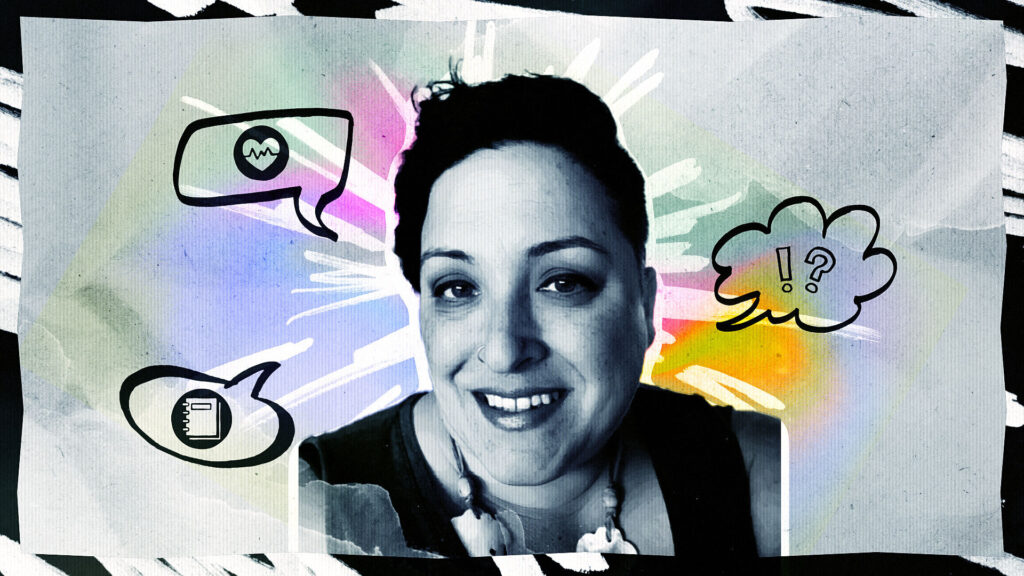
Nikki Saltzburg was born three months premature while her parents were vacationing in Bermuda. With Saltzburg weighing just 2 pounds, 2 ounces, they flew her back to Philadelphia on a Navy plane, the whole aircraft set to 98.8 degrees Fahrenheit so that she’d survive the journey.
Saltzburg is now a 45-year-old staff psychologist at Florida Atlantic University who has been paralyzed from the waist down almost her whole life. “I wasn’t injured from the circumstances of my birth,” Saltzburg clarifies. Instead, a series of medical errors, including a faulty diagnosis and a medication-induced blood clot, disabled her.
Saltzburg has a T11 incomplete fracture, meaning that she has a break in one of her mid-back vertebrae, but her spinal cord isn’t completely severed. “I have some sensory function below my level of injury, like I can feel things, pressure, extreme sensations, but I can’t move at all,” Saltzburg explains. One of the key complications of this injury is neurogenic bladder, a condition where Saltzburg has lost control of her ability to urinate.
Last year, she had a urostomy, an operation where urine is diverted from the damaged bladder into a stoma, a beefy red spout protruding from her belly. “I’ve named my stoma Freddy,” Saltzburg says with a painful smile, “because it looks like an alien to me, like Freddy Krueger.”
STAT spoke with Saltzburg about the realities of navigating the health care system as a disabled person and how she’s had to advocate for herself. This interview has been edited for brevity and clarity.
What was it like going through school with your disability?
When I was in grade school, I walked with crutches and braces; it was really important to me as a child to be as much like my friends as possible. So, I would climb up on the playground equipment, sometimes in unconventional ways. Some aide from my school called my parents and said I wasn’t allowed to play on the equipment anymore because it was a liability. That was one of those things where you realize, “Oh, I’m not like the other kids.”
When did you start using a wheelchair?
When I was 12, I had spinal surgeries, so they put some rods in my back. And that’s when I started using a wheelchair full time because I had to recover. I found that using a wheelchair was much easier and more functional because when I was walking on my crutches, I couldn’t carry things with my hands or do anything else.
All through junior high school, I got around by myself. And then when I got to ninth grade, it was my first day of high school, and this lady walked up to my bus — and I was like, “What’s happening?” Well, I had been assigned an aide, which I had no knowledge of and no need for. She met me at my class and explained to me who she was. And I was like, “Okay, thank you. That’s nice, but I don’t need your help.”
When you have a disability, people make assumptions about you, and they make judgments about your character and your abilities. That’s why it’s always been personally important to me to be independent, as independent as I can be, and prove those assumptions wrong.
What was your most formative experience growing up?
I played wheelchair tennis for much of my adolescence and early 20s. I traveled internationally; I played on the U.S. National Team. And that was amazing, not only because I got to play tennis all the time and travel to cool places. But also I met so many people from all over the world who were wheelchair users. It gave me role models; here are adults that have jobs, families, and normal lives. And that was the first time I got to see that.
It also taught me a lot about living with a spinal cord injury because we all talk about things that I’m not going to with people who don’t live this life. You get a bunch of people with spinal cord injuries in a room, and you’re talking about peeing, pooing, and sex. And you’re usually talking about sex first.
What were some of the challenges you faced with your bladder?
When I was younger, I don’t know how, but I was able to urinate on my own. I figured out ways to empty my bladder. But every time I would get a cold or flu, I would get a urinary tract infection afterwards. So I’ve had a lot of antibiotics throughout my life and a lot of UTIs. But none of them were particularly serious.
Everything started shifting for me when I was 28. I woke up one morning in excruciating pain — really bad back pain. For a few days, I was feeling like that, and then I started running a 103.5 fever.
I went to the hospital, my closest local hospital, and they didn’t know what to do with me. They accused me of drug-seeking, but I was in off-the-scales pain, my heart was pounding, my BP was off the charts. They just basically sent me home sick as hell with pain medication.
I went down to UMiami, and the neurosurgeon figured out within two hours what was wrong. I had an osteomyelitis infection at L4/L5 due to a condition called Charcot spine. Specifically, I got a type of bacteria that manifests itself harmfully in 0.01% of the population. I had a weakening of that area because that’s where my rods ended. It was because I wouldn’t let them fuse down to my pelvis when they did the spinal surgery because I wanted to be able to bend over.
So, I feel like a medical freak show sometimes.
Why did you decide to ultimately get surgery for your bladder problems?
Over the course of 15 years, my bladder started to progressively get worse. I was starting to lose my continence and was also having trouble completely emptying my bladder. So that’s why I kept getting infections and ultimately ended up having surgery.
In 2017, I got a UTI where I wasn’t responding to oral antibiotics. It turned out I had developed ESBL; it’s like an antibiotic-resistant E. coli infection. Since I had the first one, I’ve probably had six or seven more, and I’ve ended up in the hospital at least five times. I got septic a few times as well.
I also got into two really serious car accidents in my 30s. And after each car accident, it would get worse. Somebody was telling me, “You’re like an eggshell. Once something’s cracked, something else gets cracked.”
What is it like to live with this new urostomy?
They’ve created a channel to bring urine from my kidneys to this external bag, which is the urostomy pouch. The way that it works is that you cut the hole in the pouch to accommodate the size of your stoma, and you use a special kind of adhesive to put that pouch on your skin and stick it on there. My bladder is still in my body, but it’s basically not being used at all. The stoma, the urostomy pouch, basically becomes an external bladder.
It was comical to me. It’s an “incontinent diversion,” so urine will come out with no warning. I learned that it could spray urine. I had some sores and skin irritation that developed around the stoma initially, like blistering, which is very uncomfortable.
Those first six to eight months, I was also having fecal incontinence multiple times a day, and I couldn’t get to the toilet quickly. Usually I was having it if I was laying in bed or sitting in my wheelchair, which is not just messy and gross but also hard for me to get cleaned up. I was a little frustrated at first, like did I just trade urinary incontinence for fecal incontinence? I’d rather have urinary incontinence; it’s just easier to manage.
I’ve had to manage physical aspects of my life in unconventional and creative ways. So, I’m not as put off by it as most people. In some ways, it’s been not as difficult of an adjustment psychologically in terms of body image. What was very difficult psychologically was when I was super-dependent after the surgery. I was depressed, a little bit. As I’ve regained a lot of my functioning, it’s gotten better.
Do you think your recovery was more difficult because of your disability?
I had physical therapy every day in the hospital prior to my discharge. I was very worried about this because in everything I’ve read about this procedure, I couldn’t find anything about recovering when you’re paralyzed.
Everything I read was, “The best way for you to facilitate your recovery is to walk — walking is going to help your circulation, get your bowels moving, help you gain your strength back.” I don’t walk, and doing everything that you do in your day-to-day life sitting versus doing it on your feet is a very different experience.
I also remember reading, “No twisting, no lifting heavy objects.” Well, my body is a heavy object; I have to lift myself up a lot. So, I was freaked out about that. I asked my doctor about it, and he was just like, “You’ll be fine.” There was no recognition of how challenging and scary it is to be completely dependent on someone else — or frankly not even an awareness of what some of the issues might be. It wasn’t coming from a bad place. I don’t know how much he knows about the day-to-day life of what it’s like to be a paraplegic.
Has your experience navigating the health care system gotten better or worse over time?
It’s always been extremely challenging. And I think as I’ve gotten older and have had more complex needs, it’s been even more challenging. Because I’m a person with a spinal cord injury, a lot of home health agencies don’t even want to deal with me, even though I’m not even looking for care around my paralysis. So that’s been really frustrating.
Another thing that’s really challenging are the assumptions that people make about somebody like myself who uses a wheelchair full time. Doctors often assume that I’m on disability, assume I’m Medicare or Medicaid.
I work full time, I have a Ph.D., I have a family that I’m supporting. This might be my own lens that I’m super-sensitive to that, but I can’t tell you how many times it shows up — that assumption of like, “Well, you don’t have to think about driving, or you don’t have to think about showing up at work every day, or you don’t have a child that you care for.” But I do.
And then the assumption that my partner’s my caretaker — she’s not my caretaker, she’s my partner. I think that that leads to some really difficult dynamics and decision-making. I have a lot of trauma associated with interacting with the health care system.
What advice do you have for health care workers on how to better care for people with paralysis?
Unfortunately, my experience has been that many health care providers have no awareness of paralysis and the impact of spinal cord injury. So, they don’t consider it, or they overgeneralize whatever it is they know. Like they assume that whatever the issue — it’s maybe related to the fact that I’m paralyzed. I think my major piece of advice is to get more education and, if you have a patient who’s paralyzed, learning more about potential impacts of that.
I’m fortunate: I live about 50 miles away from Miami. The University of Miami Hospital has a well-known Spinal Cord Injury Program, so I’ve been able to find some doctors there that have more knowledge than most. But I think a lot of people don’t have access to care like that.