

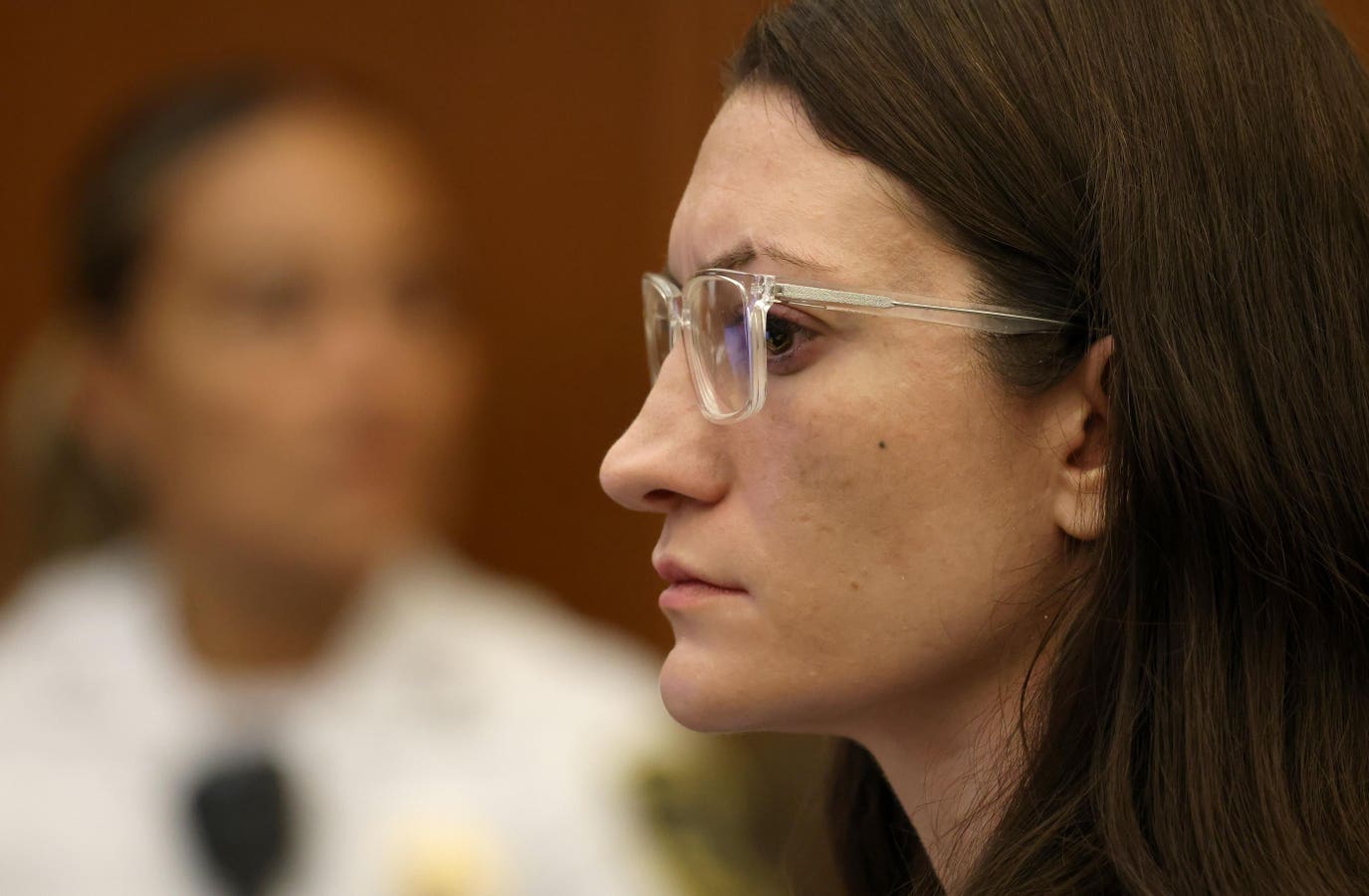
Lindsay Clancy attends her murder trial
Boston Globe via Getty Images
The trial of Lindsay Clancy, a mother accused of triple murder in January 2023, has ignited a broader discussion about how a mother actively seeking help for her mental health can end with a suicide attempt and the deaths of her children.
In a previous story, I spoke with Dr. Patricia De Marco Centeno, a board-certified consultation-liaison and reproductive psychiatrist, about the lexicon around mental health diagnoses related to pregnancy. Here, we discuss how a system designed to offer support can still fail the mothers who need it most.
Why 15 Minutes Isn’t Enough
Headshot of Dr. Patricia De Marco Centeno
Dr. Patricia De Marco Centeno
“Psychiatric diagnoses have no blood test to fall back on,” says Centeno. Any diagnosis requires deeper cognitive investment to retrieve various scattered pieces of information.
She describes three aspects of an evaluation that her field needs to improve accuracy: a detailed, longitudinal evaluation; repeated encounters over time, because “patients are going to tell you what they want you to hear” in a single visit; and collateral information from family. When a healthcare system doesn’t allow time for any of that — “psychiatry is not done safely in 15 minutes,” she says.
Subtle psychotic symptoms stay hidden behind what looks like ordinary emotional distress. “A family reporting sleeplessness gets read as insomnia rather than the decreased need for sleep that actually signals mania,” says Centeno. And a mother’s calm, guarded affect in a brief encounter reads as sadness instead of the fluctuating instability underneath.
Centeno points to one of her own cases as an example of what repeated encounters can surface. A postpartum patient believed she was a religious figure; her relative brought her in for care. It wasn’t until the third visit that she mentioned, almost in passing, a previous religious delusion she had in childhood. This childhood episode Centeno recognized as the patient’s true first episode, a sentinel event that had gone unrecognized for years.
Most patients with postpartum psychosis have an underlying diagnosis of bipolar disorder type I. These patients, she notes, can go a lifetime with only a handful of episodes, which is exactly why a single 15-minute visit is so unlikely to catch the full picture.
When The Treatment Itself Goes Wrong
Treatment for postpartum psychosis has to start immediately, and getting the first move right matters enormously. “All postpartum psychosis needs to be hospitalized. Period,” Centeno says.
Because the underlying illness is usually bipolar I rather than just depression, an antidepressant is often the wrong first move. She shares that the more appropriate first-line options are mood stabilizers like lithium, valproic acid (the latter requiring reliable contraception given its teratogenic risk) or, at minimum, an oral antipsychotic started without delay while a psychiatrist is reached.
Part of what makes psychosis so hard to treat is that the illness itself works against the patient accepting help. Centeno draws a comparison to diabetes: “Tell most patients their blood sugar is dangerously high, and they’ll generally accept the diagnosis and follow through on treatment.”
Psychosis doesn’t work that way, as patients often have anosognosia — they don’t believe anything is wrong, which drives both treatment refusal and “cheeking,” where a patient appears to take medication but doesn’t swallow it. That’s part of why long-acting injectable antipsychotics matter: Offered and accepted during a fleeting window of insight, “an LAI can buy a family weeks of protected time to secure consistent care, rather than gambling on daily adherence.” Centeno expressed how much time itself is also a clinical variable: “psychosis in general is neurotoxic to the brain,” Centeno says, and “the longer the duration of untreated psychosis, the harder it is to treat.”
The system around the patient can work against her, too. Confidentiality law can compound the delay: Nothing in “HIPAA stops one physician from calling another in an emergency to say a patient needs to be restarted on her medication.” Yet, she has found many risk-management teams interpret the law so strictly that getting written consent from a psychotic patient who doesn’t believe she’s ill becomes, in practice, a prerequisite doctors feel they both can’t skip and can’t complete.
The Fix Isn’t Just Awareness
A widely cited 2012 paper by Dr. Nancy Byatt sorted the barriers to maternal mental health care into three levels, and Centeno still leans on that framework.
At the patient level, stigma and family disapproval keep women from disclosing symptoms. At the provider level, most non-psychiatric clinicians — the “hidden” system seeing these patients first — get little to no training in reproductive psychiatry. At the system level, mental health is carved out of routine healthcare in a way no other condition is.
Centeno’s comparison: No insurer splits diabetes care by type, routing type 1 patients to one managed-care plan and type 2 patients to another. “Psychiatric care gets segmented that way constantly,” she adds. That fragmentation, plus chronic underfunding of research and overly cautious interpretations of confidentiality law, combines to slow down exactly the kind of rapid, coordinated care postpartum psychosis requires.
Where To Learn More
Postpartum Support International and Massachusetts General Hospital’s Center for Women’s Mental Health are two of the most widely used resources, for both families and clinicians. Many states also maintain a maternal mental health consultation line specifically for providers, though not all do.