

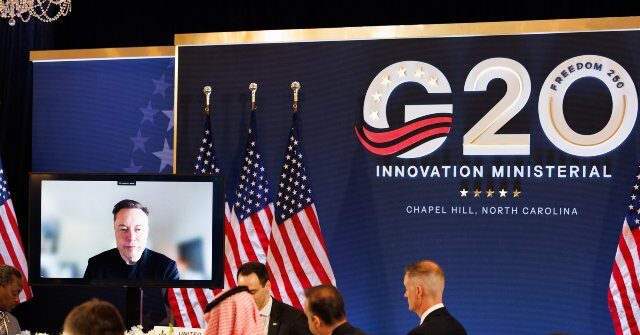
Elon Musk addressed a virtual session of the G20 yesterday, laying out predictions on AI, humanoid robots and regulation. According to Musk, within 10 years, 1 billion humanoid robots will outproduce all of humanity.
CNBC reports that Musk covered four topics: power constraints on AI, the technology’s economic potential, humanoid robotics, and how governments should regulate emerging tech.
Robotics is where Musk got more specific about mechanics. He described humanoid robot usefulness as the product of three factors: AI software, the onboard AI chip, and electromechanical dexterity, particularly in the hands. All three are improving exponentially, he said. Once robots start manufacturing other robots, growth turns recursive: slow at first, then explosive. He called his own ten-year forecast conservative, projecting well over a billion humanoid robots, each roughly five times as productive as a person. Combined, that fleet would outproduce all of humanity. This physical layer, he argued, not the digital economy, is where he expects overall economic output to grow by a factor of ten or more.
On power, Musk cited a consensus estimate that AI chips will face a shortfall of at least 15 gigawatts by 2027. AI chip production is climbing roughly 40 to 50 percent a year, he said, while power generation outside China grows only about 10 to 20 percent annually. That gap, in his view, is what actually limits the industry’s growth, not chip supply itself. Musk said Google, Anthropic and other companies are now leasing computing capacity from SpaceX, which built its own power plants to bring capacity online quickly. China has abundant electricity, he noted, but is blocked from importing the latest chips under GPU export bans. His advice to other countries: build out power generation, host AI data centers, then tax them or charge fees for the privilege.
Musk put a number on the economic upside too: a 20 to 30 percent boost to the global economy from digital AI alone, or roughly $20 trillion to $30 trillion a year. By the end of next year, he said, AI should handle any digital task that doesn’t require physically shaping atoms by hand. On software specifically, he predicted AI will reach “Stockfish-level” within about 12 to 18 months, invoking the chess engine as a benchmark and mentioning Magnus Carlsen, the five-time World Chess Champion, in the same breath. That same window, he said, applies more broadly to AI becoming extremely capable across engineering and other digital work. He also plugged X, the platform he owns, as the place where he said nearly all serious AI discourse happens.
On regulation, Musk’s position was that new technologies should be treated as legal by default rather than illegal by default. He pointed to the European Union as an example of heavy regulation that slows progress without stopping it. Using an image of young saplings against big trees in a forest, he compared startups to the saplings and incumbents to the established trees, arguing that most governments over-support the trees while starving the saplings. Large companies get access to political leaders that startups typically don’t, he said, and he thinks policy should be deliberately tilted toward young companies to correct that imbalance.
Breitbart News previously reported on Musk’s suggestion that Americans cash in their retirement savings because AI will provide everything they need:
On the Moonshots with Peter Diamandispodcast last week, Musk stated: “Don’t worry about squirreling money away for retirement in 10 or 20 years. It won’t matter.”
Musk’s comments on retirement savings are similar to his recent claims that in the AI utopia of his imagination, work will be “optional” and treated like a hobby.
Whether you believe Musk’s predictions are accurate or hold as much weight as his grand pronouncements on Mars colonization, one thing is clear — the AI revolution continues to pick up steam.. Breitbart News social media director Wynton Hall has written his instant bestseller Code Red: The Left, the Right, China, and the Race to Control AI to serve as the definitive guide on how the MAGA movement can create positions on AI that benefit humanity without handing control of our nation to the leftists of Silicon Valley or allowing the Chinese to take over the world.
Read more at CNBC here.
Lucas Nolan is a reporter for Breitbart News covering issues of AI, free speech, and online censorship.