

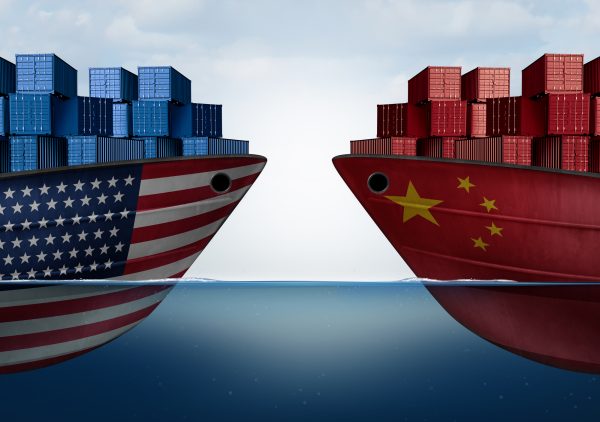
Together, China and the United States exemplify the globalization trend of the early 21st century. Despite differing views on world affairs, the two economic powerhouses have successfully coexisted and even benefited from each other, fostering the growth and prosperity of the global economy as a whole. However, in recent years, their political relationship has deteriorated, and peaceful coexistence has become increasingly challenging. Now, in a new development, political frictions are being reflected in economic relations.
China’s impressive economic growth and global interdependence have boosted its political influence, elevating it to superpower status. Meanwhile, the United States has seen a decline in its relative power on the world stage. This is not due to weakening on the United States’ part, but rather the result of China becoming stronger.
As China’s political and economic influence grows, it has taken a more assertive international stance. “Chinese leaders are in essence realist. Their making of Chinese foreign policy often starts from a careful assessment of China’s relative power in the world,” said Suisheng Zhao, a professor of Chinese politics and foreign policy at the University of Denver.
Meanwhile, Washington is increasingly worried about China’s rise.
The deteriorating political relationship has prompted both countries to reconsider their economic integration in order to prevent dangerous dependency and subsequent vulnerability. Even though China and the United States have long fostered each other’s development, security concerns are now overtaking the economic gains of globalization.
The gradual erosion of China-U.S. economic ties is evidenced by trade and investment data.
Specifically, the Chinese footprint in the U.S. economy is shrinking. In the first half of 2023, China lost its title as the top exporter of goods to the United States for the first time in 15 years. In addition, both official and alternative data sources show a sustained slowdown in Chinese foreign direct investment (FDI) in the United States since 2017, with annual investment falling from $46 billion in 2016 to less than $5 billion in 2022. Additionally, Chinese companies’ operations, earnings, and workforce in the U.S. have also exhibited a downward trend in the past few years.
Companies are increasingly aware of the impact of geopolitics on their operations. As tensions rise, they feel the need to align with their own country’s strategic objectives and concerns. And as economic ties loosen, there will be less pressure on the Chinese and U.S. governments to keep tensions in check, creating a vicious cycle of worsening relations.
Security Over Trade
According to the last (unadjusted) data released by the U.S. Commerce Department, the United States imported about $239 billion worth of goods from China from January to July 2023; that represents a 25 percent drop compared to the same period in 2022. Amid that decline, China lost its position as the United States’ top supplier of goods for the first time since 2005, being overtaken by Mexico and Canada.
This new scenario might be influenced by the supply chain problems experienced during the pandemic and by a general fall in Chinese exports; nonetheless, there are reasons to assume that it is closely related to the growing geopolitical tensions between the two powers. The U.S. drop in Chinese imports has been mainly driven by a decline in tariffed or highly scrutinized goods. U.S. companies are increasingly seeking out new suppliers due to the rising uncertainty and costs associated with importing from China.
As the United States has worked to diversify its suppliers, China has moved toward diversification of its export markets. The U.S. and Europe are no longer the main destinations: Southeast Asia has surpassed them in trade volume. According to data reported by Bloomerg, shipments from China to the Association of Southeast Asian Nations (ASEAN) member states reached a value of almost $600 billion per month. As a result, the 10-nation bloc is now ahead of the United States and European Union on the list of China’s top trading partners.
The shift has been helped also by the Regional Comprehensive Economic Partnership (RCEP), a multilateral free trade agreement that includes the members of ASEAN plus China, Japan, South Korea, Australia, and New Zealand. RCEP and the ongoing shift in export markets illustrates China’s strategy of mitigating the risks associated with an over-reliance on the markets of countries with which Beijing has increasingly strained relations.
More Competition, Less Investment
According to a recent report by the Rhodium Group, in 2022 Chinese FDI in the United States reached its lowest point in a decade. The negative trend of Chinese investment in the U.S. started in 2017 and it is fair to expect that 2023 will confirm the negative trajectory. The report highlights that Chinese FDI in the United States averaged just $667 million between 2019 and 2022. This amount is substantially lower than the resources invested by multinationals from smaller Asian or European economies like Singapore, South Korea, and Spain.
The deterioration of political trust and the increasing geopolitical competition between Beijing and Washington have undeniably been significant forces underpinning the negative trend of Chinese FDI in the United States. The Biden administration has limited Chinese companies’ access to certain markets for national security reasons, particularly in the technology sector. Furthermore, the U.S. government has implemented various measures to regulate exports and impose sanctions on Chinese businesses. It has also extended investment screening to outbound capital flows and introduced robust industrial policies that promote significant capital investments in U.S. manufacturing while limiting the involvement of Chinese investors. Two examples of such policies are the CHIPS and Science Act and the Inflation Reduction Act (IRA).
Nonetheless, it would be misleading to solely blame the geopolitical tensions between two nuclear-armed powers for the recent trend. The drop in Chinese investments abroad, including in the United States, is also related to internal dynamics initiated several years ago. Since 2016, stricter control on outbound capital flows has been gradually reintroduced under Xi Jinping’s leadership. This has encouraged domestic households and businesses to reinvest their money in the local economy instead of foreign enterprises. Additionally, the zero COVID policy adopted by China throughout 2022 further reduced outbound foreign direct investment due to restrictions on cross-border travel, which hindered deal-making activities.
Back to the Future
Throughout history, the exchange of goods and services between nations has been influenced by power struggles. Now, after a long period where the global economy has focused on maximizing profits, it seems that we are reverting to an older model, in which geopolitics and national security are the main drivers of economic activity. Governments around the world are going back to a “realist” approach, which puts security first and acknowledges that economic integration has security externalities.
The data shows that decoupling is not just an empty slogan. Multinational companies are taking into account the geopolitical concerns of their own, and other, governments. Chinese companies know that investing in the United States today is very different from doing it 10 years ago.
Nonetheless, it would be naïve to think that the strong ties developed over more than 30 years of hyper-globalization can be broken easily and quickly. For example, although other countries are replacing China as exporters to the U.S., it might not be enough to solve the puzzle of U.S. dependence on Chinese inputs. The data indicates that countries increasing their exports to the U.S. have also increased their imports from China, especially for sectors like electronics, where U.S. imports of Chinese products have declined the most. This suggests that, because global value chains are so entangled with China, diversification may not substantially reduce U.S. reliance on Chinese inputs and suppliers in the short to medium term.