

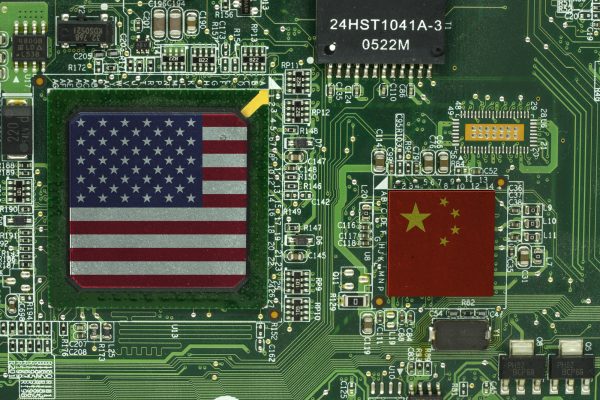
In the ongoing chip war between the United States and China, American regulators have fired a new salvo with a fresh set of rules to tighten the October 2022 export control measures. The latest round of restrictions is aimed at plugging loopholes in the previous sanctions. The new rules target the chips that power high-end AI systems and the semiconductor equipment machinery that aids the domestic production of leading-edge chips in China. The previous restrictions failed to curb domestic manufacturing in Chinese foundries, as Semiconductor Manufacturing International Corporation (SMIC) mass-produced 7 nanometer chips to power Huawei’s Mate 60 Pro, which has recorded millions of sales in China.
A major loophole in the previous round of measures came from the narrow approach of restricting chips based on their bandwidth. To evade the restrictions, American chipmakers could easily make new chips with lower bandwidth and identical performance. The new restrictions avoid the pitfall of bandwidth and restrict chips based on their total processing performance (TPP).
The new rules have serious implications for China’s ability to produce high computing machinery. They restrict a variety of graphics processing units (GPUs) that earlier were not under the radar of export controls like the GPU L40 and AMDMI210. The United States has principally restricted all performance application specific integrated circuits (ASICs) that chipmakers previously manipulated to run on any hardware that passed the regulations. This regulatory move largely limited China’s potential with respect to transformers and diffusion models that power the AI-run machines and programs.
China faces a crucial state of handicap in the segment of semiconductor manufacturing equipment, as this chokepoint technology significantly affects China’s overall ability to domestically produce chips. The new rules enhance the scope of restrictions for the sale of etching tools, EPI tools, mask-making tools, and atomic layer deposition (ALD) tools among others previously covered.
Concerning China’s ability to repurpose the lagging-edge deep ultraviolet (DUV) tools, the Biden administration now revamped the restriction on DUV tools by adding the criteria “Dedicated Chuck Overlay,” which aims to restrict tools with an overlay below 2.4 nm. In lithography technique, an overlay determines the accuracy of patterns and layers that are printed on the wafer. China’s maneuvering for the 7 nm technology was achieved as the Dutch firm ASML restricted exports to 1.5 nm, which excluded the export of the 1980i tool to SMIC. The United States will be able to extend this rule to the Netherlands’ ASML by using its Foreign Direct Product (FDP) rule.
Assessing the Nature and Efficacy of the New Rules
The new ecosystem of chip restrictions employed by the United States’ Bureau of Industry Standards (BIS) creates two zones: a black zone that completely restricts the exports and imposes a licensing regime under the entity list, and a grey zone that allows the export of certain chips with 25-day prior notice and examination by the regulators. The grey zone creates possibilities for another set of loopholes in the U.S. sanctions.
Previously, American chipmakers like Nvidia were able to bypass the sanctions as they could make specifically manufactured chips to be shipped to China. Under the new rules, that is hardly possible as the specifications pertaining to TPP, chip density, and bandwidth are nearly impossible to evade. The entire line of Nvidia chips comes under the defined spectrum except for 30A series, which are not crucial for AI capability. What could possibly be done by the American chipmakers is to sell a small number of mediocre chips that would largely hamper the demands coming from China. Thus, in the case of AI chips, the restrictions are nearly impossible to bypass.
In the segment of semiconductor manufacturing equipment, the rules apparently adopt an approach to harmonize with the Dutch and Japanese restrictions, which were released earlier this year. Even though the FDP rule extends solely to American components, which make up just 25 percent of the total, for ASML evading this rule by manufacturing machines devoid of U.S. technology will take several years.
Though the United States goes a step further by restricting the equipment with an overlay below 2.4 nm, the restrictions are imposed only on the biggest foundries in China. This is an area that can be easily manipulated to supply equipment in China.
With the current pace of acceleration in China’s domestic industry, hundreds of semiconductor foundries are expected to open up in the coming years. Since the export of 1980i tools is restricted to only a handful of fabs in China under the “advanced foundries” category, it will not be difficult for small foundries, backed by huge Chinese government subsidies, to import Dutch machinery. Under the cusp of a looming environment of more stringent restrictions, more and more immature foundries can be set up and eventually turn around into mature foundries, for example, China’s CXMT. Therefore, the “advanced fabs” loophole is a matter of concern if the American regulators still expect that Chinese firms cannot avail themselves of technological access through clandestine means.
Despite the fact that the Biden administration has made the rules almost impossible to evade to support China’s AI computing capability, the leniency on lagging edge chips can ultimately fail to de-risk the supply chain. The loopholes in semiconductor manufacturing equipment exports will continue to boost American competitiveness only in design and software as compared to manufacturing. As long as Chinese firms have access to semiconductor manufacturing equipment, even for manufacturing lagging-edge chips, its prominence in the supply chain for foundries and ATP facilities will remain less hindered. Moreover, SMIC’s ability to repurpose the lagging edge machinery to produce a leading-edge 7 nm processor cannot be ignored.
Although the updated rules aim to curb the use of American technology components in China’s military-civil fusion (CMF) policy and to reduce China’s capability to use AI chips for military purposes, they are less effective in addressing the chip manufacturing potential for a vast set of electronic applications, China’s continuous R&D potential, and the Chinese way of copying technology tools.
What Lies Ahead?
The latest restrictions will significantly impact the course of China’s domestic semiconductor manufacturing. The visible option left for China is to produce homegrown abilities in the AI industry that reduce reliance on American technology in the long term. The difference that these new sanctions make is that they necessitate a faster growth of China’s AI chip infrastructure.
With the AI Accelerator programs, China may start exploring alternative ideas to maneuver AI techniques, especially for GPUs, than its rivals. The Chinese state and corporations are expected to invest heavily in memory computing, analog technology, neuromorphic computing, etc. A short path dependence may be expected from Huawei. Its recent breakthrough with 7 nm technology and its capability to mass produce the device signals the stockpiling of equipment and software.
While it is yet to be seen how the move creates ripples in China’s semiconductor sector, the recent measures definitely bring concerns and will impact the competitiveness of advanced chipmakers like Nvidia and AMD in the ongoing and increasingly intensifying technology war.