

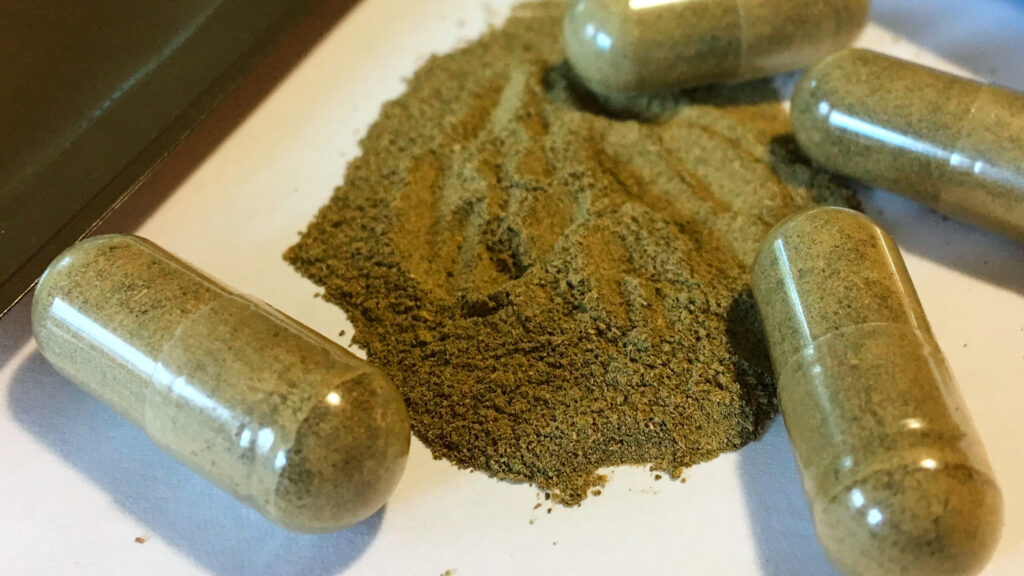
Kratom leaf products, often used to ease chronic pain, anxiety, or withdrawal from opioids, have been sold in the U.S. for decades, largely skirting any regulatory restrictions despite a known risk for physical dependence. But increasingly, Americans are turning to newer, more potent products made with a semi-synthetic kratom derivative, 7-hydroxymitragynine, or 7-OH.
Clinicians and recovery advocates warn that highly-concentrated 7-OH could be even more addictive than kratom, though research is scarce. Most people agree that some sort of guardrails need to be put into place. They disagree, however, on what those regulations should be.
In July, the Drug Enforcement Agency proposed temporarily designating 7-OH above a certain threshold of potency as Schedule I, the category for drugs that carry the most risk without any medical benefit. The move would allow milder, natural kratom products to continue flying under regulatory radar.
“We have a history of being asleep at the wheel,” Marty Makary, then-commissioner of the Food and Drug Administration, said at a press conference on 7-OH in July 2025, referencing public health threats like tobacco and Oxycontin. “For the sake of our nation’s children, let’s not get caught flat-footed again.”
The agency has not yet finalized the law, but has moved three less common kratom-related synthetics into Schedule I without a threshold caveat. Pressure for action on all types of kratom is mounting after two students at the University of Mississippi died this month, with kratom products found on the scene in both cases. (Authorities have not claimed that kratom contributed to either death.)
Classifying 7-OH as a schedule I drug is not a perfect solution, addiction experts say. It leaves dependent users at risk of withdrawal if they can’t get the products anymore, and vulnerable to criminal prosecution if they do find a way to continue. It starts a game of whack-a-mole with synthetic innovations that would be difficult to win, and makes it much more difficult to conduct needed scientific research. But other approaches, such as a more rigorously regulated marketplace, may be difficult to accomplish.
“Even if we schedule 7-OH and kratom, are we really addressing the underlying conditions causing people to obtain these substances? I don’t think we have great solutions on that,” said Regina LaBelle, an addiction policy professor at Georgetown who served in the White House Office of National Drug Control Policy under President Obama and President Biden. “Often, the only tool we have in our tool belt is scheduling.”
It’s unclear when the DEA will finalize the 7-OH law, after an extended public comment period ended on Sept. 10 with nearly 36,000 submissions. If and when finalized, the law could remain in effect for up to two years, with the possibility for another year extension if the agency decided to pursue a permanent scheduling.
In the meantime, states and local municipalities have begun to issue their own emergency bans on 7-OH, and in some places, on kratom overall.
Existing regulations (or lack thereof)
Historically, kratom products have avoided regulation in the U.S. The main psychoactive compounds — mitragynine and, secondarily, 7-OH — don’t currently appear anywhere in the federal scheduling system for drugs. Out of sight, out of mind. The American Kratom Association, an industry lobbying group, asserts that it is regulated under a looser dietary supplement law. (A separate lobbying group for 7-OH products also says it supports better regulation — and acknowledges the risk of dependence — but rejects laws limiting the amount of 7-OH.)
“Can kratom products be regulated better? Yes,” Mac Haddow, AKA’s senior fellow on public policy, said in a recent Georgia committee meeting.
Some states are making an attempt. For the past few years, the addiction recovery nonprofit Shatterproof has helped about half a dozen states craft policies on kratom. They based their initial recommendations on a set of marijuana legalization provisions to protect young people, including restrictions on what’s in the product, dosage, packaging, labeling, marketing, manufacturing, and more.
Around two dozen states have enacted some version of the Kratom Consumer Protection Act, which has been heavily promoted at the state and federal level by the AKA. The laws typically include age limits, but other measures vary state by state. Critics say these laws usually don’t go far enough, and can even provide more protection to the kratom manufacturers and sellers than consumers.
“The protections on that are so weak, they’re not useful,” said Leah Kaufman, a vice president of state policy at Shatterproof. She pointed to Utah and West Virginia as the best examples of a well-regulated kratom marketplace.
In Utah, only specialty tobacco retail locations with a specific license that encompasses kratom can sell it. Consumers can reference a public list of registered products to check on whatever they’re buying. Products must be tested for safety and quality by accredited, third-party laboratories before they can be registered. Earlier this year, the state amended its laws to prohibit the sale of anything other than “pure leaf kratom,” including potent 7-OH products.
Of course, these stringent laws cost money. States need independent labs to test products, the authority to seize noncompliant ones, and staff to execute. Utah and West Virginia both installed taxes on the products to pay for the services, which increased the rules’ effectiveness, Kaufman said. Otherwise, enforcement is a major problem.
In states without well-regulated marketplaces, temporarily scheduling kratom may offer the government more time to consider how it might create one. “More and more, this might be a scenario where we need to press pause on the market,” Kaufman said.
In the meantime, as new synthetic drugs continue to appear, some experts worry that researchers and policymakers will always be a step behind. Shatterproof has encouraged lawmakers to use the language of “kratom-related derivatives” to capture a wider swath of evolving substances, but casting a wide net only does so much.
In 2018, a proactive federal measure made all fentanyl analogs Schedule I. While the action did interfere with the availability of those substances, LaBelle noted that it didn’t stop other “creative chemicals” from appearing.
Opposites react
Despite its drawbacks, the federal proposal to schedule 7-OH has some surprising supporters. “I think the federal regulations are great,” said Nabarun Dasgupta, a pharmacoepidemiologist at the University of North Carolina and harm reduction advocate. He sees the decision to schedule a specific quantity of the molecule, rather than the molecule itself, as an innovative step toward creating a safe supply.
“I think that has only been done on the criminal punitive side, but to have it on the permissive regulatory side is a major leap,” Dasgupta said. “This could be really cool.”
Slowing down the innovation process, “whether licit or illicit,” helps drug users create protective behaviors, Dasgupta said. That means it’s reasonable to enact limits like this when a new product hits the market, giving people time to adapt.
Other supporters of the action have a more black-and-white view, especially as overdose deaths in the U.S. remain high. “Make it illegal,” said Andrew Herring, chief of addiction medicine at Alameda Health System in Oakland, Calif. He emphasized that any exposure to an opioid can be meaningful, and the longer people are exposed, the longer the repercussions will last.
“The most dangerous substance there is, is the substance that’s marketed as safe but is actually dangerous,” he said.
Others who express hesitation or opposition to bans often cite the risk of sending people who are dependent on 7-OH into withdrawal, and potentially leading them to other, more dangerous substances. The Obama administration considered scheduling kratom products in 2016, but decided against it after receiving pushback and considering similar concerns while the country’s overdose crisis worsened, LaBelle said.
“I’m not a fan of 7-OH,” said Myles Jen Kin, an addiction clinician in Massachusetts who, like others across the country, has seen an increasing number of patients dependent on these products. “However, I think a blanket ban like this can cause some problems.”
Massachusetts issued a temporary statewide ban on all kratom products in late August. A few weeks after the emergency order went into place, Jen Kin confirmed that he hadn’t seen the large uptick in clinic admissions for 7-OH that he’d expected. Still, others who have seen more 7-OH patients in recent months believe the increase could be due to similar state bans.
Accounts from people who say they have used 7-OH products tend to fall into two camps: People who have suffered from excruciating withdrawals trying to stop using, and others who have benefited by using them to stop taking other, harmful opioids.
One representative comment on the federal proposal describes the commenter’s experience developing a habit of taking 40 to 50 milligrams of 7-OH per day, “nothing more.” But now: “I’m in the throws [sic] of severe withdrawal,” they wrote. “The best thing that could happen is to ban it, or set a threshold that does not allow for anyone to fall into this cycle.”
There’s some evidence and many anecdotes that kratom leaf products have helped people wean themselves off of opioids or other illicit drugs. Commenters say that 7-OH has also helped in this regard. “I’ve been a heroin addict for the past 20 years ever since I’ve been using 70H [sic] I don’t use it anymore,” another commenter wrote. “Please please don’t take it off market.”
It’s hard to say how many people using 7-OH have similar experiences. There’s little research on the compound, and academics worry that scheduling will hamper future studies.
“To go all the way to scheduling seems very extreme to me when we haven’t fully fleshed out the full risk-benefit profile of these substances,” said Katherine Hill, an epidemiology Ph.D. candidate at the Yale School of Public Health who has studied kratom-related products. It’s unclear if these products are markedly different from other intoxicating substances like alcohol or cannabis that are allowed to stay on the market, she said.
“We need more time to figure that out,” Hill said. “We need time for clinical trials.”
Others who are interested in research see the 7-OH proposal as a positive step. Nora Volkow, director of the National Institute on Drug Abuse at the National Institutes of Health, told reporters at a Q&A on Tuesday that she was very interested in the potential that mitragynine may have as an addiction treatment and painkiller. But she’s still concerned at how easy it is for people to access highly concentrated 7-OH products.
“It’s not surprising that you are seeing an increase in reports that kratom has been involved with overdoses in the past five years, which were not there before,” she said. “It would minimize the harms if it is properly regulated.”
STAT’s coverage of chronic health issues is supported by a grant from Bloomberg Philanthropies. Our financial supporters are not involved in any decisions about our journalism.