

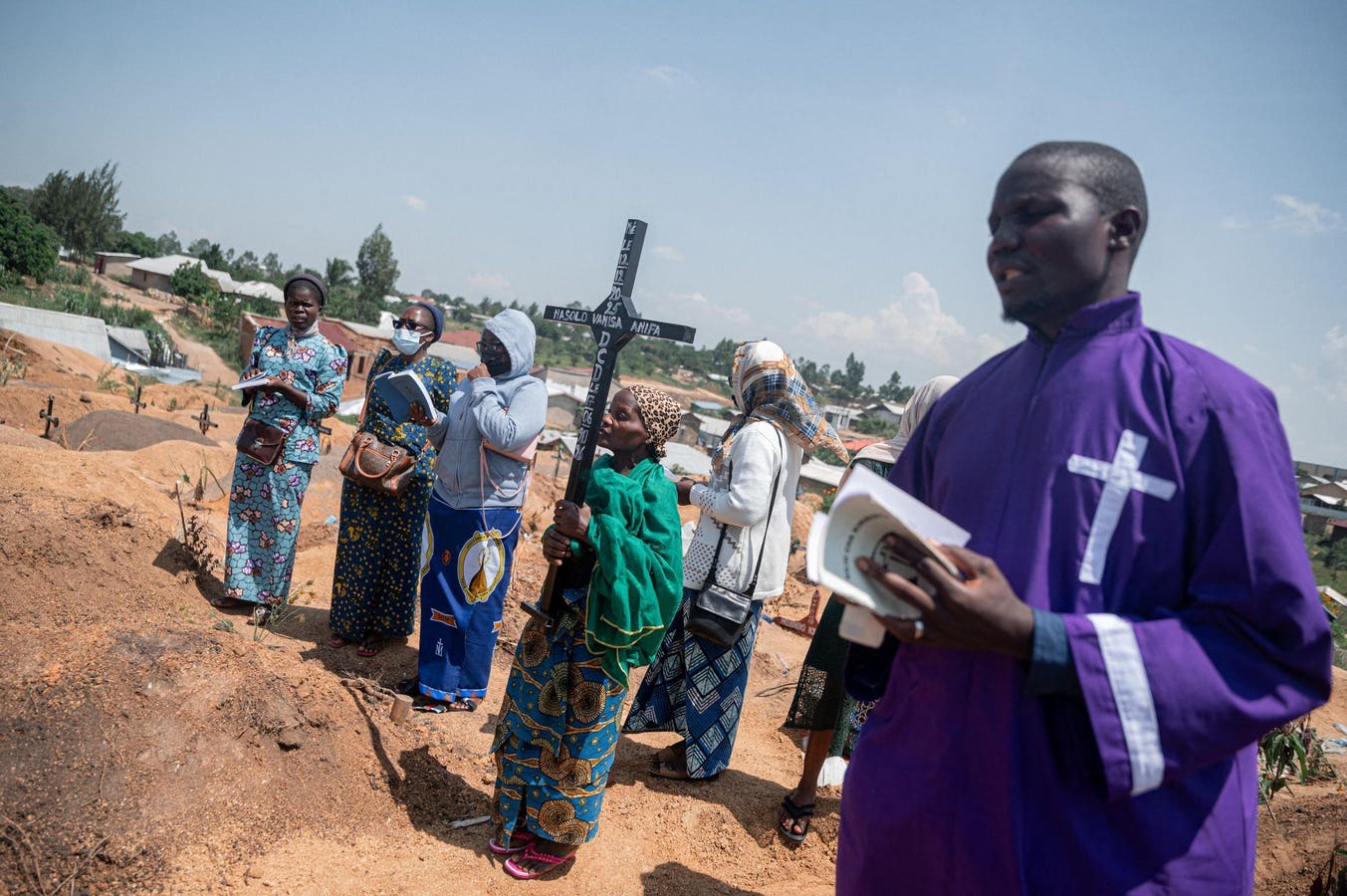
TOPSHOT – A priest conducts a blessing ceremony at Mbiyo cemetery for a fourth orphan who died from Ebola virus disease at an orphanage in Bunia, Ituri Province, June 19, 2026. A virus but no vaccine, a territory prey to armed groups and public distrust: Ebola resurfaced in mid-May at the borders of the DRC, Uganda and South Sudan. Since then, health authorities have been engaged in a race to catch up with the epidemic.On May 15, the Democratic Republic of Congo (DRC) declared the 17th Ebola outbreak, caused by the Bundibugyo strain, in the vast Central African country. The day before, tests carried out in a laboratory in the capital, Kinshasa, had confirmed the presence of the virus.The epicenter of the crisis is in Ituri, a troubled province in northeastern Congo marked by high population mobility linked to mining activity. Already 246 suspected cases, including 80 deaths, had been reported at that point. (Photo by Jospin Mwisha / AFP via Getty Images)
AFP via Getty Images
The Democratic Republic of Congo surpassed 1,000 confirmed cases of Ebola as of June 21, 2026, according to the U.S. Centers for Disease Control and Prevention — the first time any Ebola outbreak has crossed that threshold since the catastrophic 2018–2020 epidemic in North Kivu and Ituri. That alone would be alarming. What makes this outbreak harder to address is that it is spreading across remote, conflict-affected terrain with no vaccine available for this strain of the virus.
A Different Virus
The pathogen driving the 2026 outbreak is Bundibugyo virus (BDBV), a distinct species within the Orthoebolavirus genus. It is not the Zaire strain that devastated West Africa in 2014. The rVSV-ZEBOV vaccine — sold as Ervebo — was developed against the Zaire strain, and no approved vaccine exists for Bundibugyo virus. The two viruses share only about 55 to 60 percent amino acid identity in their surface glycoproteins — the protein that vaccines typically target — and animal studies suggest Ervebo is unlikely to offer meaningful cross-protection against BDBV. A specific BDBV vaccine candidate exists and is being fast-tracked, but it has never been tested in humans.
This is the 17th Ebola outbreak in DRC history, and the first large one caused by BDBV. Symptom onset dates trace back to at least April 24; the DRC declared the outbreak on May 15 and WHO declared a Public Health Emergency of International Concern two days later. Cases have since spread across the border into Uganda, where approximately 20 confirmed cases and 2 deaths have been reported. Containment within a single province is already a lost goal.
Three Curves
The figure below places the 2026 outbreak alongside two predecessors, aligned by days since official declaration.
Cumulative reported cases for three Ebola outbreaks on a logarithmic scale, each aligned to the day of official declaration. Solid lines show laboratory-confirmed cases; dashed lines include all reported cases (confirmed, probable and suspected); shaded regions reflect case classification uncertainty. The 2026 DRC/Uganda outbreak (magenta) had passed 1,000 confirmed cases by day 37 with no sign of slowing. Sources: WHO situation reports compiled by Caitlin Rivers (2014–2016), Kristian G. Andersen (2018–2020) and INRB-UMIE (2026).
John M. Drake
The 2014–2016 West Africa epidemic remains the reference for scale: 28,616 total cases and 11,310 deaths, caused by Ebola virus Zaire, spreading through Guinea, Sierra Leone and Liberia over nearly two years. Its curve on the log scale is a long, slow climb — a catastrophe unfolding in slow motion across health systems with inadequate capacity to respond.
The 2018–2020 DRC outbreak tells a different story. It reached roughly 3,470 total cases and 2,299 deaths — a case fatality rate of around 66% — but it bent. Ring vaccination with rVSV-ZEBOV, combined with contact tracing in extraordinarily difficult conditions in North Kivu, eventually brought transmission under control. The slope on the figure shows the deceleration. It bent.
The 2026 curve does neither. At day 37 from declaration, the 2026 outbreak had accumulated roughly ten times as many confirmed cases as the 2018–2020 outbreak at the same point. The slope shows no visible flattening. With 267 confirmed deaths, the case fatality rate sits near 25% — lower than 2018–2020, which likely reflects differences in surveillance completeness as much as anything about the virus itself.
Interpreting the Case Count
One thing the figure cannot show is the pace of actual transmission. WHO’s May 29 situation report noted explicitly that newly reported confirmed cases may include a backlog of samples waiting to be tested — meaning some recently counted infections are older than they appear, and the confirmed case curve is rising faster than transmission actually is. The DRC Ministry of Health also purged suspected case counts in late May, removing cases ruled out as the surveillance system was refined. Both affect what the numbers show: 1,000 confirmed cases does not mean 1,000 infections acquired in recent days, and the true slope is shallower than it appears.
The cleanest picture would come from a line list of cases by symptom onset date. Epidemiologists working the outbreak almost certainly have this for a subset of cases, but it is not public. What the public record shows is that the confirmed count is large, rising and showing little sign of bending. That is already consequential, whatever the backlog turns out to be.
Why the Trajectory Is What It Is
The absence of a vaccine is the single largest structural difference between 2026 and 2018–2020. Ring vaccination with rVSV-ZEBOV, combined with contact tracing, isolation and safe burial practices in extraordinarily difficult conditions in North Kivu, eventually bent the curve. Epidemiological studies suggest ring vaccination alone averted more than half of potential cases in the hardest-hit areas. With no equivalent for Bundibugyo virus, the response depends entirely on contact tracing, isolation and supportive care. These tools work. They are also slow, labor-intensive and deeply sensitive to the security and logistical conditions on the ground.
The 2026 outbreak had also been circulating for at least three weeks before it was declared — and probably much longer. The x-axis in the figure is aligned to declaration date, which means the 2026 curve’s apparent head start is partly real and partly an artifact of where the clock starts. The true epidemic curve began earlier, possibly well before anyone knew to look for it.
What to watch now is whether the slope begins to change. The 2018–2020 outbreak did not bend for close to two years; the 2014–2016 epidemic ran longer still. The 2026 response has no ring vaccination to lean on, and it is already working against an outbreak that crossed into a second country. Where the curve goes from here will be determined by contact tracing capacity, isolation infrastructure and the kind of sustained logistical commitment that is easy to announce and hard to maintain. The numbers will tell that story, one situation report at a time.