

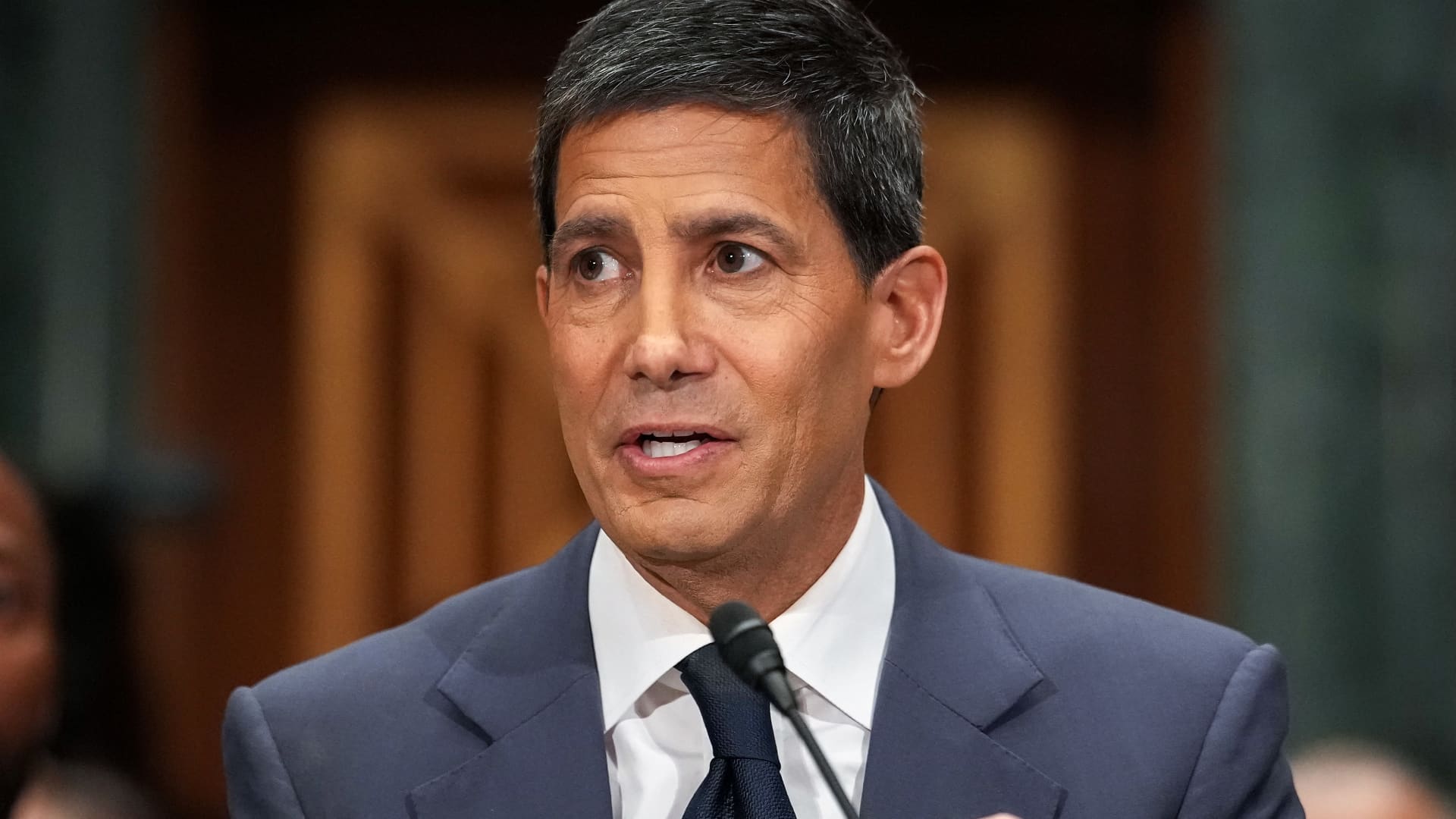
Kevin Warsh, then U.S. President Donald Trump’s nominee for Chair of the Federal Reserve, delivers an opening statement during his Senate Committee on Banking, Housing, and Urban Affairs confirmation hearing in the Dirksen Senate Office Building on April 21, 2026 in Washington, DC.
Andrew Harnik | Getty Images
Incoming Federal Reserve Chair Kevin Warsh’s talk about “regime change” at the central bank has generated speculation about everything from interest rates to major personnel changes to fundamental alterations in the way it operates and communicates.
But what that eventually might look like is subtler though perhaps more consequential – a rethink of how the Fed manages the financial plumbing in the U.S. economy and the mammoth balance sheet it has built through some 18 years of crisis fighting.
Interviews with former Fed officials and economists, along with a growing library of research, suggest Warsh could guide the Fed to a smaller role in day-to-day financial markets, while also setting clearer rules for how and when it should intervene.
Simply stated, the debate centers on whether the Fed should continue using its balance sheet as a regular tool for influencing financial conditions and supporting markets — as it has through much of the post-financial crisis era — or reserve it for periods of market dysfunction and more pernicious economic stress.
Rewriting the Fed playbook
The debate over the $6.8 trillion balance sheet is technical in nature and tucked away from the more common discussions about Fed policy. But the stakes are substantial.
Since the financial crisis that exploded in 2008, the Fed has aggressively used its holdings of Treasurys and mortgage-backed securities to stabilize markets and influence broader financial conditions.
Prior to the crisis, the Fed had a minuscule balance sheet relatively speaking – about $800 billion – but expanded it at one point to about $9 trillion. The Fed’s asset holdings now equate to about 23% of the U.S. economy, or some seven times where they were pre-financial crisis.
Any effort to change the system could have wide ramifications, potentially impacting Treasury yields, mortgage rates and other interest-sensitive areas of the economy, while influencing the way policymakers respond to future crises.
“It’s a debate we’re going to be seeing later this year. But one thing that’s encouraging about all of this is that nobody, including Kevin Warsh, is arguing that any of this could be done rapidly,” said Lou Crandall, chief economist at Wrightson ICAP and a longtime Fed watcher.
“It’s got to be done carefully, and some of the changes … would probably take time to implement,” he added. “Everyone’s looking at this as a medium-term project rather than part of the day-one agenda.”
Warsh called the balance sheet, in a Wall Steet Journal op-ed piece last year, “bloated” and said it could be reduced while at the same time allowing the Fed to lower interest rates.
What ‘regime change’ might entail
While Warsh has spoken in broad strokes about shrinking the Fed’s footprint, Wall Street already is gaming out what a new operating framework could look like.
Among the more provocative ideas comes from TS Lombard’s chief U.S. economist, Steve Blitz, who argues that a Warsh Fed could place greater weight on the overnight repo market — the short-term funding system that underpins the Treasury’s market function — rather than relying solely on the federal funds rate — which banks charge each other for overnight lending — as the key transmission mechanism for policy.
“The repo rate becomes the policy rate,” Blitz said in a client note.
In practice, that could create an unusual dynamic: Warsh might be able to satisfy Trump’s push for lower interest rates while still maintaining tighter underlying financing conditions as policymakers grapple with persistent inflation pressures.

However, he’s likely to run into quick opposition from his fellow policymakers, some of whom are skeptical of both the Fed’s ability to significantly reduce its holdings and the benefits this might provide.
“I think shrinking the balance sheet is the wrong objective, and many of the proposals to meet this objective would undermine bank resilience, impede money market functioning, and, ultimately, threaten financial stability,” Fed Governor Michael Barr said in a speech last week. “Some would actually increase the Fed’s footprint in financial markets.”
Barr’s thesis essentially is that looking merely at the size of the balance sheet is too narrow – that other issues, such as how it is comprised with respect to duration and composition also matter. Neglecting those issues, he asserts, could have “perverse” consequences such as increased volatility and even the possibility of more interventions from the Fed. At the same time, he said, lowering reserve requirements for banks could destabilize the system.
Understanding how it works
The balance sheet mechanics regarding reserves are straightforward.
When building the balance sheet, the Fed credits itself with digital cash and uses it to buy assets from banks, creating reserves. That provides the banks liquidity that then theoretically flows through the financial system. Conversely, when the Fed is reducing the balance sheet, it is no longer buying assets while also allowing the proceeds of the bonds it has purchased to roll off, rather than reinvesting them.

On the other side of the operation, the Fed is using its trading desk to achieve the interest rate it targets. The central bank also has a slew of other tools, such as the interest it pays on reserves, its discount window rate and, critically, overnight reverse repurchase operations that keep the financial flows moving.
The Fed has been operating under a system of “ample” reserves, a nebulous term that essentially means more than typical but not excessive — that would be “abundant.” Warsh has implied that the Fed can go back to its precrisis policy of “scarce” reserves, with the option to add when needed.
“Reasonable people can disagree on this,” said Bill English, the Fed’s former head of monetary affairs and now a professor at Yale. “The Fed could certainly go back to a system with scarce reserves, it would work perfectly well. Might be a little complicated to get there. You’d want to do it slowly, but I think they could do it.”
After spending much of the past 18 years depending on the Fed’s balance sheet to keep operations running smoothly — and, critics would argue, support the bull run in stocks — markets will be watching closely.
“I would very much expect the Fed to have an open discussion about establishing a framework for future operations, so the market doesn’t just assume that they’ll do unlimited amounts,” Wrightson economist Crandall said. Doing so “would allow the market to form more sensible expectations about what would happen.”
As things stand, the Fed has never communicated clear rules about when and how the balance sheet will be used.
Markets have adopted terms for the balance sheet operations – quantitative easing, or QE, for expansion and quantitative tightening, or QT, for reduction – but the Fed has never set out clear guidance about when either will be used. That’s particularly true when distinguishing between addressing financial market functioning and supporting its dual inflation and employment goals.
“They’ve never really set up a framework for when to use quantitative easing,” said former Cleveland Fed President Loretta Mester. “The Fed hasn’t done a very good job, I think, over time of distinguishing and explaining when it’s using asset purchases for a monetary policy reason.”
Changing the message
This is where Warsh especially can come in.
Setting the tone for policy guidance is right within the chair’s wheelhouse, and Warsh could try to diminish market expectations that the Fed is going to crank up asset purchases when Wall Street starts to get the jitters.
In addition, he has spoken in favor of efforts that Michelle Bowman, the Fed’s vice chair for bank supervision, has undertaken to ease some banking regulations. Part of that would alter what kinds of assets banks could claim as reserves and use in times of crisis, an effort that Dallas Fed President Lorie Logan cited in a recent speech, saying she looks forward “to seeing how that work progresses.”
Logan has firsthand experience with the dynamics that go into balance sheet management. Prior to her current position, she ran the trading desk at the New York Fed, which is charged with executing the central bank’s open market strategy.
Logan also noted, in the speech delivered April 2, that the Fed has other tools at its disposal to help the flow of liquidity — essentially using components from both the Warsh and Barr sides of the argument.
Like others, she spoke in favor of moving slowly to address the issue.
“I’d emphasize that any changes in the balance sheet should be gradual and planned carefully,” Logan said.
The work has begun
Internally, Fed officials are girding for debate.
Central bank researchers have released several papers on the issue, including one titled “A User’s Guide to Reducing the Federal Reserve’s Balance Sheet.”
The paper concluded, without an endorsement in either direction, that up to $2.1 trillion in reductions could be achieved through the current policy framework, with further cuts possible should the Fed change direction into a scarce reserves approach to banking. The paper also contends it would take “at least a year and quite possibly several” before the process could even begin.
All of these proposals are likely to be on the table after Warsh takes over Friday.
He inherits a Fed facing not only economic challenges but also high political expectations from a president who regularly attacked outgoing Chair Jerome Powell, nicknaming him “Too Late” as he repeatedly threatened to fire him for not carrying out Trump’s desire for lower rates.
For all the discussion about “regime change,” former officials caution against expecting a dramatic overnight overhaul, with Warsh’s lofty goals about to meet central bank reality.
Warsh will inherit a Federal Open Market Committee built on consensus, where even major policy shifts typically move deliberately and only after lengthy internal debate. Political considerations, these officials say, are left outside the central bank’s walls.
“I was going to FOMC meetings when [Alan] Greenspan was chair, so that’s a long time. Politics never enters that room,” said Mester, the former Cleveland Fed president. “Political considerations never enter the discussion.”
