

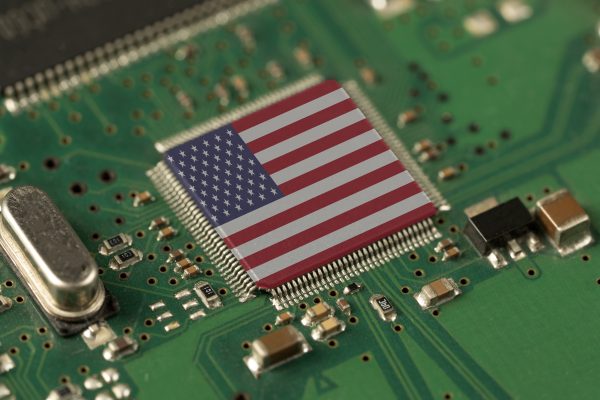
Semiconductors play a crucial role in advanced technological applications, including transportation, communications, healthcare, artificial intelligence (AI), and of course, military hardware. As my new co-authored book makes clear, the growth of the semiconductor industry in the United States found its catalyst in an unexpected place: the poor rate at which its munitions actually hit their designated targets during the Vietnam War. The subsequent elevation of semiconductor technology to its contemporary status as an essential component of modern warfare and global commerce underscores its profound impact on geopolitics and national security.
After the pullout from Vietnam, American semiconductor development continued to receive a significant boost from the imperative of Cold War geopolitical rivalry. The Defense Advanced Research Project Agency (DARPA), originally launched in response to Soviet technological breakthroughs, laid the groundwork for the emergence of Silicon Valley as a hub of innovation. Today, despite persistent efforts to maintain technological dominance, U.S. decision-makers must confront the fact that the global dispersion of the semiconductor supply chain has shifted the political dynamics surrounding this crucial industry. The rise of countries like China, Taiwan, South Korea, and Japan as major players in the landscape of semiconductor production is contributing to increased competition and geopolitical tension.
In particular, Washington is struggling to figure out how exactly to calibrate its policies on semiconductors in the context of its broader security competition with China. The question therefore arises: Has the United States’ approach to this globalized industry succeeded in the three decades following the collapse of the Soviet Union?
Some experts, such as Stephen Walt of Harvard University and John Mearsheimer of the University of Chicago, have long argued that the United States excessively fixated on promoting democracy by force and expanding liberal economic practices abroad during this period, to the detriment of looming geopolitical challenges like the rise of new major power adversaries.
My view, informed by my previous tenure as the head of South Korea’s Ministry of Small-and-Medium Enterprises and Startups, is that such pathologies are evident when it comes to the semiconductor industry. Finding itself the world’s sole great power after the Soviet collapse, the United States outsourced manufacturing to countries like China to exploit cost savings. China and the United States became economically interdependent, with their overall trade volume rising from $10 billion in 1980 to over $600 billion in 2023. Empowered by this interdependence, China’s economy grew at an astonishing pace, its per capita income increasing 25-fold over the same period. Its Gross Domestic Product (GDP) surpassed that of Japan by 2010.
It didn’t take long for China to use its growing economic and military might to raise challenges to the United States. One critical – though often overlooked – dimension of the newly invigorated great power competition is the fact that numerous U.S. semiconductor manufacturing plants moved their operations to countries like China, Taiwan, and South Korea during the decades following the end of the Cold War. Even technological giants like Apple continue to rely on these countries for chip production. This foreign dependence is a direct result of the United States’ long-complacent approach to globalization.
China’s ambitions in semiconductor production manifest through the strategic cultivation of companies like SMIC, which aims to directly challenge the market power of Taiwan’s TSMC. China reportedly aims to produce 70 percent of its internally consumed semiconductors domestically by 2025, even though it imports 80 percent of its current supply. China thus heavily subsidizes its indigenous semiconductor industry, with planned investments in the range of $40 billion in the coming years.
These developments underscore how the question of semiconductors could complicate China-U.S. competition. China experienced a slow start in semiconductor development due to the failure of Mao Zedong’s economic plans and the turmoil of the Cultural Revolution. Despite more dedicated investments from 1978 onward, the Chinese semiconductor industry did not see marked progress. However, it has experienced notable growth spurts since the turn of the millennium, fueled by China’s entry into the World Trade Organization (WTO) and integration into the globalized economy. In 2015, Xi Jinping’s 10-year “Made in China 2025” plan declared that semiconductor development would be a central aspect of China’s technological competition with the United States.
Xi hinted powerfully at China’s ambition to shape and eventually dominate the East Asian political landscape when I met him in 2014 while serving as the Floor Leader of South Korea’s New Politics Alliance for Democracy (known today as the Democratic Party of Korea). Xi advocated for dialogue and cooperation on the North Korea problem with the statement that “Blood is thicker than water,” paralleling Chinese Foreign Minister Wang Yi’s more recent appeal that countries like South Korea and Japan should “know where [their] roots are.” Wang added: “No matter how yellow you dye your hair, or how sharp you make your nose, you’ll never turn into a European or American; you’ll never turn into a Westerner.”
What should the United States be doing with regard to the semiconductor industry in this setting? In August 2022, the Biden administration signed into law the “CHIPS and Science Act” – a significant initiative aimed at strengthening U.S. semiconductor manufacturing capacity and more generally promoting the growth of advanced technologies. One of its key components is a $53 billion investment plan focused on supporting the semiconductor industry and enhancing technological competitiveness through increased federal support. It is worth debating whether the U.S. approach to semiconductors epitomized by this act will effectively safeguard the core security interests of the United States, as well as its overall alliance network. Especially worth scrutinizing is the effectiveness of U.S. technological sanctions against China.
My experiences in the South Korean government have profoundly shaped my perspective on this matter. In 2020, South Korea and Japan experienced a highly publicized trade dispute, during which time the Japanese government prompted tension and controversy by restricting exports of key materials used in semiconductor manufacturing. At the time, I led daily high-level meetings at the Ministry of Small-and-Medium Enterprises and Startups to devise strategies for counteracting these export restrictions. While the domestic semiconductor industry was initially thrown into chaos, the government and relevant stakeholders eventually succeeded in stabilizing it by pursuing supplier diversification and developing in-house technologies. Paradoxically, then, Japan’s export restrictions ended up strengthening South Korea’s domestic semiconductor industry.
More work is needed to reevaluate and recalibrate U.S. sanctions against China in light of such experiences. At minimum, these lessons suggest that – tempting as it may be – adopting an aggressively competitive approach on all dimensions of this crucial technology will not yield desirable outcomes and may even backfire in costly ways. What I specifically advocate for is to introduce further precision on the scope of U.S. technology-export restrictions amid the intensifying great-power rivalry with China. Some have termed this the “small yard, high fence” approach, that is, strengthening restrictions on technologies that have high military potential while reducing the number of items that fall under the purview of such restrictions.
Indeed, this seems to be part of what U.S. National Security Advisor Jake Sullivan had in mind in his April 2023 speech at the Brookings Institution, where he signaled the administration’s policy shift from “decoupling” to “de-risking.” The idea is to focus squarely on curbing the diffusion of relatively risky technologies while avoiding broad-strokes sanctions that could hurt U.S. allies and partners.
It is not difficult to find examples where broadly cast sanctions caused economic difficulties for countries and threatened to strain U.S. alliance ties. This was the case for countries like South Korea, whose semiconductor exports rely heavily on the Chinese market – current figures stand at 7 percent of exports directed to the United States and 40 percent to China. Many observers in South Korea – both in decision-making circles as well as among ordinary members of the public – felt that the United States did not consider implications for its allies with sufficient care when it first devised its export restrictions against China in 2022.
It did not escape the attention of South Korean media, for instance, that the South Korean economy had suffered most among major semiconductor-equipment producing countries that were friendly to the United States. Ironically, the United States’ own equipment exports to China only experienced a slight decrease of 3.1 percent. Exports from Japan and the Netherlands increased by 4.7 percent and 150.6 percent, respectively, as Chinese firms scrambled to strategically hoard pricier “legacy” (i.e., general-purpose) equipment from these countries to preempt the anticipated expansion of U.S.-led export restrictions. By contrast, the export of South Korean semiconductor equipment – interwoven more extensively into China’s industries and therefore less scarce and more substitutable – decreased from $5.6 billion in 2022 to $4.5 billion in 2023, a whopping 20 percent decline.
Effective policy on semiconductors is like a team sport. It is important for countries in the U.S.-led alliance network – as well as liberal democracies more broadly – to work together to synchronize their national strategies on semiconductor supply chains. Today, longtime U.S. allies like South Korea are experiencing economic stagnation due in no small part to a sudden deterioration of the regional trade environment vis-à-vis China. The devastating defeat of the Yoon Suk-yeol administration’s People Power Party (PPP) in South Korea’s parliamentary elections attest to this worsened situation.
The upshot is that the United States should take care to balance its national security concerns with the health of its allies and alliance relationships. This is especially so when it comes to policy on sectors like semiconductors, which are distinguished not only by their indispensability for advanced economies but also by their globally interconnected nature. Preserving unity among allies ensures a strong front against rising geopolitical challenges. The United States must work to safeguard “semiconductor sovereignty” not only for its own national security but for its broader alliance network.